 Bellingham
 Cedar Still Has a Pull on Bellingham Homeowners
There's a reason cedar siding keeps coming up in conversations with Bellingham homeowners. It's a genuinely beautiful material — real wood grain, warm color, a Pacific Northwest look that feels right at home in Whatcom County. Cedar is also naturally rot-resistant compared to most other woods, thanks to oils in the wood itself, and it's a renewable, locally available material with a long tradition in this region's architecture.
We're not here to talk anyone out of liking cedar. We're here to talk about what it actually takes to keep cedar siding looking good and performing well once it's on a house in this climate, year after year — because that's the part that doesn't show up in the sales pitch.
What "Low Maintenance" Really Means for Wood Siding
Every wood siding product gets marketed somewhere along the spectrum from "rustic and natural" to "just needs a wash now and then." In practice, cedar siding is a maintenance commitment, not a set-it-and-forget-it exterior. Here's what ownership actually looks like over time:
Refinishing Is Not Optional
Cedar left unfinished will silver and weather unevenly, and unfinished wood is far more vulnerable to moisture absorption. Most homeowners choose to stain or paint cedar siding, which means committing to a refinishing cycle — not a one-time project. Stain, even quality semi-transparent or solid-body stain, breaks down under UV exposure and moisture cycling. Paint holds longer but eventually blisters and peels, especially where the wood underneath is moving with humidity changes.
Caulking and Sealing Need Regular Attention
Every joint, seam, and trim intersection on a cedar-sided house is a place water can get behind the siding if the sealant fails. Caulk doesn't last forever — UV and temperature swings break it down — and once it cracks, moisture finds its way behind the boards where it's hardest to deal with.
Inspection Has to Be Routine, Not Reactive
Cedar problems are often invisible until they're serious. Rot can develop behind siding boards, at butt joints, or near ground contact long before it shows on the surface. By the time paint is visibly failing or boards feel soft, the damage underneath is usually further along than it looks.
Why Whatcom County's Climate Is Hard on Cedar Specifically
This is the part that matters most for homeowners in Bellingham, and it's the reason we bring this up as honestly as we can. Cedar siding's maintenance demands aren't hypothetical here — they're accelerated by exactly the conditions this area is known for.
Bellingham sits right on Bellingham Bay, and salt air off the water speeds up the breakdown of finishes and accelerates corrosion of the fasteners holding siding in place. Add in Whatcom County's driving rain, which comes in sideways during winter storms and gets forced into joints and laps that would stay dry in calmer weather, and cedar's finish takes a beating from two directions at once — salt exposure degrading the coating, and wind-driven moisture testing every seam.
Then there's moss. Bellingham's long, damp moss season — realistically much of the year given our rainfall and cloud cover — means cedar siding, especially on north-facing walls and shaded elevations, stays damp longer than it would in a drier climate. Moss and algae don't just look bad; they hold moisture against the wood surface, which is exactly the condition that leads to rot, cupping, and finish failure. Homeowners in wooded or shaded lots around Bellingham see this most, but it shows up across the county.
The Real Cost of Cedar Over Time
The sticker price comparison between cedar and other siding materials rarely tells the whole story. What matters is the cost of ownership over the life of the siding — refinishing labor, materials, and the repair work that catches up with homeowners who fall behind on maintenance.
| Maintenance Item | Typical Cycle | What Drives the Cost |
|---|---|---|
| Restaining / repainting | Every 3-7 years, depending on exposure and finish type | Labor-intensive: prep, back-brushing, multiple coats |
| Caulk and seal joints | Every 2-5 years | Failure points multiply with every seam and trim piece |
| Board replacement (rot/damage) | As needed, often unpredictable | Hidden damage is usually worse than surface signs suggest |
| Moss/algae treatment and cleaning | Annually in shaded or north-facing areas | Soft washing and treatment to prevent moisture retention |
None of these costs are unreasonable on their own. The issue is that they repeat, indefinitely, for as long as the siding is on the house — and they compound quickly if a homeowner misses a cycle or two.
Where Cedar Problems Actually Start
When we've evaluated cedar-sided homes in this area, the failure points tend to follow a pattern:
- Butt joints and end grain — the ends of cedar boards soak up water far faster than the face of the board, and this is where rot most often starts.
- Lower courses near grade or decks — splashback and prolonged dampness accelerate decay where siding sits close to the ground or hardscape.
- North and shaded elevations — slower drying time means more moss, more algae, and more sustained moisture contact.
- Nail heads and fasteners — corrosion (worse with salt air exposure) can stain the finish and eventually compromise the fastener's hold.
- Behind failed caulk joints — once a seal cracks, water gets behind the cladding where it can sit against the wood undetected.
None of this means cedar is a bad material. It means cedar is a material that punishes deferred maintenance, and Bellingham's climate shortens the window before deferred maintenance turns into a repair bill.
Cedar vs. Fiber Cement: A Straight Comparison
We think homeowners deserve a side-by-side look rather than a sales pitch, so here's how cedar siding compares to the James Hardie fiber cement siding we install, on the factors that matter most in this climate:
| Factor | Cedar Siding | James Hardie Fiber Cement |
|---|---|---|
| Refinishing cycle | Every 3-7 years | ColorPlus factory finish backed by a separate finish warranty; far less frequent repainting |
| Moisture/rot risk | Vulnerable at joints, end grain, and shaded areas | Fiber cement doesn't rot; engineered for moisture resistance |
| Combustibility | Combustible wood product | Non-combustible material |
| Moss/algae resistance | Wood surface holds moisture, feeds growth | Denser surface sheds moisture faster, resists sustained growth |
| Warranty structure | No manufacturer warranty on the wood itself; finish warranty depends on coating chosen | Long transferable product warranty from the manufacturer |
| Regional engineering | Not climate-specific | HZ5 product line engineered for Pacific Northwest moisture conditions |
Why We Standardized on James Hardie
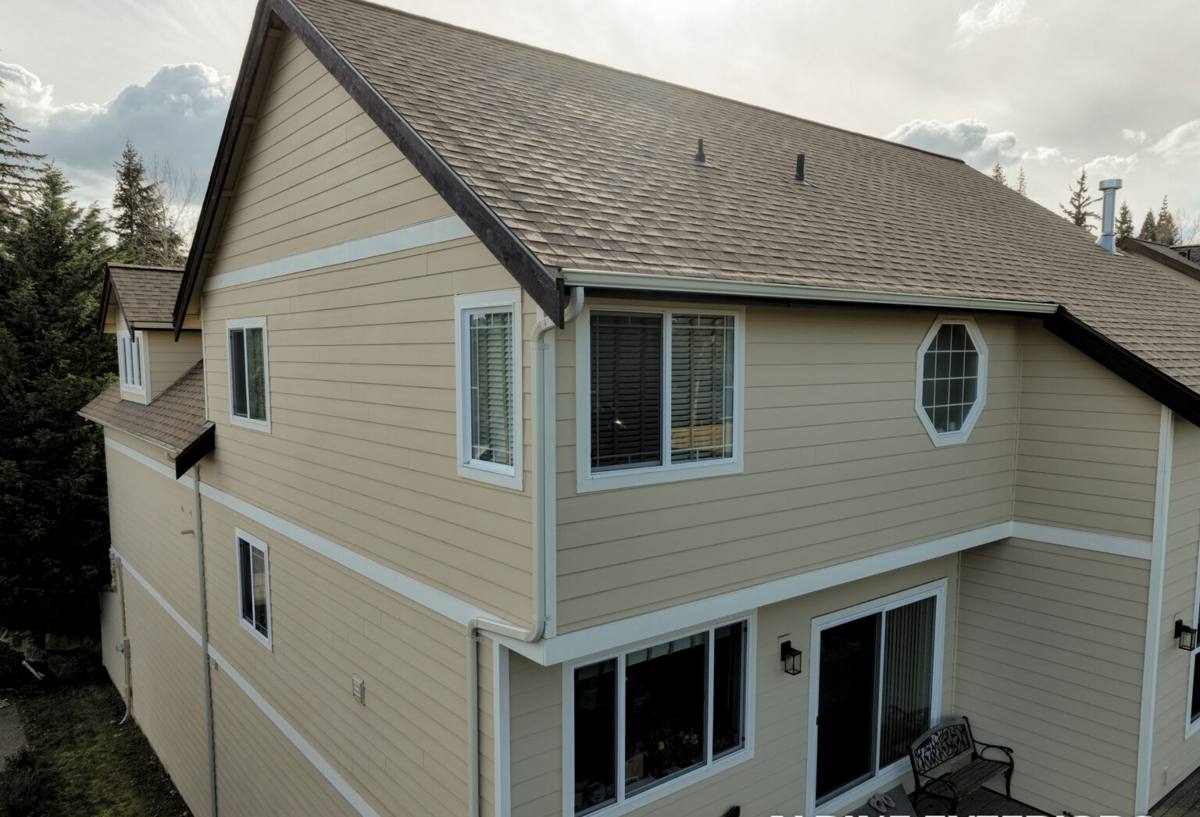
We're not a company that installs everything a homeowner might ask for. We made a decision to install James Hardie fiber cement siding exclusively, and cedar is one of the products we walk away from — not because it's a bad material in the abstract, but because we've seen what Bellingham's salt air, driving rain, and moss season do to it over a 10 or 15 year span, and we don't think it's fair to sell a homeowner a product whose real maintenance burden doesn't match what gets promised at the time of installation.
James Hardie's fiber cement doesn't rot, doesn't feed moss the way wood does, and holds its factory-applied ColorPlus finish far longer than a field-applied stain or paint job on cedar ever will. It's non-combustible, which matters more every year given regional wildfire smoke and ember exposure concerns. And it comes with a manufacturer warranty that's transferable to the next owner if you sell — something wood siding simply doesn't offer in the same way.
That's not a knock on cedar as a material. It's an honest statement about what we're willing to put our name behind, install to spec, and stand by for the long haul on homes in this specific climate.
If You're Weighing Cedar for Your Bellingham Home
If cedar's look is what's drawing you in, that's worth taking seriously — it's a genuinely handsome material. But go in with eyes open about the refinishing schedule, the inspection routine, and the exposure your specific elevations will get, especially if you're near the water or under tree cover where moss takes hold fastest. Ask any cedar installer directly about their finish warranty terms, expected refinishing intervals, and what a realistic 15-year maintenance budget looks like — not just the installed cost.
If you'd rather have the cedar look without the recurring maintenance cycle, James Hardie's lap siding and shingle profiles are worth a look before you commit either way.
We're happy to walk your home, talk through what we're seeing on your specific exposures, and give you a straightforward, no-pressure estimate — no obligation either way.