 Bellingham
 Siding in Lynden: Built for Whatcom County's Wet Side
Lynden sits inland from Bellingham Bay in the Nooksack River valley, close enough to the Canadian border that a lot of homeowners here think of their weather as "different" from the coast. In some ways it is — Lynden doesn't take the direct wind off the water the way a beachfront property does. But the climate that shapes Whatcom County as a whole still reaches every home in Lynden: long stretches of steady rain from fall through spring, high humidity that lingers on north-facing walls, and a moss season that can run most of the year on shaded siding and rooflines. Add in the marine air that moves through the whole region off Bellingham Bay and the Strait of Georgia, and you've got an exterior envelope that's working hard every single day, whether the homeowner notices it or not.
We're a siding, roofing, window, and deck contractor that works across Whatcom County, and Lynden is part of our regular service area — not an afterthought we tack on to a Bellingham route. This page walks through what the local climate actually does to exterior materials, and why our answer for siding is the same on every job: James Hardie fiber cement, installed correctly, and nothing else.
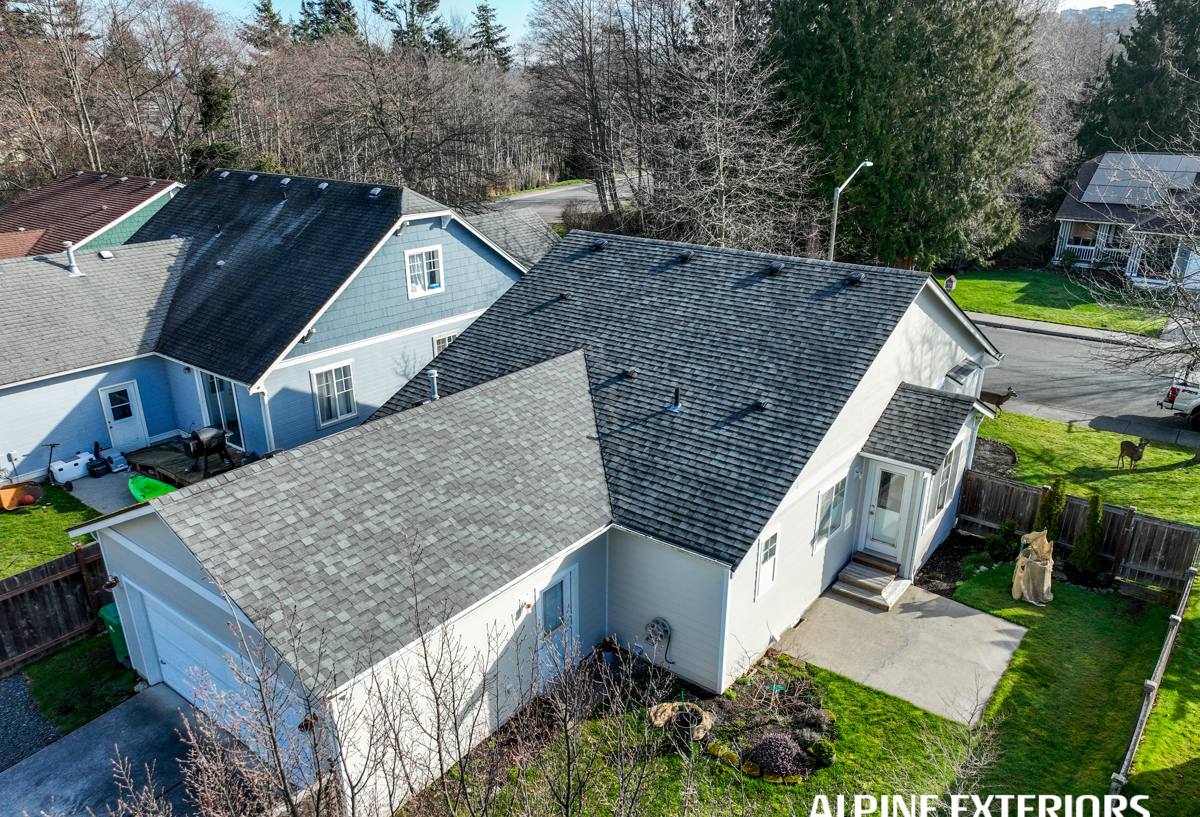
What Lynden's Climate Does to Exterior Siding
Driving Rain and Moisture Cycling
Whatcom County doesn't get hurricane-force storms, but it gets something arguably harder on siding: months of low-grade, sideways rain that never really lets a house dry out completely. That constant wet-dry cycling is what breaks down siding materials over time. Wood-based products swell when they take on moisture and shrink as they dry, and repeated over years, that movement opens seams, telegraphs through paint, and eventually leads to rot at the most vulnerable points — bottom edges, butt joints, and anywhere caulk has started to fail.
The Long Moss Season
Moss and algae need moisture, shade, and time, and Lynden's tree cover combined with our extended wet season gives them plenty of both. North and east-facing walls, areas under eaves that don't get direct sun, and siding near mature landscaping are the first places we see green and black staining show up. On some materials that's just a cosmetic problem you can pressure wash away. On others, sustained moss growth traps moisture against the surface and accelerates whatever decay process is already underway underneath.
Temperature Swings and Freeze-Thaw
Lynden's winters aren't brutal, but they're not mild enough to ignore either. We get enough freeze-thaw cycling each year that any siding material holding moisture at the time of a freeze is at risk — water expands as it turns to ice, and that expansion works joints, fasteners, and seams loose a little more with every cycle. A material that resists moisture absorption in the first place sidesteps this problem almost entirely; a material that doesn't will show the wear eventually, freeze by freeze.
Why We Only Install James Hardie Fiber Cement
We made a decision, as a company, to install one siding system: James Hardie fiber cement. Not because it's the only decent product on the market, but because after years of doing exterior work in exactly this climate, it's the one system we can stand behind on every job without hedging. Fiber cement is engineered from cement, sand, and cellulose fibers — it doesn't absorb water the way wood-based siding does, it's non-combustible, and it holds paint and factory finishes far longer than wood substrates because it isn't fighting moisture movement from the inside out.
That matters more in Whatcom County than it would somewhere dry. A siding material that shrugs off nine months of rain and a permanent moss threat isn't a luxury feature here — it's the baseline we think a home needs.
The Products We Chose Not to Install
We get asked fairly often why we don't offer LP SmartSide, vinyl, cedar, or primed wood siding, since all of them are legitimate, widely used products elsewhere. Here's the honest breakdown of why we standardized on Hardie instead.
| Material | What it does well | Why it's not our standard here |
|---|---|---|
| LP SmartSide | Engineered wood strand product, workable, lower material cost than fiber cement | Wood-based core is still moisture-sensitive; long-term performance depends heavily on caulking and maintenance discipline in a wet climate |
| Vinyl siding | Low upfront cost, low maintenance in mild climates, easy to source | Can warp or crack in temperature swings, doesn't hold up structurally the way fiber cement does, and doesn't match the appearance most Whatcom County buyers expect on a resale-focused home |
| Cedar / primed spruce | Natural look, long regional tradition, repairable board by board | Real wood needs ongoing refinishing and is the most vulnerable material to our rain-and-moss cycle if maintenance ever lapses |
| Cemplank / Allura | Also fiber cement, similar core material to Hardie | We standardized on one manufacturer's engineering, factory finish, and warranty structure rather than mixing systems across jobs |
None of these are "bad" products in a vacuum. They're just not what we choose to put our name behind, because we've seen how each one performs after ten or fifteen years in this specific climate, and Hardie is the one that consistently holds up with the least drama.
James Hardie's HZ5 Line and ColorPlus Finish
James Hardie engineers its siding by climate zone, and the Pacific Northwest falls under their HZ5 product line, built specifically for regions with heavy moisture exposure. That's not marketing language — it affects the actual formulation of the board to better resist moisture-related damage in exactly the conditions Lynden sees most of the year.
We also install almost exclusively with Hardie's ColorPlus factory-applied finish rather than field-painted siding. The finish is baked on at the factory under controlled conditions, which gives a more consistent, durable topcoat than paint applied on-site — and it comes backed by its own finish warranty separate from the substrate warranty. In a climate where paint failure is usually a moisture problem in disguise, starting with a factory finish engineered for exactly that fight is worth the difference over cheaper field-painted alternatives.
What a Proper Siding Installation Looks Like Here
Fiber cement is only as good as the installation behind it. In a climate like ours, the details around water management matter as much as the siding material itself. On every Lynden job, our crew follows the same non-negotiables:
- Correct rain-screen or drainage plane behind the siding so any moisture that gets past the surface has somewhere to go
- Manufacturer-specified fastener patterns and clearances — proper gaps at the bottom edge, around windows, and at grade
- Flashing detail at every horizontal transition, window, and door, not just where code requires it
- Butt joints and seams sealed per Hardie's installation guide, not generic caulk-and-hope
- Ventilation checked at the wall assembly level, not just at the roof
Skip any of those steps and even the best siding material in the world will underperform. It's the combination of the right product and the right installation that actually delivers the 30+ year lifespan fiber cement is capable of.
Beyond Siding: Roofing, Windows, and Decks for Lynden Homes
Siding doesn't work in isolation — it's one piece of a home's exterior envelope, and we treat it that way. We also handle roofing, window replacement, and deck construction for homeowners in Lynden, and we look at all four together when we walk a property. A roof that's shedding water improperly onto a wall, or window flashing that's failing behind the trim, will undermine even a perfectly installed siding job. When we quote a project, we're looking at how water moves across the whole exterior, not just the surface we're being asked to replace.
Why a Local Crew Matters
Whatcom County's weather isn't exotic, but it is specific, and a crew that works this region year-round builds a different kind of judgment than one that treats it as generic Pacific Northwest siding work. We know which wall orientations in this area collect moss first, how our winter freeze-thaw pattern actually behaves compared to further south or east, and what installation details actually matter here versus what's just written into a generic manual. That local pattern recognition is part of what you're paying for when you hire a contractor who works this specific area consistently, not a crew passing through from out of the county.
Cost Factors for a Lynden Siding Project
Every home is different, but a few factors tend to drive the biggest swings in siding project cost and timeline for homes in this area:
| Factor | Why it matters |
|---|---|
| Existing siding removal | Tear-off of failing wood or vinyl siding, and any hidden rot repair found underneath, adds labor before new siding goes up |
| Wall complexity | Homes with more corners, dormers, and window trim take longer to flash and finish correctly than a simple rectangular footprint |
| Siding profile and accessories | Lap siding, board-and-batten, and trim/soffit packages all price differently, and ColorPlus color selection affects lead times |
| Access and staging | Lot size, driveway access, and how close scaffolding or lifts can get to the home affect labor time |
We don't quote a number until we've actually walked the property, but these are the variables that tend to move the estimate the most, and we'll flag them plainly during the walkthrough rather than let them surprise you later.
If your Lynden home's siding is showing moss staining, cracked or peeling paint, soft spots near the bottom edge, or you're just planning ahead for a replacement, we'll come take a look and give you a straight, no-pressure estimate. There's a form below — reach out and we'll get a walkthrough on the calendar.