 Bellingham
 Siding Built for Ferndale's Coastal Climate
Ferndale sits close enough to the water that homes here deal with a different set of exterior pressures than houses further inland. Salt-laden air moves in off Bellingham Bay and the Strait of Georgia, driving rain comes in sideways during winter storms, and the long gray stretch from fall through spring keeps exterior surfaces damp for weeks at a time. Add in the shade from mature trees on many Whatcom County lots, and you get conditions that are close to ideal for moss, algae, and mildew growth on anything that holds moisture.
None of this is unusual for northwest Washington. But it does mean that siding choice and installation quality matter more here than they would in a drier climate. A product or installation method that would hold up fine in eastern Washington can fail years early in Ferndale if it isn't matched to what this area actually throws at a house.
What Salt Air, Rain, and Moss Actually Do to a House
Salt Air and Metal Fasteners
Airborne salt accelerates corrosion on exposed metal — fasteners, flashing, trim edges. Over years, that shows up as rust streaking, staining, and eventually failed connection points if the wrong hardware was used in the first place. It's a slow process, but it's constant, and it doesn't stop at the waterfront — it reaches well inland on windy days.
Driving Rain and Wind-Driven Moisture
Ferndale's winter storms don't just drop rain straight down. Wind pushes it sideways and up under laps, trim, and poorly sealed penetrations. Siding systems that rely on caulk alone to keep water out, rather than a proper drainage plane behind the cladding, tend to trap moisture instead of shedding it — and trapped moisture is what eventually rots sheathing and framing.
Moss, Algae, and the Shade Problem
Whatcom County's tree cover means a lot of homes have siding that's in partial shade most of the day. Combined with our long wet season, that's exactly the environment moss and algae need. Porous or textured siding surfaces give spores something to grip; siding that stays damp longer gives them time to establish. It's cosmetic at first, but persistent moss holds moisture against the surface and can accelerate whatever underlying damage is already starting.
Why We Only Install James Hardie Fiber Cement
We made a decision a long time ago to install one siding system — James Hardie fiber cement — and not offer vinyl, LP SmartSide, or other fiber cement brands as alternatives. That's not a marketing position, it's a practical one based on what actually performs in this climate over decades, not just the first few years.
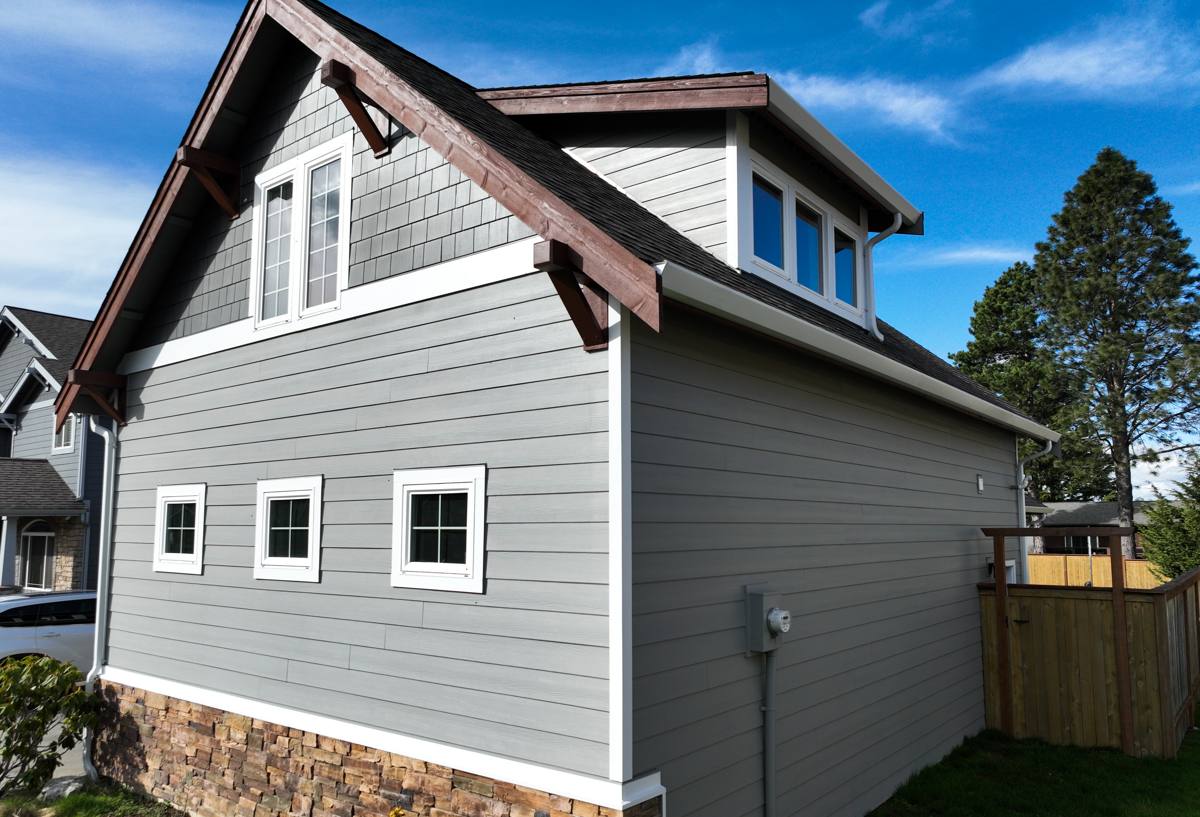
Fiber cement is non-combustible, which matters increasingly to insurers and homeowners regardless of region. It doesn't absorb water the way engineered wood products can, so it isn't vulnerable to the swelling, edge-flaring, and fungal decay that wood-based siding can develop when it stays wet — a real risk given how much of the year Ferndale spends under cloud cover and rain. James Hardie's factory-applied ColorPlus finish is baked on and warrantied against fading and flaking, which matters when a house is going to sit exposed to sun, salt, and rain cycles year after year with minimal maintenance in between.
Hardie also engineers specific product lines — its HZ5 formulation — for wetter, harsher climates like ours, rather than shipping one generic board everywhere. That climate-specific engineering, paired with a strong transferable warranty, is why we standardized on it instead of carrying multiple product lines with different failure modes and different maintenance expectations.
How We Install for This Environment
Assessment First
Before any siding comes off, we look at what's underneath — sheathing condition, existing moisture damage, window and door flashing, and how water has historically moved around the house. Ferndale homes vary a lot in age and construction, and what's behind the old siding tells us more than the siding itself does.
Drainage Plane and Rainscreen Details
Given how much wind-driven rain this area sees, we don't rely on the siding surface alone to keep a house dry. Proper weather-resistant barrier installation, correctly lapped and sealed penetrations, and rainscreen gapping where appropriate all give any water that does get past the cladding a way to drain and dry out instead of sitting against the wall assembly.
Installed to Hardie's Written Specifications
James Hardie's warranty is conditional on installation meeting the manufacturer's fastening, clearance, and caulking requirements. Corners cut here — wrong nail placement, insufficient clearance from grade or roof lines, gaps left uncaulked — are exactly what shows up as early failure points in a wet climate. We install to spec, not to whatever is fastest.
Corrosion-Resistant Hardware
Because of the salt air, we pay attention to fastener and flashing material selection rather than defaulting to whatever's cheapest. It's a small cost difference at install time and a meaningful difference in how the trim and connection points look and hold up ten or fifteen years out.
Common Problems We Find on Existing Ferndale Homes
- Moss and algae buildup on north- and shade-facing walls, often mistaken for a cleaning problem when it's really a moisture and airflow problem
- Rust staining running down from steel fasteners or flashing that wasn't rated for coastal exposure
- Paint failure and soft spots on older wood or engineered wood siding, especially at butt joints and bottom edges
- Caulk-dependent trim details that have opened up and are letting water track behind the siding
- Missing or undersized kickout flashing where roof lines meet walls, a common source of hidden rot
Most of these aren't dramatic — they're slow, cumulative issues that get more expensive to fix the longer they're left alone. A siding inspection every few years, especially on an older home, catches most of this before it becomes a sheathing or framing repair.
More Than Siding: The Whole Exterior Envelope
Siding doesn't work in isolation. Roofing, windows, and siding all interact at the same edges and penetrations, and a weak point in one often shows up as damage in another. We handle roofing, window replacement, and decks alongside siding work, which means we're not treating your siding as a standalone product — we're looking at how water moves across the whole exterior of the house.
That matters especially for decks and any exposed framing in this climate, where wood that isn't detailed and maintained correctly deteriorates fast under repeated wet-dry cycles. If a roof, window, or deck issue is contributing to a siding problem, we'll tell you rather than just re-siding over it.
What Cost Actually Depends On
| Factor | Why It Affects Cost |
|---|---|
| Home size and wall complexity | More square footage, corners, and roof intersections mean more material and labor time |
| Condition of existing sheathing | Hidden rot or water damage found during tear-off requires repair before new siding goes on |
| Siding profile and trim detail | Lap width, board-and-batten, and trim complexity all affect material and installation time |
| Access and site conditions | Tree cover, tight lot lines, and multi-story sections can slow installation |
| Scope beyond siding | Bundling roofing, window, or trim work into the same project can affect scheduling and overall cost |
We won't quote a number without seeing the house — anyone who does hasn't actually accounted for what's under the existing siding.
Maintaining James Hardie Siding in a Wet Climate
- Rinse siding annually to keep moss and algae from establishing, especially on shaded walls
- Keep gutters clear so overflow isn't running down the siding face
- Trim back vegetation and tree limbs that keep sections of the house shaded and damp
- Check caulking at trim and penetrations every year or two and touch up as needed
- Have flashing and fastener points inspected periodically, particularly on the side of the house facing prevailing wind and rain
Hardie siding is low-maintenance compared to wood, but "low-maintenance" isn't "no-maintenance" — especially in a climate that stays wet as long as this one does.
Why a Local Crew Matters
A crew that works around Bellingham and Whatcom County regularly sees how houses in this specific climate age — which details fail first, which sides of a house take the worst weather, what a normal amount of moss looks like versus what signals a real moisture problem. That familiarity shapes how we install and what we flag during an inspection. It's different from a crew that installs the same way everywhere and treats Ferndale's rain and salt air as an afterthought.
Get a Free, No-Pressure Estimate
If your Ferndale home's siding is showing moss buildup, staining, soft spots, or you're just planning ahead for a replacement, we're happy to take a look and walk you through what we see — no pressure, no obligation. Use the form below to request a free estimate.