 Bellingham
 Why We Made Hardie Our Only Option
Every siding contractor eventually has to decide what they're willing to put their name behind. We looked at fiber cement, vinyl, engineered wood, and primed wood siding side by side, weighed how each one actually performs on a Whatcom County house over 20-30 years, and standardized on James Hardie fiber cement. Not because it's the cheapest option on the shelf — it isn't — but because it's the one product line we've found that consistently holds up to salt air off Bellingham Bay, months of driving rain, and the moss and mildew pressure that comes with our long wet season, without the maintenance headaches or moisture failures we've seen with other materials.
This page isn't a sales pitch dressed up as an article. It's an explanation of what James Hardie siding actually is, how the product system is engineered, and why we think it's the right long-term investment for homes in this climate.
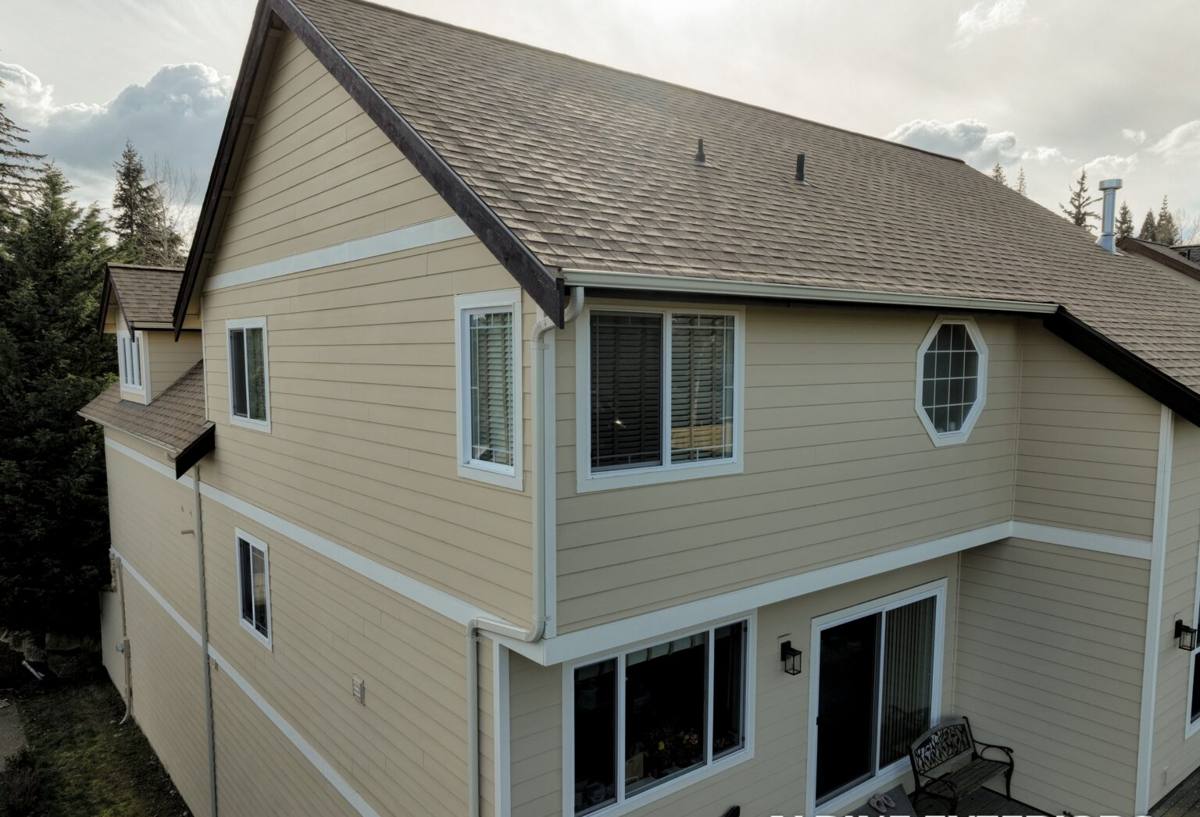
What James Hardie Fiber Cement Actually Is
Fiber cement siding is a composite of Portland cement, sand, and cellulose fiber, cured under pressure into dense, dimensionally stable boards and panels. It's not a form of wood, and it's not plastic. That matters because it means the board doesn't expand and contract the way wood does with humidity swings, doesn't soften or rot the way untreated wood can, and — unlike vinyl — it's non-combustible, which some homeowners and insurers care about directly.
James Hardie is the manufacturer, not a generic term for fiber cement. There are other fiber cement brands on the market (Cemplank and Allura among them), and we get asked fairly often why we don't install those instead, since the raw material category is similar. Our answer comes down to manufacturing consistency, the ColorPlus finish system, and the HardieZone engineering described below — differences that show up in how the siding performs after 10 or 15 years, not on install day.
Where It's Manufactured and Backed
James Hardie has been producing fiber cement siding in North America since the 1980s and is the largest manufacturer in the category. That scale matters for warranty stability — a manufacturer with decades of installed product and a large market share is more likely to still be standing behind that warranty in year 25 than a smaller or newer entrant.
HardieZone: Climate-Engineered Siding, Not One-Size-Fits-All
This is the part most homeowners have never heard of, and it's the single biggest reason we trust the product here. James Hardie doesn't manufacture one formulation of siding for the whole country. They engineer two distinct formulations — HZ5 and HZ10 — matched to regional climate zones based on freeze-thaw cycles, humidity, and moisture exposure.
Bellingham and the rest of Whatcom County fall in the HZ5 zone, which covers the wetter, more temperate parts of the country. HZ5 boards are engineered specifically for sustained moisture exposure and freeze-thaw resistance — exactly the stress a house here deals with for roughly eight months of the year. That's a meaningfully different product than what gets shipped to a dry climate, and it's a detail that's easy to overlook if you're comparing siding purely on price per square foot.
The Product Lines We Install
James Hardie's lineup covers most of the exterior of a house, which lets us keep the whole envelope in one consistent material system rather than mixing brands and finish types.
| Product | What It's For | Typical Use |
|---|---|---|
| HardiePlank | Lap siding, the most common horizontal siding profile | Primary wall cladding on most homes |
| HardiePanel | Large-format vertical siding | Board-and-batten look, accent walls, modern facades |
| HardieShingle | Staggered or straight-edge shingle panels | Craftsman and cottage-style accent areas |
| HardieTrim | Fiber cement trim boards | Corners, fascia, window and door trim |
| HardieSoffit | Pre-finished soffit panels | Vented and non-vented eave applications |
Using one manufacturer's system across siding, trim, and soffit means the materials are engineered to move and weather together, and it simplifies warranty coverage — you're not trying to reconcile three different manufacturers' claims if something goes wrong at a transition point.
ColorPlus Technology: Why We Push Clients Toward Factory Finish
James Hardie siding is available either primed for field painting or pre-finished with their ColorPlus baked-on color system. We steer almost every client toward ColorPlus, for a practical reason: a factory-applied, baked-on finish resists fading and chipping better than a field-applied paint job, and it comes with its own finish warranty separate from the substrate warranty.
Field painting still has its place — custom colors outside the ColorPlus palette, or matching an existing scheme — but it shifts the long-term durability of the finish onto the paint product and the quality of that specific paint job, rather than a factory process built for exactly this purpose.
Color and Style Considerations for This Region
- Darker ColorPlus tones show less streaking from moss and mildew runoff between cleanings than very light or pure white finishes
- Smooth or cedar-grain textures are both available — grain texture reads more traditional, smooth reads more contemporary
- Trim and field color contrast matters more on homes with heavy tree cover, where diffuse light flattens low-contrast schemes
Why Salt Air, Rain, and Moss Actually Change the Math Here
It's fair to ask whether "climate-engineered siding" is marketing language or a real factor. In Bellingham it's real, for three specific reasons:
Salt air. Homes closer to Bellingham Bay and the Salish Sea coastline take on airborne salt that accelerates corrosion of fasteners and degrades some finishes faster than inland exposure. Fiber cement itself doesn't corrode, and James Hardie's fastening guidelines call for corrosion-resistant fasteners specifically for this reason.
Driving rain. Whatcom County gets sustained, wind-driven rain events, not just steady drizzle. Siding here needs to shed water reliably at laps, seams, and penetrations for months at a stretch, not just resist an occasional storm. This is as much about installation detail — proper lap, flashing, and house wrap integration — as it is about the board itself, which is why we treat installation as inseparable from material choice.
Moss and mildew season. The long wet season here keeps siding damp for extended stretches, which is exactly the condition that promotes moss and mildew growth and, over time, can degrade materials that absorb moisture. Fiber cement doesn't feed mold the way wood-based products can, and it doesn't trap moisture behind the surface the way vinyl can when installation goes wrong.
The Warranty — What's Actually Transferable
James Hardie backs its siding products with a non-prorated limited warranty, and ColorPlus finishes carry their own separate finish warranty. Two details matter more than the headline number of years:
- Transferability. The warranty can transfer to a subsequent homeowner if the home is sold, which is a real selling point when it comes time to list the house — buyers and their inspectors do ask about siding age and warranty status.
- Installation requirements. Manufacturer warranties on any fiber cement product are conditioned on installation to the manufacturer's published instructions — correct fastener spacing, clearance from grade, proper flashing, and caulking practices. A warranty is only as good as the installation behind it, which is why we follow Hardie's installation spec to the letter rather than treating it as a suggestion.
Ask any contractor quoting fiber cement to show you, specifically, how they handle fastener type, butt joint treatment, and ground clearance — those are the details that determine whether a warranty claim actually holds up years down the road.
Installation: Why Execution Matters As Much As the Material
Fiber cement is a forgiving, durable material when installed correctly and a source of real problems when it isn't. Improper caulking, wrong fastener placement, or siding installed too close to grade or a roofline can trap moisture behind the board regardless of how good the material itself is. A short list of what correct installation actually involves:
- Minimum clearance from grade, roofing, and decks per manufacturer spec, to keep the bottom edge of the siding out of standing water and splash-back
- Corrosion-resistant, properly spaced fasteners driven to the manufacturer's depth and placement tolerances
- Correct weather-resistive barrier and flashing integration behind the siding, not just at the surface
- Proper joint treatment at butt seams and trim transitions, sealed with a compatible sealant
- Field cutting and handling that follows Hardie's dust-control and blade specifications
This is also why we don't treat "installs fiber cement" as interchangeable across contractors. The product's real-world durability depends on the installer following these details consistently, on every wall, not just on the parts that are easy to get to.
What It Costs, and What Drives the Range
We won't quote a number here that doesn't apply to your house — siding pricing depends on square footage, tear-off scope, trim complexity, and story height. What we can tell you is what actually moves the price up or down within a project:
| Factor | Effect on Cost |
|---|---|
| Existing siding removal vs. new construction | Tear-off and disposal add labor cost |
| ColorPlus vs. primed-for-paint | ColorPlus costs more up front, less to maintain long-term |
| Home height and roofline complexity | Multi-story and steep-roof access increase labor time |
| Trim and architectural detail | More corners, gables, and trim runs add material and labor |
| Underlying sheathing and moisture damage | Rot repair discovered during tear-off is priced separately |
A full siding replacement is a significant investment, and we think it's worth doing once, correctly, with a material that's engineered for this specific climate rather than revisiting it again in a decade.
Ready to Talk About Your Home
If you're weighing siding options for a home in Bellingham or anywhere else in Whatcom County, we're glad to walk your property, look at your current siding and trim condition, and give you a straight, no-pressure estimate for a James Hardie install — including which product lines and finish make sense for your home's exposure. Fill out the form below to get started.