 Bellingham
 Fairhaven's Exterior Climate Challenge
Fairhaven sits close to Bellingham Bay, tucked against wooded hillsides with a mix of century-old homes and newer construction along its tree-lined streets. That combination — water on one side, dense tree canopy on the other — puts real, ongoing stress on exterior building materials that homeowners further inland don't deal with in the same way. When we look at a siding, roofing, or window job in this neighborhood, we're planning around three things specifically: salt-laden air off the bay, wind-driven rain that finds its way into every gap and seam, and a moss season that runs longer here than in drier parts of Whatcom County.
Salt Air and Coastal Exposure
Homes within a mile or two of Bellingham Bay are exposed to airborne salt, especially during winter storms when wind carries moisture off the water. Salt air accelerates corrosion on fasteners, flashing, and exposed metal, and it degrades certain paints and coatings faster than inland exposure would. It doesn't turn a house to rust overnight, but it changes the math on what holds up over 20 or 30 years versus what starts failing at year eight or ten.
Driving Rain and Wind-Driven Moisture
Bellingham gets a lot of rain, but the type of rain matters as much as the amount. Storms coming off the water often arrive with real wind behind them, pushing rain sideways into wall assemblies rather than letting it fall straight down and run off. That's a harder test for siding than a calm, steady rain — it pressures seams, laps, and penetrations (windows, hose bibs, light fixtures) that a fair-weather install might get away with cutting corners on.
Moss, Algae, and Shade
Fairhaven's mature tree cover is part of what makes the neighborhood attractive, but shaded, damp siding stays wet longer after every rain, and that's exactly the environment moss and algae need to take hold. Wood-based products are the most vulnerable here — moss holds moisture directly against the substrate, and once it's established it's a recurring maintenance job, not a one-time cleanup.
Why Siding Choice Matters More in Fairhaven
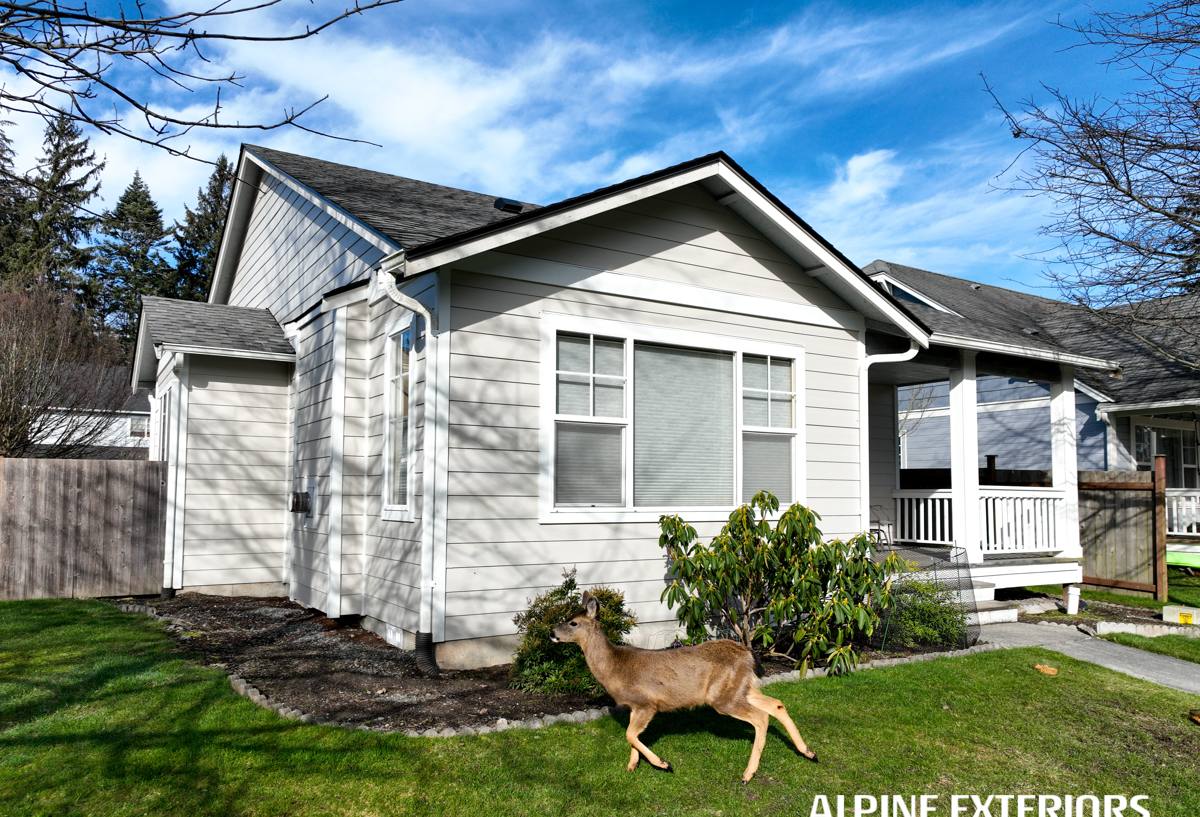
Every siding material handles moisture, salt, and shade differently, and in a climate this demanding the gap between a good choice and a bad one shows up faster than it would in a milder region. This is why we don't install every product on the market — we install one, and we're upfront about why.
| Material | Common Issue in This Climate | Our Position |
|---|---|---|
| Vinyl siding | Can warp or become brittle with temperature swings; seams and laps are a weak point against wind-driven rain; color is not repairable, only replaceable | We don't install it |
| LP SmartSide (engineered wood) | Wood-strand core is vulnerable if moisture gets past the coating, especially in shaded, damp conditions like much of Fairhaven | We don't install it |
| Cedar or primed spruce | Requires regular refinishing; shaded, moss-prone siding is a maintenance cycle that's hard to keep up with | We don't install it |
| James Hardie fiber cement | Non-combustible, engineered for Pacific Northwest moisture, factory-cured finish | What we install on every job |
None of the products we don't install are "bad" products in every context — vinyl is inexpensive and easy to source, engineered wood has real fans, and cedar has genuine curb appeal. But we've made a professional call that in a coastal, shaded, high-rainfall climate like Bellingham's, those trade-offs — warping, moisture sensitivity, or a repaint-and-reseal cycle — aren't ones we want to put our name behind. That's why we standardized on James Hardie fiber cement and only install that.
What We Install: James Hardie Fiber Cement
James Hardie fiber cement siding is made from cement, sand, and cellulose fiber, engineered specifically to resist moisture intrusion, hold paint far longer than wood, and stand up to the freeze-thaw and wet-dry cycling that's normal for Whatcom County. It's non-combustible, which matters for wildfire-adjacent risk and general fire safety, and it doesn't feed moss and algae the way wood fiber does — the surface simply doesn't give organic growth the same foothold.
ColorPlus Factory Finish
Most of what we install uses Hardie's ColorPlus finish — a coating baked onto the board at the factory under controlled conditions, rather than field-painted on site after installation. That finish is formulated to resist fading and holds up better against the coastal UV and salt exposure Fairhaven homes see than a standard field-applied paint job, and it comes with its own finish warranty separate from the product warranty.
Climate-Engineered HZ Product Lines
Hardie manufactures its boards in different formulations (HZ5 and HZ10) tuned to different climate zones around the country — freeze-thaw cycling, humidity, and moisture exposure all factor into which formulation is right for a given region. We install the line engineered for the Pacific Northwest's wet, moderate-temperature conditions, not a generic national product.
Roofing, Windows, and Decks — The Whole Exterior Envelope
Siding doesn't work in isolation. Water that gets past a roof edge, a poorly flashed window, or a deck ledger board attachment can travel and show up as a siding problem two years later, even if the siding itself was installed correctly. Because we handle siding, roofing, windows, and decks, we look at a Fairhaven home's whole exterior envelope as one connected system rather than four separate trades that happen not to talk to each other.
- Roofing: proper underlayment, flashing, and ventilation keep moisture from being driven down into wall assemblies from above
- Windows: correct flashing and integration with the water-resistive barrier is often where leaks actually originate, not the siding itself
- Decks: ledger attachment and flashing at the house connection point is one of the most common sources of hidden rot on older Fairhaven homes
- Siding: the visible, weather-facing layer that ties it all together and needs to be compatible with how the rest of the envelope manages water
What Correct Installation Actually Involves
Fiber cement performs the way it's supposed to only when it's installed to spec — that's true of any high-performance material, but it matters more in a climate like this one where installation mistakes get tested by weather constantly instead of occasionally. A rushed or corner-cutting install can undercut even the best product.
- Correct water-resistive barrier and flashing installation behind every course of siding
- Proper clearance between siding and grade, decking, and roof lines to avoid wicking moisture
- Manufacturer-specified fastener type, spacing, and placement — not a generic nail schedule
- Correctly sized gaps at butt joints and trim to allow for expansion without trapping water
- Caulking and sealant only where Hardie's installation guidelines actually call for it, not as a substitute for proper flashing
- Field cutting and handling that follows manufacturer dust-control and cutting guidance
When any of these steps gets skipped, the failure often doesn't show up right away — it shows up in year five or six as a soft spot, a stain, or a section that's holding moss when the rest of the wall isn't. That lag is exactly why installation quality matters as much as product choice.
Why a Local Crew Matters in Fairhaven
A crew that works in Bellingham and Whatcom County regularly understands things a national or out-of-area contractor generally doesn't: how a shaded, bay-adjacent lot behaves differently than an open lot a mile inland, how older Fairhaven homes were originally built and where their existing weak points tend to be, and what a realistic install timeline looks like around this region's rain patterns rather than a generic seasonal assumption. Local knowledge doesn't replace good installation practice, but it shapes the judgment calls that come up on every real job — where extra flashing attention is worth it, which sides of a house take the worst weather, and how to sequence work around the wet season instead of fighting it.
Planning a Project: What Affects Cost
Every home is different, and we don't quote sight unseen, but these are the main factors that move the price on a siding, roofing, window, or deck project in this area.
| Factor | Why It Matters |
|---|---|
| Home size and wall complexity | More corners, gables, and trim detail mean more labor and material cutting |
| Existing siding removal | Tear-off and disposal of old material adds time versus a bare or already-stripped wall |
| Extent of underlying damage | Rot or moisture damage found once old siding comes off may need repair before new siding goes on |
| Product line and profile | Lap width, shingle-style siding, and trim details vary in material cost |
| Access and site conditions | Steep lots, mature landscaping, and tight setbacks near the water can affect staging and labor time |
| Scope — siding only vs. combined with roofing, windows, or decks | Bundling exterior work can reduce redundant setup and improve how the systems integrate |
Maintenance in a Coastal, Shaded Climate
One of the practical advantages of switching a Fairhaven home to James Hardie fiber cement is how little ongoing maintenance it asks for compared to wood-based siding in the same conditions. It doesn't need periodic repainting on the same cycle wood does, and its resistance to moisture absorption means it isn't feeding moss and algae growth the way a wood substrate can. That doesn't mean zero maintenance — gutters still need to be kept clear so water isn't dumping down a wall face, and any landscaping that's crowding a wall should be trimmed back to let siding dry out between rain events — but it's a meaningfully lighter maintenance load over the life of the material, which matters in a neighborhood where tree cover and bay moisture are constants, not occasional conditions.
Getting Started
If you're weighing a siding, roofing, window, or deck project on a Fairhaven home, we're happy to come take a look, walk the exterior with you, and talk through what we're seeing and what it would take to address it — no pressure, no obligation. Use the form below to request a free estimate.