 Bellingham
 Sehome's Exterior Challenge: A Little Elevation, A Lot of Moisture
Sehome sits close to the heart of Bellingham, wrapped around Sehome Hill and within a few miles of Bellingham Bay. That combination gives the neighborhood a specific exterior challenge: homes here catch salt-tinged air rolling in off the water, sit under tree canopy that keeps north-facing walls shaded and damp for weeks at a time, and take the same steady, driving rain that defines a Whatcom County winter. None of that is dramatic on any single day. It's the accumulation — month after month, year after year — that wears down the wrong siding, roofing, and trim materials faster than homeowners expect.
We've worked on enough homes in this part of Bellingham to know the pattern. It's rarely one big failure. It's soft trim at a window sill, a moss line creeping up a north wall, or paint that won't hold past three or four years no matter how carefully it was applied. Those are climate problems, not workmanship problems — and they call for materials engineered to handle this specific kind of weather, not materials that happen to work fine in a drier region.
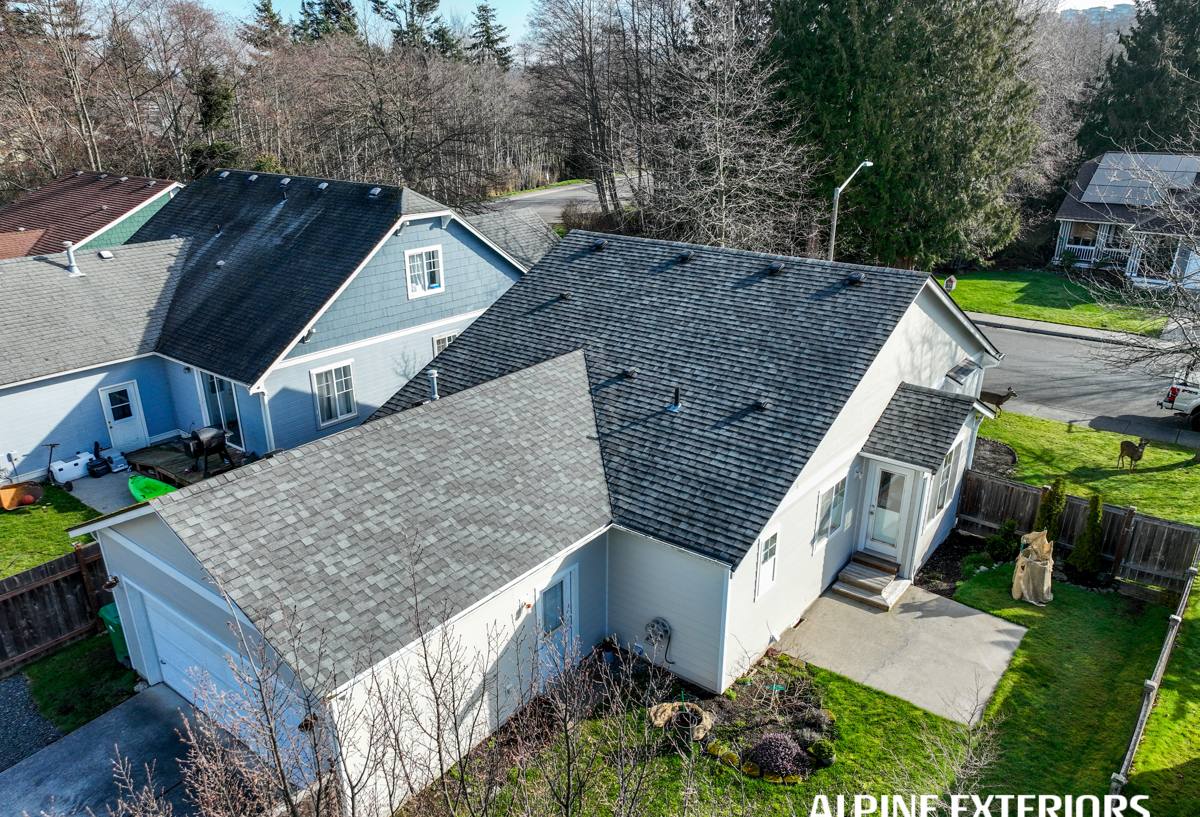
What Bellingham's Wet Climate Actually Does to a House
Moisture That Doesn't Let Up
Whatcom County doesn't get intense downpours as often as it gets long, low-intensity rain that sits against a house for hours or days. Wood-based siding products absorb that moisture at seams, fastener holes, and cut edges. Over repeated wet-dry cycles, that absorption leads to swelling, warping, and eventually rot — especially at the bottom courses near grade and around window and door trim where water collects.
Moss and Algae Season
Shaded, north- and east-facing walls in Sehome — particularly on lots with mature trees near Sehome Hill Arboretum — stay damp longer than sun-exposed walls. That's exactly the environment moss and algae need to take hold. On porous or textured siding, moss doesn't just sit on the surface; it can work into seams and joints, holding moisture against the substrate and accelerating whatever decay process is already underway.
Salt Air, in Small Doses
Sehome isn't waterfront, but it's close enough to Bellingham Bay that homes catch some of the same salt-laden air that hits closer-in neighborhoods. Salt exposure doesn't destroy siding on its own, but it does accelerate corrosion on fasteners and metal trim, and it works against paint adhesion over time — which matters a lot when a siding product depends entirely on field-applied paint to stay protected.
Local Climate Stressors and What They Damage
| Condition | What It Affects | Typical Failure Mode |
|---|---|---|
| Sustained driving rain | Seams, fastener holes, cut edges | Swelling, warping, rot at joints |
| Shade and canopy cover | North/east walls, ground-level siding | Moss, algae, prolonged dampness |
| Salt-tinged coastal air | Fasteners, metal trim, paint film | Corrosion, reduced paint adhesion |
| Freeze-thaw swings | Water-saturated wood fibers | Cracking, splitting |
Why We Only Install James Hardie Fiber Cement
We made a decision as a company to install James Hardie siding exclusively — not vinyl, not LP SmartSide, not Cemplank or Allura, not primed spruce or cedar. That's not a marketing position; it's a response to what we consistently see happen to other materials in exactly this climate.
Vinyl siding is inexpensive and low-maintenance in the sense that it doesn't need paint, but it's a poor match for a region with real temperature swings and long wet seasons. It expands and contracts more than fiber cement, seams and gaps can open over time, and it doesn't stand up well to the kind of impact damage that's common near decks, driveways, and play areas. It also can't be painted to match a home's evolving look — once you're tired of the color, you're tired of the siding.
Wood-based composite siding, including LP SmartSide, uses engineered wood strand technology that performs reasonably in moderate climates, but wood fiber — even engineered and treated — is still wood fiber. In a climate defined by sustained moisture exposure, cut edges and fastener penetrations are the vulnerable points, and those products depend heavily on correct field sealing and maintenance to keep water out over the long run. Miss a maintenance cycle in a wet climate like ours, and the risk compounds quickly.
Primed spruce and raw cedar require the homeowner to stay on top of repainting and resealing on a tight schedule — often every few years — just to keep moisture out. In a neighborhood with as much shade and dampness as parts of Sehome, that maintenance window shrinks further.
James Hardie fiber cement is cement, sand, and cellulose fiber — it doesn't rot, it isn't attractive to insects, and it holds paint dramatically longer than wood because the ColorPlus factory finish is baked on under controlled conditions rather than applied on-site in variable weather. Hardie also engineers specific product lines (the HZ5 line, for example) for regions with more moisture and temperature variation, which is a meaningful distinction most homeowners don't hear about until they're comparing options directly.
Siding Product Lines and What They're Built For
- HardiePlank lap siding — the most common choice for full re-sides, available in several exposure widths and textures (smooth or cedar-textured).
- HardiePanel vertical siding — often used for accent sections, gables, or a modern board-and-batten look.
- HardieShingle — a straight-edge or staggered shingle profile for homes wanting a traditional Pacific Northwest look without the maintenance of real cedar shingle.
- HardieTrim — fiber cement trim boards that resist the same moisture and rot issues as wood trim, used around windows, doors, and corners.
All of it comes with a factory-applied ColorPlus finish backed by a substantial, transferable warranty — transferable matters if you plan to sell the home within the warranty period, since it becomes a selling point rather than a question mark for the buyer.
Roofing: The Other Half of Keeping Water Out
Siding only does part of the job. In a wet climate, the roof is the first line of defense, and Bellingham's moss-friendly conditions apply just as much to roofing as they do to siding — especially on shaded slopes. We install and repair roofing alongside siding work because the two systems interact directly at flashing points, eaves, and transitions. A roof that's shedding water improperly, or losing granules and moss-proofing over time, will send that moisture straight down onto the siding and trim below it, undermining even a well-installed fiber cement system. When we're on-site for a siding project, we look at roof condition as part of the overall picture, not as a separate concern.
Windows and Decks: Where Water Actually Gets In
Most water intrusion problems on Bellingham homes don't happen through the field of the siding — they happen at penetrations: window openings, door thresholds, and deck ledger connections. Old or poorly flashed windows are a common source of hidden rot behind otherwise sound siding, which is why window replacement often gets bundled with a re-side when we find deteriorated flashing or trim during tear-off. Decks face their own version of the same climate problem: standing water, shaded ground-level framing, and the ledger board connection to the house, which needs correct flashing to keep water from tracking back into the wall assembly. We handle windows and decks alongside siding and roofing so these connection points get addressed together instead of by three different contractors working from three different assumptions.
What a Sehome Siding Project Involves
Assessment
We start by looking at the existing siding's actual condition — not just the surface, but what's happening at seams, corners, and anywhere moisture has clearly been sitting. This tells us whether it's a straightforward re-side or whether there's sheathing or framing damage that needs to be addressed first.
Installation to Spec
James Hardie siding performs the way it's rated to perform only when it's installed to Hardie's published specifications — correct fastener type and spacing, proper clearances at grade and roof lines, and correctly sealed and flashed joints. Installation quality is the difference between a 30-plus-year exterior and one that develops problems in year five. This is also where a lot of the "why is my siding failing early" complaints homeowners hear about actually originate — not from the material, but from a rushed or spec-deviating install.
Local Crew, Local Conditions
A crew that works in Whatcom County regularly understands things a traveling or out-of-area crew won't think twice about: how far up a wall moss tends to climb on a shaded Sehome lot, which flashing details matter most given our rain patterns, and what a realistic install timeline looks like around a Pacific Northwest weather window. That local knowledge shows up in the details, not in anything you'd notice on a sales visit.
What Affects Cost
| Factor | Why It Matters |
|---|---|
| Home size and wall complexity | More corners, gables, and dormers mean more cutting, trim, and labor time |
| Existing siding condition | Rot or sheathing damage found during tear-off adds repair scope |
| Product line and texture | Panel vs. lap vs. shingle profiles carry different material and labor costs |
| Trim and accent work | HardieTrim detailing around windows and corners adds finish-carpentry time |
| Access and site conditions | Slopes, landscaping, and tree cover near Sehome Hill can affect staging and cleanup |
We give straightforward, itemized estimates rather than vague ranges, so you know what you're actually paying for before work starts.
A Simple Checklist Before You Choose a Contractor or Product
- Ask what siding material is being proposed and why — not just what it costs.
- Confirm whether the installer follows the manufacturer's published fastening and clearance specs.
- Ask how flashing is handled at windows, doors, and deck ledgers — this is where most water damage starts.
- Check whether the warranty is transferable if you sell the home.
- Ask whether the crew has worked in this specific climate and neighborhood before, not just "the Pacific Northwest" broadly.
- Get a written, itemized estimate rather than a single lump-sum number.
Let's Take a Look at Your Home
If you're noticing moss creeping up a wall, paint that won't hold, or siding that's due for replacement, we're happy to come take a look and give you an honest read on what's going on and what it would take to fix it right. There's no pressure and no obligation — just a straightforward assessment from a crew that works in this climate every day. Fill out the form below to request a free estimate.