 Bellingham
 Siding in Columbia: A Neighborhood With Its Own Weather Story
Columbia sits close enough to Bellingham Bay that salt-laden air is a constant, low-grade presence on every exterior surface in the neighborhood. Add Whatcom County's long, wet winters and the shoulder-season drizzle that can stretch from October into May, and you've got a climate that never really gives siding a break. Homes here don't fail because of one big storm — they fail slowly, from months of dampness that never fully dries out between rain events.
Older housing stock is common in and around Columbia, which means a lot of exteriors were built and re-sided under products and standards from decades past. Some of that siding has held up fine. A lot of it hasn't, and the failures tend to show up in predictable places: north-facing walls that stay shaded and damp, lower courses near grade that wick moisture, and anywhere caulking or paint has quietly failed and let water behind the cladding instead of off of it.
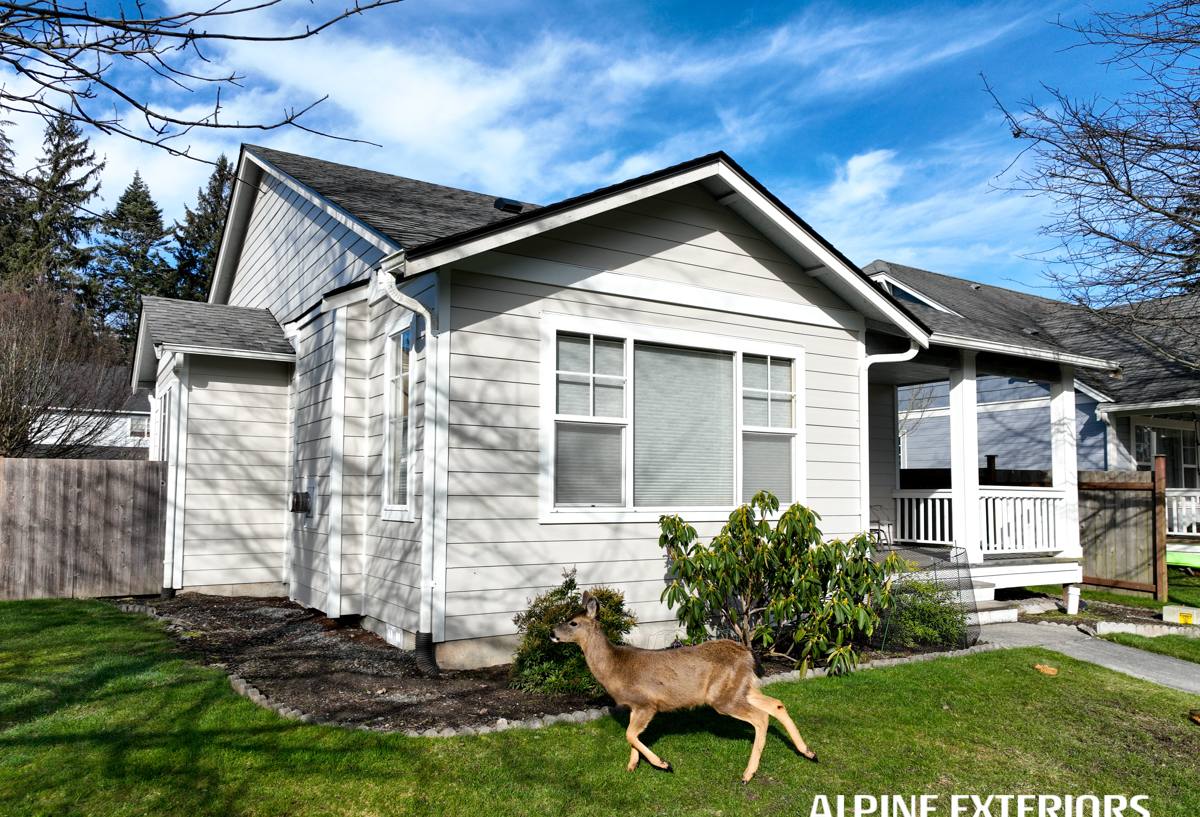
What Salt Air, Driving Rain, and Moss Actually Do to a Wall
Salt Air
Salt is hygroscopic — it pulls moisture out of the air and holds it against whatever surface it settles on. On wood-based siding, that means paint films break down faster, fasteners corrode sooner, and any exposed edge or cut end absorbs water more readily. It's a slow, cumulative effect, not a single dramatic failure, which is exactly why it gets overlooked until the damage is well established.
Driving Rain
Bellingham's storms often come with wind, and wind-driven rain doesn't just run down a wall — it gets pushed sideways and upward into laps, seams, and trim joints. Siding systems that aren't detailed with generous overlaps, proper flashing, and a drainage plane behind the cladding let that water in. Once it's behind the siding, it can sit there for weeks before anyone notices a soft spot or a stain.
Moss and Sustained Dampness
Whatcom County's moss season is long, and moss doesn't just grow on roofs — it colonizes shaded siding, trim, and anywhere organic debris collects against a wall. Moss and algae hold moisture directly against the material, which accelerates rot in wood products and can stain and degrade coatings on almost anything. Regular cleaning helps, but the real fix is a cladding material that doesn't feed the problem in the first place.
Signs a Columbia Home Needs Siding Replacement, Not Just Repair
- Soft, spongy, or crumbling spots when you press on the siding, especially near the bottom courses or under windows
- Paint that's peeling, bubbling, or needing repainting more often than every 6-8 years
- Visible gaps, warping, or boards pulling away from the wall
- Persistent moss or dark streaking that comes back within a season of cleaning
- Rising energy bills with no other explanation — often a sign the wall assembly behind the siding is compromised
- Siding that's original to a home built more than 25-30 years ago, especially if it's never been fully replaced
A repair can buy time for isolated damage. But once moisture has been getting behind the siding for a while, patching the visible symptom usually just delays a full replacement — and can let hidden sheathing damage keep spreading underneath.
Why We Standardized on One Product
We install James Hardie fiber cement siding exclusively. We don't offer vinyl, LP SmartSide, Cemplank, Allura, or primed wood siding as alternatives, and that's a deliberate choice, not a limitation of what we're capable of installing. After years of exterior work in this climate, the trade-offs of the other options became hard to justify for homes that have to deal with salt air, driving rain, and moss season every single year.
Fiber cement is inherently resistant to the things that hurt siding here. It doesn't feed mold or moss the way wood-based products can, it doesn't soften or delaminate from sustained moisture exposure the way some engineered wood products can if a seam or cut edge isn't sealed correctly, and it holds paint and color far longer than wood substrates typically do. James Hardie's ColorPlus finish is baked on at the factory under controlled conditions, which gives it better adhesion and UV stability than field-applied paint — a real advantage in a climate where repainting season is short and unpredictable.
How James Hardie Compares to Other Common Siding Options
| Factor | James Hardie Fiber Cement | Vinyl | Engineered Wood (e.g. LP SmartSide) |
|---|---|---|---|
| Moisture resistance | Does not rot or absorb water like wood; resists moss/algae growth on the surface | Won't rot, but can warp, crack in cold, and trap moisture behind it if installed poorly | Treated to resist moisture, but vulnerable at cut edges and seams if not sealed correctly |
| Fire performance | Non-combustible material | Can melt or deform under heat | Wood-based, combustible |
| Finish longevity | Factory-applied ColorPlus finish, long fade/adhesion warranty | Color is through the material but can fade and chalk over time | Typically field- or factory-primed, needs regular repainting |
| Maintenance | Occasional washing; repainting on a much longer cycle | Low, but limited repair options if damaged | Regular inspection of seams and cut edges; repainting on a shorter cycle |
| Product lines for climate | HZ5 line engineered for Pacific Northwest moisture exposure | Generally one product regardless of climate zone | Not climate-zoned in the same way |
None of these other products are junk — vinyl is inexpensive and low-maintenance, and engineered wood siding has a real market for a reason. But when we weighed long-term performance against the specific abuse a wall takes near Bellingham Bay, fiber cement was the material that held up to scrutiny consistently enough that we stopped installing anything else.
The HZ5 Line: Built for This Exact Climate
James Hardie makes different formulations of its fiber cement for different climate zones across the country, and the Pacific Northwest falls into their HZ5 category — engineered specifically for regions with heavy moisture exposure. That's not a marketing distinction; the composition and engineering account for the reality of homes that see rain and damp air for much of the year. Combined with correct installation — proper clearances from grade and decking, sealed cut ends, and flashing detailed to shed water rather than trap it — HZ5 siding is built to hold up to the exact conditions Columbia homes face.
What Siding Replacement Looks Like on a Columbia Property
Every project starts with a real inspection, not just a measurement. We look at the condition of the sheathing underneath the existing siding, check for water damage around windows, doors, and roof intersections, and assess how the current wall assembly is draining — or failing to. That inspection tells us whether we're dealing with a straightforward re-side or whether there's underlying sheathing or framing repair needed first.
From there, the process generally includes:
- Removal of the existing siding and inspection of the sheathing and weather barrier underneath
- Repair or replacement of any damaged sheathing, trim, or framing found during removal
- Installation of a proper weather-resistive barrier and flashing details at windows, doors, and penetrations
- Installation of James Hardie fiber cement panels or planks per manufacturer specifications, including correct fastener spacing and clearances
- Caulking, trim work, and a final inspection for water management before finishing
Correct installation matters as much as the product itself. Fiber cement that's installed too close to grade, with insufficient gaps at trim, or with fasteners driven wrong, can develop problems no matter how good the material is. That's a large part of why we treat installation standards as seriously as the material selection.
It's Not Just Siding — The Whole Exterior Works Together
Siding doesn't perform in isolation. Roofing, windows, and decks all interact with the same water management system, and a weak point in any one of them can undermine the others. A roof that's shedding water onto a wall in the wrong spot, windows that aren't flashed correctly, or a deck ledger that's trapping moisture against the house can all cause siding to fail early even if the siding itself is sound. Because we handle siding, roofing, windows, and decks, we can look at a Columbia home's exterior as one connected system rather than treating each component as a separate problem — which matters in a climate that gives water so many chances to find a way in.
What Affects the Cost of a Siding Replacement
| Factor | Why It Matters |
|---|---|
| Home size and wall complexity | More square footage, dormers, and cut-outs mean more material and labor |
| Condition of existing sheathing | Hidden water damage found during tear-off adds repair scope |
| Siding profile chosen | Lap, shingle-style, and panel profiles vary in material and installation cost |
| Trim and detail work | Corner boards, window trim, and fascia detailing add labor time |
| Access and site conditions | Steep lots, tight setbacks, or limited staging area can affect labor efficiency |
We give honest estimates based on what we actually find during inspection, not a flat number pulled from square footage alone. If tear-off reveals sheathing damage, we'll show you what we found and what it costs to fix before moving forward — no surprise change orders sprung on you after the walls are already open.
Why a Local Crew Matters in a Neighborhood Like This
Whatcom County's building conditions aren't the same as siding a home in a dry inland climate, and a crew that mostly works in different conditions can miss the details that matter here — clearances, flashing sequencing, and how to handle a wall that's been absorbing moisture for years. A local crew that works this climate regularly knows what damp Bellingham walls actually look like once you open them up, and installs with that reality in mind rather than a generic checklist. That local knowledge shows up in the small decisions — where extra flashing goes, how much clearance to leave at grade, how to detail a wall that gets more weather exposure than others on the same house.
If you're weighing a siding replacement for a home in Columbia, we're happy to take a look and give you a straightforward, no-pressure estimate — including what we find during inspection, what it would cost to address, and why James Hardie fiber cement is what we'd put on your walls.