 Bellingham
 Edgemoor's Exterior Challenge: Water, Salt, and Shade
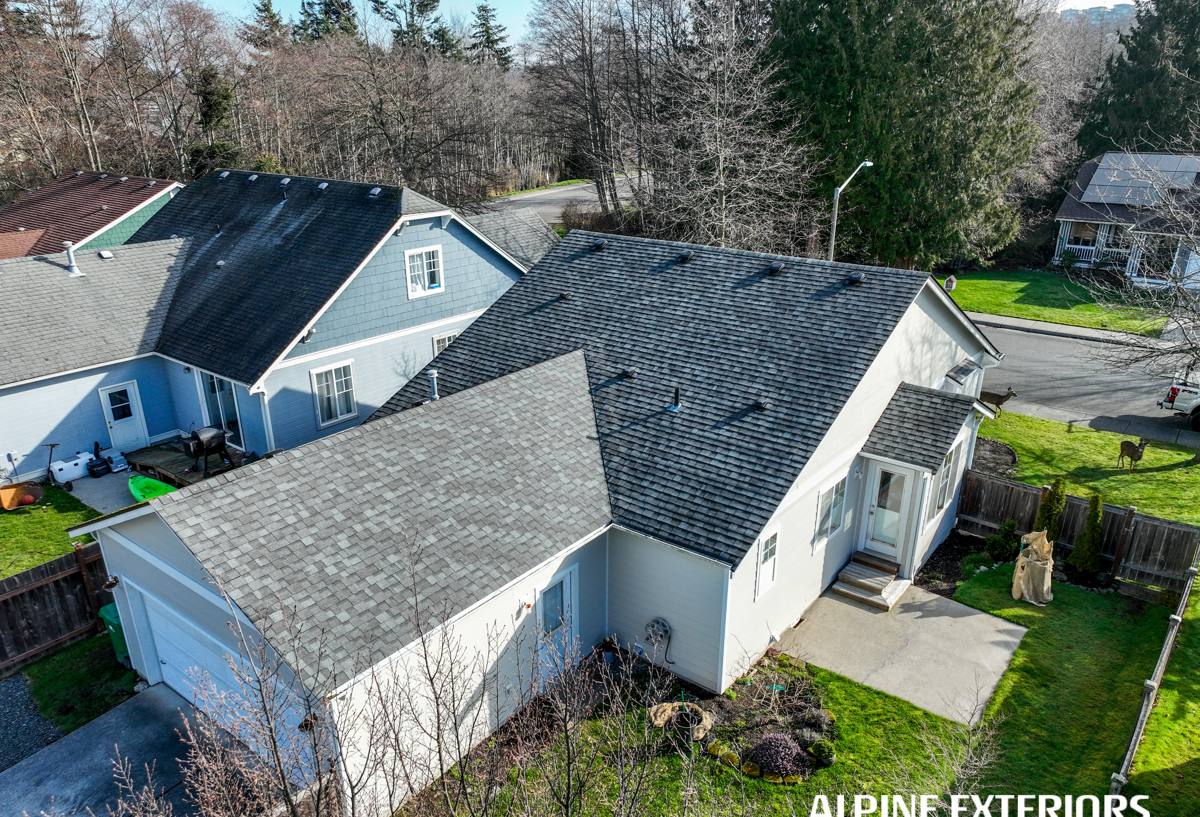
Edgemoor sits along Bellingham Bay in one of the most exposed and heavily wooded pockets of Whatcom County. That combination — waterfront salt air on one side and dense tree canopy on the other — puts more stress on a home's exterior than almost any other setting in Bellingham. Siding, trim, and roofing here don't just deal with the Pacific Northwest's normal wet-winter routine; they deal with it in a location where the air itself carries moisture and salt, and where shade from mature trees keeps surfaces damp long after a storm passes.
If you own a home in Edgemoor, you've probably already noticed the pattern: north- and west-facing walls that never fully dry out, trim that shows moss or algae before the rest of the house does, and paint or caulking that seems to fail faster than it should. None of that is bad luck. It's the direct result of the microclimate this neighborhood sits in, and it should shape what materials go on your walls and roof.
What Bellingham Bay's Climate Does to a House
Salt Air and Driving Rain
Homes close to the water take on a fine mist of salt-laden air, especially during winter storms when wind pushes moisture directly off the bay. Combined with wind-driven rain — rain that hits siding at an angle instead of falling straight down — this accelerates corrosion of exposed metal fasteners and flashing, and it keeps wood-based siding products wet on the surface far more often than homes even a mile inland.
A Long, Real Moss Season
Whatcom County's wet season runs long, and in a shaded, waterfront neighborhood like Edgemoor it runs longer. Moss and algae need shade and consistent moisture to establish, and Edgemoor's tree cover provides exactly that. Once moss gets a foothold on siding, trim, or roofing, it holds water against the surface, which is where real damage — rot, coating failure, substrate breakdown — actually starts.
Temperature Swings and UV
Coastal Whatcom County doesn't see extreme heat, but siding still expands and contracts with daily and seasonal temperature changes, and whatever sun does reach the property (especially on south- and west-facing exposures) breaks down unprotected finishes over time. A siding product needs to hold its color and its seal through both the damp winters and the drier summer stretches.
Why We Install Only James Hardie Fiber Cement
We get asked regularly why we don't offer vinyl, LP SmartSide, cedar, or other fiber cement brands like Cemplank or Allura. The honest answer is that in a climate like this one — and especially in an exposure like Edgemoor's — the trade-offs of those products showed up too often in the field, and we decided to standardize on one system that we could stand behind on every job.
James Hardie fiber cement is engineered specifically to resist moisture intrusion, and Hardie's HZ5 product line is formulated for regions with freeze-thaw cycling and high moisture exposure — a good match for the Pacific Northwest coast. It's non-combustible, it doesn't swell or delaminate the way wood-based products can when they take on repeated moisture, and its ColorPlus factory-applied finish is baked on under controlled conditions rather than field-applied, which means better, more consistent adhesion and color retention over time than a coating applied on-site.
None of this means other products are unusable everywhere — it means that for the specific conditions we install in around Bellingham Bay, we settled on the one system that gave us the fewest callbacks and the longest track record of holding up. That's a professional standard, not a knock on every home that has something else on it.
How the Common Siding Options Compare
| Material | Moisture & Moss Behavior | Maintenance | Typical Lifespan |
|---|---|---|---|
| Vinyl | Doesn't rot, but can warp/crack in temperature swings; seams and J-channels trap moisture and organic growth | Low, but panels can't be spot-repaired cleanly | 20-30 years |
| Cedar | Attractive but absorbs moisture; needs a sound, maintained finish to resist rot and moss in shaded, damp exposures | High — recoating/staining on a regular cycle | Varies widely with upkeep |
| LP SmartSide (engineered wood) | Treated to resist moisture, but still wood-based; edge and seam sealing is critical and installation-sensitive | Moderate — caulking and touch-up over time | 25-30 years with proper maintenance |
| Other fiber cement (Cemplank, Allura) | Similar base material to Hardie; differences show up in finish process and factory quality control | Low to moderate | Comparable category lifespan |
| James Hardie fiber cement | Non-combustible, dimensionally stable, HZ5 engineered for wet coastal climates | Low — factory finish holds up without a repaint cycle | Long service life with a strong transferable warranty when installed to spec |
It's Not Just Siding — The Whole Envelope Matters
In an exposure like Edgemoor's, siding is only part of the story. We handle roofing, windows, and decks as well, because water finds the weakest point in a building envelope, and a strong siding job can still be undermined by a roof that's shedding granules, a window that's no longer sealing, or a deck ledger board that's trapping moisture against the house.
Roofing
A roof under constant moss pressure and salt air needs proper ventilation and flashing details as much as it needs a good roofing material. We look at roof condition as part of any siding estimate in this neighborhood, because the two systems interact directly at every wall-roof intersection.
Windows
Old or poorly flashed windows are one of the most common sources of hidden water intrusion behind siding. When we replace siding on a home with aging windows, we flag it — not to upsell, but because re-siding around a window that's already leaking just seals the problem in.
Decks
Decks facing the bay take the same driving rain and salt exposure as the siding above them, plus standing water and ground moisture. Proper ledger flashing and material choice matter just as much here as they do on the walls.
What Correct Installation Looks Like
James Hardie siding performs the way it's rated to perform only when it's installed to Hardie's specifications — and that's especially true in a demanding coastal microclimate. Correct installation in Edgemoor typically includes:
- A drainage plane / weather-resistive barrier installed and lapped correctly behind the siding
- Proper clearance between siding and grade, roofing, and decks to avoid wicking moisture
- Correctly spaced, corrosion-resistant fasteners set to Hardie's fastening schedule — important given the salt exposure
- Tight, consistent caulking at joints and penetrations, using products rated for the ColorPlus finish
- Flashing details at every window, door, and roofline intersection, not just at the field of the wall
Skipping any one of these steps is how a good product ends up with a bad outcome. It's also why we treat installation quality, not just material choice, as the real driver of how a home in this neighborhood performs over the next few decades.
Why a Local Crew Matters Here
Edgemoor isn't a generic subdivision — it's a specific waterfront microclimate within Bellingham, and it behaves differently than inland Whatcom County neighborhoods or even other parts of the city just a short drive away. A crew that works around Bellingham Bay regularly knows which walls take the worst of the wind-driven rain, where moss establishes fastest, and how to sequence a job around the wetter stretches of the year so materials aren't installed over damp substrate.
That local knowledge also shows up in the small decisions: fastener choice near salt air, where extra flashing attention pays off, and how to plan a project timeline around this area's weather rather than a generic regional forecast.
Questions Worth Asking Any Contractor Before You Hire
- Are you installing to the manufacturer's written specifications, including fastener schedule and clearances?
- Who handles flashing at windows, doors, and roof intersections — is it included, or treated as an add-on?
- What's covered by the manufacturer's warranty versus your workmanship warranty, and is either transferable?
- Do you carry current licensing and insurance for work in Washington State?
- Can you walk me through how moisture and moss risk on this specific property will be addressed?
Get a Straight Answer for Your Property
Every home in Edgemoor sits a little differently relative to the wind, the water, and the tree cover, and that affects what your exterior actually needs. If you'd like an honest look at your siding, roofing, windows, or deck — and a clear explanation of why we'd recommend James Hardie for your situation — we're happy to walk the property with you. Use the form below to request a free, no-pressure estimate.