 Bellingham
 Exterior Work Built for Silver Beach's Conditions
Silver Beach is one of the older, well-established residential pockets of Bellingham, and homes here run the gamut — mid-century ramblers, split-levels from the 70s and 80s, and a growing number of newer infill builds tucked among the mature trees. What almost every one of those homes has in common is exposure to the same set of conditions that make exterior maintenance in Whatcom County a different animal than it is in drier parts of the country: persistent moisture, marine-influenced air moving off the water, and long stretches of overcast, damp weather that never really let a wall assembly fully dry out between storms.
We work throughout Bellingham, and Silver Beach comes with its own particular mix of tree cover, terrain, and orientation that affects how a home's exterior ages. A house tucked under a canopy of firs and cedars deals with moss, algae, and shaded siding that stays damp longer than a home in the open. A house on a more exposed slope catches more wind-driven rain and gets hit harder during winter storms. Either way, the siding, roofing, windows, and decking on a Silver Beach home are doing real work every single day, whether the homeowner notices it or not.
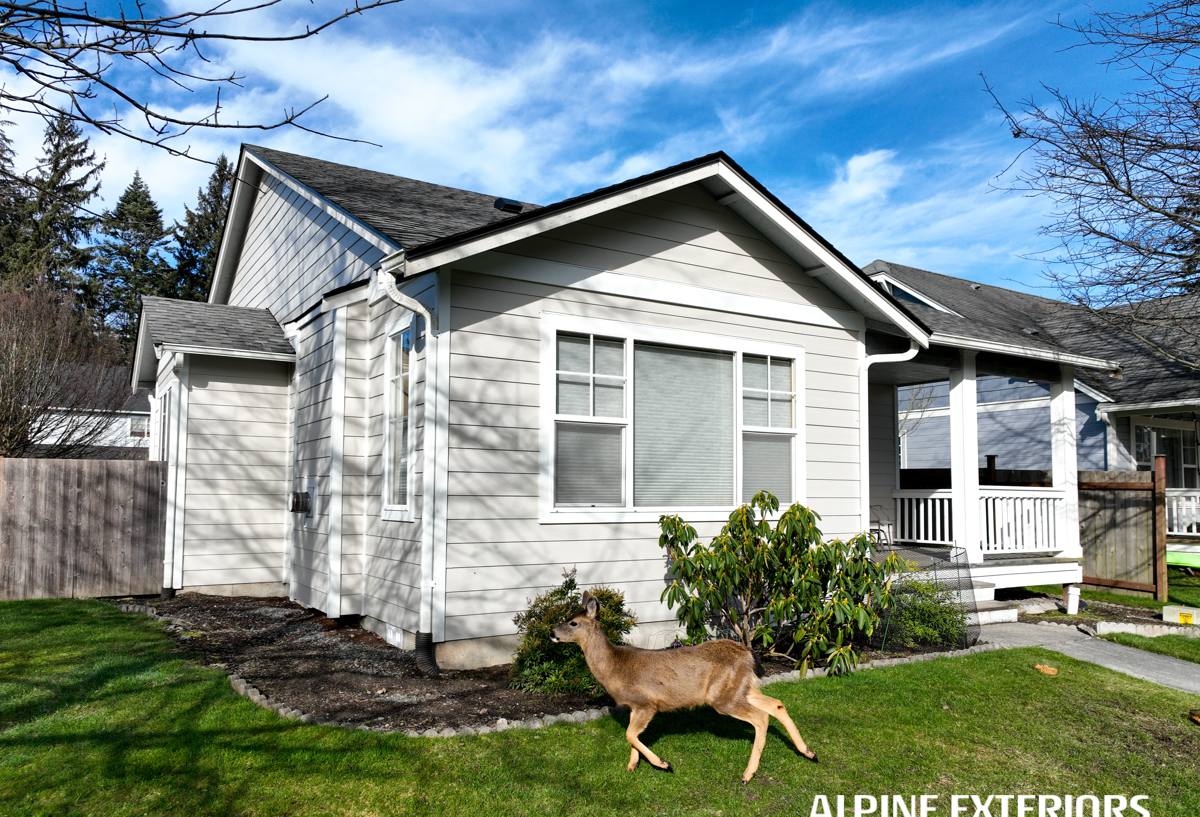
What Whatcom County Weather Does to a Home's Exterior
Bellingham sits in a part of Washington where "rain" isn't really the right word for what happens most of the year — it's more of a slow, persistent dampness punctuated by heavier storms in the fall and winter. Combine that with salt-tinged marine air moving in off the water and you get a specific set of failure patterns we see over and over on older homes:
- Moss and algae growth on shaded roof slopes and north-facing siding that holds moisture against the surface for weeks at a time
- Paint failure and swelling on wood-based siding products where water finds its way into seams, butt joints, and fastener holes
- Soft or delaminating trim around windows and doors where caulking has aged out and water has been quietly working its way behind the surface
- Corrosion on fasteners and flashing from prolonged exposure to salt-laden air, especially on the weather-facing sides of a house
- Deck boards that gray, cup, or rot faster than manufacturers' literature suggests, because they rarely get a real dry-out period
None of this is unique to Silver Beach — it's the reality for most of Whatcom County — but it does mean that exterior materials chosen for a home here need to be evaluated differently than the same materials would be in Spokane or Eastern Washington. What holds up fine in a dry climate can fail early in a wet, moss-prone one.
Why "Long Moss Season" Isn't Just a Cosmetic Issue
Homeowners tend to think of moss as an appearance problem — something that makes a roof or a north wall look neglected. It's more than that. Moss holds water against a surface, and sustained moisture is the single biggest driver of rot, coating failure, and substrate breakdown on almost every exterior material. A siding or roofing product that resists moisture absorption, or a finish that sheds it instead of trapping it, buys a home real years of service life in a climate like this one.
Siding: Why We Only Install James Hardie
We install James Hardie fiber cement siding exclusively. We don't install vinyl, LP SmartSide, Cemplank, Allura, or primed wood siding — not because those products don't have a place in the market, but because after years of doing exterior work in this climate, we've made a professional judgment about what actually holds up here and what we're willing to put our name behind.
Here's the honest reasoning:
- Vinyl siding is inexpensive and low-maintenance in the sense that it doesn't need painting, but it's a thin, flexible plastic product that can warp in temperature swings, crack in cold snaps, and fade unevenly over time. It also relies heavily on the wall assembly behind it to manage moisture, since vinyl itself isn't a structural or highly water-resistant barrier.
- LP SmartSide and other engineered wood products use treated wood strand technology, which has improved over the years, but wood-based products are still fundamentally vulnerable to moisture intrusion at cut edges, seams, and fastener penetrations if installation and caulking aren't perfect and stay perfect for decades. In a climate that rarely lets a wall dry out, that's a lot of ongoing risk.
- Cemplank and Allura are both fiber cement products, similar in concept to Hardie, and reasonable products in general. Our decision to standardize on one manufacturer isn't a knock on their materials — it's about consistency of installation training, warranty support, and color-match availability across every job we do.
- Primed spruce or cedar siding looks great when it's new and can be a fine choice for the right homeowner who wants a real wood look and is committed to a maintenance schedule. But it requires the most upkeep of any option — regular repainting, caulk inspection, and prompt repair of any damage — and in a moss-prone, high-moisture climate, that maintenance window closes faster than most homeowners expect.
James Hardie fiber cement is non-combustible, dimensionally stable (it doesn't expand and contract with moisture the way wood does), and comes with a factory-applied ColorPlus finish that's baked on and warranted separately from the substrate — meaning the color itself is engineered to resist fading from UV and moisture exposure, not just painted on and hoped for. Hardie's HZ5 product line is specifically engineered for cold, wet climates like ours, which matters more here than in most parts of the country.
How This Plays Out on a Silver Beach Home
On a home with heavy tree shade, moss and algae are going to grow on any exterior surface eventually — that's a maintenance reality regardless of material. The difference is what happens underneath that moss. Fiber cement doesn't rot, swell, or delaminate the way wood-based products can when moisture sits against the surface for extended periods. That's the core reason we've standardized on it for homes in this kind of environment.
Roofing, Windows, and Decks: The Rest of the Envelope
Siding is only part of what protects a Silver Beach home. We also handle roofing, window replacement, and deck construction, because an exterior envelope only works when every component is doing its job together.
Roofing
A roof in this climate needs to shed water fast and resist moss growth, especially on shaded slopes. Proper ventilation, underlayment, and flashing details at every penetration matter as much as the roofing material itself — a lot of leaks we find on older Bellingham homes trace back to flashing that was never installed correctly in the first place, not to the shingles themselves failing.
Windows
Older single-pane or early double-pane windows are common in Silver Beach's established housing stock. Beyond energy loss, aging windows are frequently a hidden source of water intrusion around the frame — caulking and flashing that degraded years ago and has been quietly letting moisture into the wall cavity. Replacement is as much a moisture-management decision as it is a comfort or efficiency one.
Decks
Decks in a wet, shaded climate take a beating. Ledger board flashing, proper drainage away from the house, and material selection all matter more here than they would in a drier region, because a poorly built deck connection is one of the more common ways water finds its way into a home's structure.
Comparing Siding Options for a Home Like This
| Factor | Vinyl | Engineered Wood | Primed Wood/Cedar | James Hardie Fiber Cement |
|---|---|---|---|---|
| Moisture resistance | Depends on wall assembly | Moderate; edge-sensitive | Low without diligent upkeep | High |
| Maintenance | Low | Moderate | High | Low |
| Fire resistance | Melts/deforms | Combustible | Combustible | Non-combustible |
| Finish longevity | Can fade/chalk | Painted; needs upkeep | Needs repainting | Factory ColorPlus finish, separately warranted |
| Cold/wet climate fit | Fair | Fair to good | Requires strict upkeep | Purpose-engineered (HZ5) |
What to Check Before Hiring Anyone for Exterior Work
Whatever contractor a homeowner ends up choosing, there are some basics worth confirming before signing anything:
- Active Washington state contractor license and proof of liability insurance
- A written scope of work that specifies materials, brands, and product lines by name — not just "siding" or "roofing"
- Manufacturer installation training or certification for the specific product being installed
- Clear flashing and moisture-barrier details, especially around windows, doors, and deck ledgers
- A warranty structure that's explained in writing, including what's covered by the manufacturer versus the installer
- Local references or completed work the contractor can speak to specifically
A crew that works this region regularly understands things a traveling or out-of-area contractor won't — how much roof overhang actually matters for wall protection here, which sides of a house take the worst weather, and how long moss and algae growth take to become a real problem versus a cosmetic one.
Why a Local Crew Matters in Silver Beach
Whatcom County's climate isn't extreme in the way hurricane or wildfire zones are, but it's relentless in its own quiet way — steady moisture, limited sun exposure on shaded lots, and salt-influenced air that adds up over years, not days. A contractor based here and working here regularly builds a feel for those patterns that doesn't come from a spec sheet. That's the perspective we bring to every Silver Beach project, whether it's a full siding replacement, a roof, new windows, or a deck rebuild.
If you're weighing options for your home's exterior, we're happy to take a look and talk through what actually makes sense for your property — no pressure, no pushy sales pitch. Reach out for a free estimate using the form below.