 Bellingham
 South Hill sits up on the slope above downtown Bellingham and Bellingham Bay, and that elevation cuts both ways. The views are part of why people love living there, but the same exposure that gives South Hill homes a wide-open outlook also puts their exteriors in the direct path of weather rolling in off the water. Homeowners on South Hill deal with a specific combination of salt-tinged air, wind-driven rain, and long stretches of damp, shaded shoulder seasons that add up to real wear on siding, roofing, and trim over time. We've worked on homes throughout this part of Bellingham, and the patterns repeat: it's rarely one dramatic failure that gets a homeowner to call us — it's slow, steady deterioration that finally becomes impossible to ignore.
What South Hill's Climate Does to a House
Whatcom County doesn't get hurricanes or hailstorms, and that can lull people into thinking exterior materials here have it easy. They don't. The Pacific Northwest's version of hard weather is patient and constant, and South Hill's exposure to wind off the bay makes it more pronounced than in more sheltered parts of the city.
Salt Air and Moisture
Homes closer to the water pick up a fine mist of salt-laden air, especially during winter storms. Salt accelerates corrosion on fasteners, flashing, and any metal components on the exterior, and it can also speed up the breakdown of paint films on wood and composite products that aren't built to handle it. Over years, that shows up as premature peeling, chalking, or rust streaking down siding and trim.
Driving Rain
Bellingham's rain doesn't always fall straight down. Wind off the bay pushes it sideways, and on an elevated, exposed site like South Hill, that means water gets driven into seams, laps, and joints that would stay dry on a more sheltered lot. Any weak point in the water-management plane — a gap in flashing, a caulk joint that's failed, a siding product that swells when wet — becomes an entry point for moisture that can travel behind the cladding and rot sheathing or framing before anyone notices from the outside.
The Long Moss Season
Bellingham's combination of moisture, mild temperatures, and shaded lots (South Hill has plenty of mature trees) makes it prime territory for moss and algae growth on roofs and north-facing siding. Moss holds moisture against the surface it's growing on for extended periods, which is bad news for wood-based products and asphalt roofing alike. It also just looks bad, and it's a recurring maintenance chore for homeowners who'd rather spend their weekends doing something else.
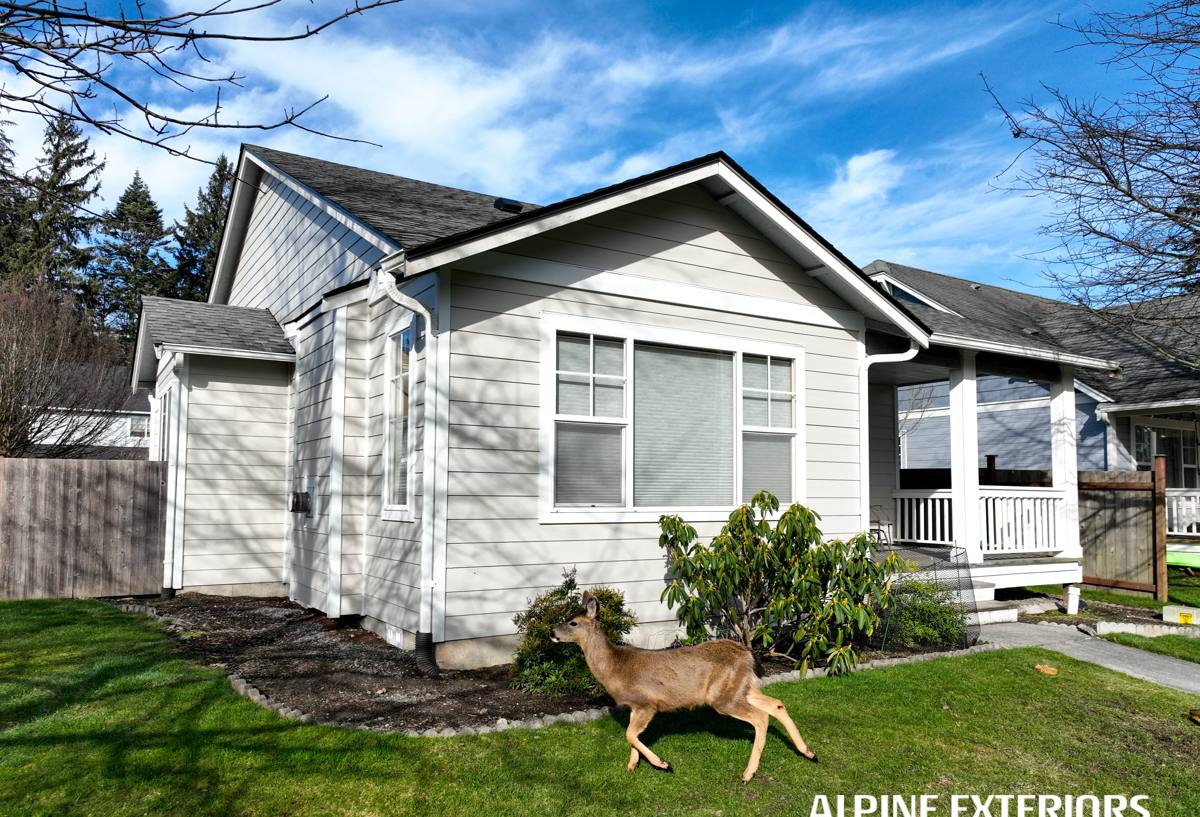
Why We Only Install James Hardie Siding
We made a decision early on to install one siding system: James Hardie fiber cement. We don't install vinyl, LP SmartSide, primed wood, or other fiber cement brands, and on a page like this it's worth explaining why, especially given what South Hill's climate throws at a house.
Fiber cement is fundamentally a cement-and-cellulose composite, not a wood or wood-fiber product. That matters in a climate like ours because it doesn't absorb and swell with moisture the way wood-based sidings can, and it doesn't provide the same food source for the moss, algae, and fungal growth that thrives in Bellingham's damp shoulder seasons. It's also non-combustible, which is an increasingly common ask from insurers and homeowners alike, even in a region that isn't primarily known for wildfire risk.
James Hardie in particular engineers regional product lines — its HZ5 formulation is built for climates like the Pacific Northwest's freeze-thaw and moisture cycles — and backs its ColorPlus factory-applied finish with a substantial, transferable warranty. That finish matters more on an exposed hillside lot than it does on a sheltered one, because factory-cured coatings hold up to UV and moisture cycling far better than field-applied paint, especially in a spot that's getting more direct weather than most.
None of this means other products are junk — plenty of them perform fine in the right application. It means that after years of doing this work in Whatcom County, we standardized on the one system we're confident holds up to what this specific climate does to a house, and we'd rather install one product well than several products adequately.
Roofing, Windows, and Decks: The Rest of the Envelope
Siding doesn't work in isolation — it's one piece of a home's exterior envelope, and on South Hill, the roof, windows, and any exterior decking take the same weather beating.
Roofing
A roof in this neighborhood needs to shed driving rain and resist the moss growth that shaded, damp roof planes are prone to. We look at flashing details, ventilation, and moss-resistant material choices as part of any roofing conversation, not just the shingle or panel itself.
Windows
Older homes on South Hill often still have original or aging window units, and the flashing and sealant details around those windows are frequently where water problems start. When we replace siding, we always check window flashing integration, because a new siding job installed around a leaking window detail just hides the problem instead of fixing it.
Decks
Exterior decks on a hillside lot see a lot of the same rain exposure as the siding, plus the added stress of ground contact and moisture wicking. We build and repair decks with materials and detailing meant to handle sustained Northwest moisture, not just look good on a dry day.
What Correct Installation Looks Like Here
Fiber cement siding is only as good as its installation, and that's especially true in a wind-and-rain-exposed setting like South Hill. A few details matter more here than they might in a calmer climate:
- Proper water-resistive barrier and flashing integration behind every siding plane, with extra attention at window and door openings
- Correct fastener spacing and type — inconsistent nailing is a common source of long-term problems with fiber cement
- Manufacturer-specified clearances between siding and grade, decks, roof lines, and other surfaces where water can pool or wick
- Properly caulked and back-primed cut edges wherever field cuts expose the raw material
- Ventilation behind the cladding so that any incidental moisture can dry out rather than being trapped
Skipping any of these steps doesn't usually cause an immediate problem — it causes a problem five or ten years down the road, after the crew that did the work is long gone. That's a big part of why installer quality matters as much as product choice.
Comparing Siding Options for a South Hill Home
| Factor | James Hardie Fiber Cement | Vinyl | Wood / LP SmartSide |
|---|---|---|---|
| Moisture resistance | Strong — cement-based, doesn't swell | Good surface resistance, but seams and fasteners are weak points | Vulnerable if the engineered coating is compromised |
| Moss/algae resistance | Better than wood-based products | Can grow algae, especially in shaded, damp spots | More prone to organic growth if moisture gets in |
| Finish durability | Factory-cured ColorPlus finish, long warranty | Color molded in, but can fade and become brittle over time | Field-applied or factory coatings vary in longevity |
| Fire resistance | Non-combustible | Combustible | Combustible |
| Wind/impact durability | Rigid, holds up well to wind-driven debris | Can crack or blow off in high wind | Depends on product and installation |
Maintenance on a Hillside Lot
Even the right materials need some upkeep, and South Hill's tree cover and elevation change what that upkeep looks like compared to a flatter, more open lot.
- Rinse siding and roof surfaces periodically to keep moss and algae from establishing, especially on shaded north- and east-facing walls
- Keep gutters clear — clogged gutters on a sloped roof push water where it's not supposed to go, often straight down the siding
- Trim back tree limbs and vegetation that keep siding shaded and damp longer than it needs to be
- Walk the exterior once or twice a year and look for caulk failure, loose trim, or staining that suggests water is getting somewhere it shouldn't
Why a Local Crew Matters
A lot of exterior problems in a neighborhood like South Hill are site-specific — which walls take the worst of the wind-driven rain, which spots stay shaded and mossy longer, how the hillside grading affects water runoff around the foundation. That's the kind of knowledge that comes from working on homes in this specific part of Bellingham repeatedly, not from a general contractor passing through. A crew that knows Whatcom County's weather patterns is going to make different, better-informed calls on flashing details, material clearances, and maintenance recommendations than one that doesn't.
Getting Started
If your South Hill home's siding, roof, windows, or deck are showing signs of wear — peeling paint, moss buildup, staining, or just age — we're happy to take a look and give you an honest read on what's going on and what your options are. There's no pressure and no cost to get a free estimate; it's simply a chance to get a clear picture of where your home stands.