 Bellingham
 Why Birch Bay Roofs Take a Different Kind of Beating
Birch Bay sits right on the water, and that changes what a roof has to survive. Salt-laden air off the bay works on exposed metal year-round — fasteners, flashing, vent caps, and any hardware that isn't rated for a marine-adjacent environment corrodes faster here than it would ten miles inland. Add in wind-driven rain that comes in sideways off the water during winter storms, and you've got moisture finding its way into laps, seams, and fastener penetrations that would stay dry on a more sheltered lot.
Then there's shade and moisture together, which in Whatcom County means moss. A roof surrounded by conifers or facing north often stays damp long after a storm has passed, and moss doesn't just sit on top of shingles — it holds water against the surface, works into the granule layer, and lifts shingle edges as it grows. Left alone through a few wet seasons, that's a roof that fails from the inside of the material, not just the outside.
None of this means a Birch Bay roof needs to be exotic or overbuilt. It means the details — underlayment, fastener grade, flashing metal, and ventilation — need to actually match the exposure the house sits in, instead of using whatever spec works fine in a drier part of the county.
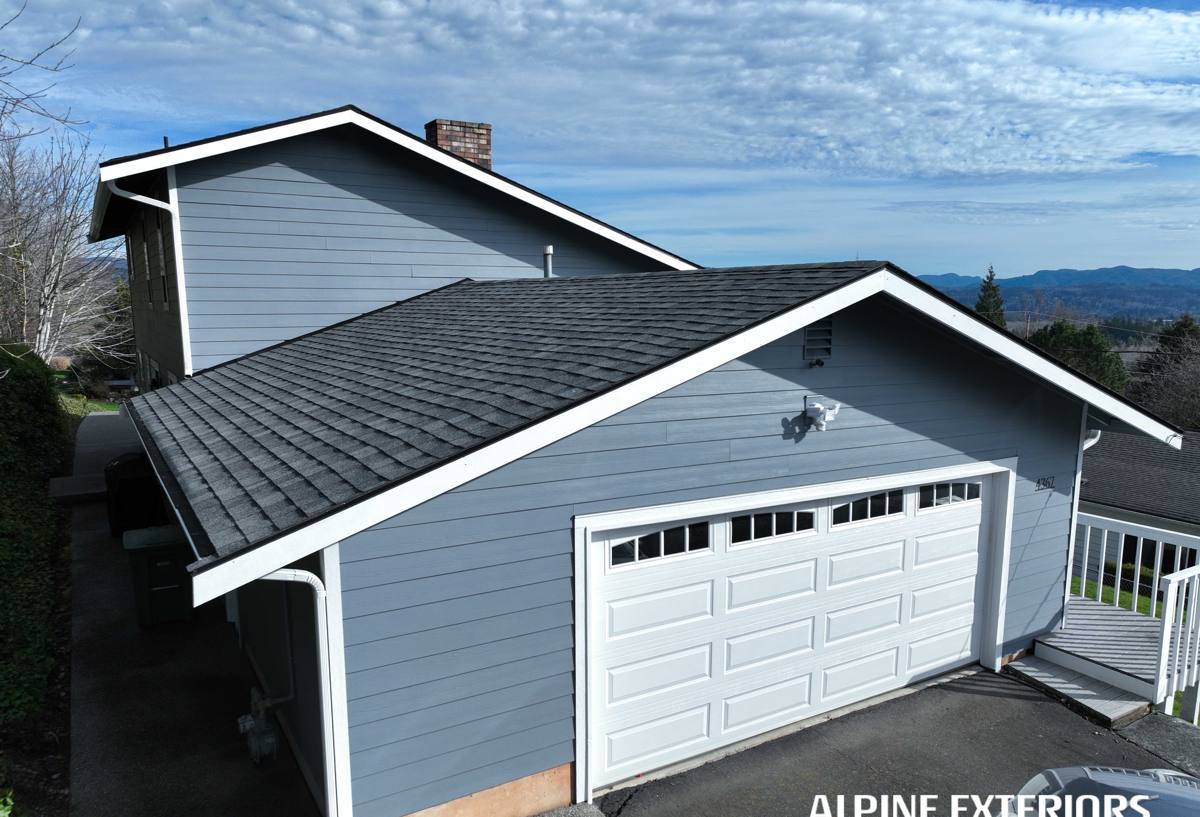
Signs It's Time to Replace, Not Just Repair
Age and material lifespan
Most asphalt composition roofs in this climate are realistically good for 18-25 years, even with a rated "30-year" shingle, because coastal exposure and moss shorten the practical service life. If your roof is in that range and you're calling about repairs more than once a year, patching individual spots is usually just delaying a full replacement while spending money that won't show up as value when the roof does get replaced.
Visible wear that points to replacement
- Granules collecting in gutters or at downspout outlets, exposing the black asphalt mat underneath
- Shingles that are cupping, curling at the edges, or cracking when you look at them from the ground
- Moss or dark algae staining across large sections rather than a small patch near a shaded valley
- Soft spots or sagging in the roof deck, felt when walking the attic or seen as a dip from the street
- Daylight visible through the roof deck from inside the attic, or water stains on attic sheathing
- Flashing around chimneys, skylights, or wall intersections that's rusted, lifted, or was never properly stepped
One or two of these can sometimes be repaired in isolation. Several at once, especially combined with age, usually means the underlying material is failing across the whole roof, not just at the spot you can see the damage.
What a Correct Roof Replacement Involves
Tear-off and deck inspection
A proper replacement starts with a full tear-off down to the deck, not a layover on top of existing shingles. That's the only way to actually see the plywood or OSB underneath, which matters a lot in a wet climate — soft, delaminated, or rotted deck sections need to be cut out and replaced before anything new goes down, or the new roof is just covering the same problem.
Underlayment and water barriers
Given how much wind-driven rain a Birch Bay roof deals with, underlayment choice isn't a place to cut corners. Self-adhered ice-and-water membrane belongs at eaves, valleys, and around every penetration, with synthetic underlayment across the rest of the field. This is the layer that keeps a roof dry even if wind manages to push water up under a shingle tab — which happens here more than in sheltered inland neighborhoods.
Ventilation
Balanced intake and exhaust ventilation keeps the attic dry and temperature-stable, which does double duty: it extends shingle life by keeping the underside cool, and it keeps moist attic air from condensing on the roof deck during cold, damp stretches. A roof can be installed perfectly and still fail early if the attic underneath it is trapping humidity.
Flashing
Flashing at chimneys, skylights, sidewalls, and valleys is where the majority of roof leaks actually start, not in the open field of shingles. Correct step flashing, counter-flashing, and valley metal — installed new, not reused from the old roof — is one of the details that separates a roof that holds up through Whatcom County winters from one that starts leaking at year three.
Choosing a Roofing Material for Salt Air and Moss
There's no single "best" roofing material for every Birch Bay home — it depends on the home's exposure, roof pitch, budget, and how much long-term maintenance the owner wants to take on. Here's how the common options actually compare in this specific climate:
| Material | Moss resistance | Salt air durability | Typical lifespan here | Maintenance |
|---|---|---|---|---|
| Architectural asphalt shingle | Moderate — benefits from copper or zinc strips | Good with corrosion-resistant fasteners | 18-25 years | Periodic moss treatment, gutter cleaning |
| Standing seam metal | High — sheds moisture, little surface for moss to hold | Good if coated/fastener-rated for coastal use; needs correct alloy | 40-plus years | Low; occasional fastener and coating check |
| Cedar shake | Low without regular treatment | Moderate; needs upkeep against salt and moisture combined | 20-30 years with maintenance | High — cleaning, treatment, inspection |
| Composite/synthetic shake | High — engineered to resist moisture uptake | Good | 30-50 years | Low to moderate |
We're upfront about the trade-offs rather than pushing whatever has the best margin. Cedar shake looks great and has a long history in this region, but it asks for real ongoing maintenance to hold up against sustained moisture and salt exposure — that's a maintenance-burden conversation we have honestly, not a knock on the material itself. Metal and composite options cost more upfront but ask less of the homeowner over the life of the roof, which matters if the house is a second home or rental that doesn't get checked on weekly.
Our Roof Replacement Process
- On-site inspection and written estimate. We walk the roof and attic, document the actual condition, and give you a written scope — not a ballpark guess from the driveway.
- Material selection. We go over the options above against your budget, how long you plan to own the home, and how much upkeep you want to take on.
- Permitting. Whatcom County and local jurisdictions require permits for full roof replacements; we handle the application and inspection scheduling as part of the job.
- Tear-off and deck repair. Old material comes off, the deck gets inspected, and any soft or damaged sheathing is replaced before anything new is installed.
- Underlayment, flashing, and ventilation. Ice-and-water membrane at vulnerable areas, new flashing throughout, and ventilation checked and corrected if it's undersized.
- Installation. New roofing material installed to manufacturer spec, with fastener patterns and materials chosen for coastal exposure.
- Cleanup and walkthrough. Site cleaned, magnetic sweep for nails, and a walkthrough so you know exactly what was done and where.
- Warranty paperwork. Manufacturer warranty registered in your name, along with our workmanship warranty documentation.
Keeping a New Roof Ahead of Moss and Salt
A correctly installed roof still benefits from a little seasonal attention in this climate. None of this is complicated, but skipping it is how a 25-year roof turns into a 15-year roof.
- Clean gutters and downspouts at least twice a year so water isn't backing up under the eaves
- Have moss and algae growth treated before it spreads, rather than after it's covering whole slopes
- Trim back tree branches that keep sections of the roof shaded and damp longer than the rest
- Do a visual check of flashing around chimneys and skylights each fall, before the wet season sets in
- Rinse accumulated salt residue off metal roofing or flashing periodically if the home has direct water exposure
- Confirm attic vents stay unobstructed by insulation or debris so moisture keeps moving out
Cost Factors Worth Understanding
Roof replacement pricing varies enough between homes that a real number only comes from an on-site look, but the factors that move the price are consistent:
| Factor | Why it matters |
|---|---|
| Roof size and pitch | Steeper roofs take longer and need more safety setup, adding labor cost |
| Number of existing layers | Tear-off of multiple old layers costs more than a single-layer removal |
| Deck condition | Rotted or soft sheathing found during tear-off adds material and labor not visible from the ground |
| Material choice | Asphalt, metal, and composite options carry different material and installation costs, as shown above |
| Access and site conditions | Trees, slope, and how close the house sits to the water can affect staging and equipment needs |
| Ventilation and flashing upgrades | Bringing an older roof's ventilation up to a correct standard adds some cost but pays back in roof life |
Why Local Experience in Birch Bay Matters
A roofing crew that only occasionally works this stretch of Whatcom County will often spec a roof the same way they would for a home twenty miles inland — and that gap shows up a few winters later as premature moss growth, corroded fasteners, or a leak at a flashing detail that wasn't built for driving rain. Working Birch Bay regularly means knowing which slopes on which lots hold moisture longest, which fastener and flashing grades actually hold up against the salt air, and how the local permitting process runs so a project doesn't stall waiting on paperwork.
It also means being straight with homeowners about what their specific lot demands. A shaded, north-facing roof close to the water needs a different maintenance conversation than a sun-exposed roof on the same street, and a contractor who's replaced roofs across this community for years can tell you that from experience, not guesswork.
If your roof is showing wear, nearing the end of its expected life, or you just want an honest read on its condition, we're happy to come take a look. There's no pressure and no obligation — just a straightforward inspection and a written estimate you can use to make a real decision. Fill out the form below to get a free estimate scheduled.