 Bellingham
 Why Blaine's Coastal Climate Is Tough on Asphalt Shingle Roofs
Blaine sits right on Semiahmoo Bay at the northern edge of Whatcom County, close enough to open water that salt-laden air is a daily fact of life for every roof in town. That salt air, combined with driving rain that blows in off the Strait of Georgia during fall and winter storms, and the long gray stretches each year when a roof simply doesn't get enough sun to dry out, adds up to conditions that work asphalt shingles harder than they're worked in drier parts of Washington. None of this makes Blaine unusual, but its position right on the water, without the buffering that some inland pockets of Whatcom County get, means roofs there take a slightly harder hit from wind-driven moisture and salt exposure than roofs a few miles inland.
Salt air corrodes exposed fasteners and thin flashing metal faster than inland air does. Driving rain finds any gap in flashing or underlayment before it ever reaches the siding below. And moss finds exactly what it wants in this part of the Pacific Northwest: shade, near-constant moisture, and winters mild enough that it never really dies back. A roof built without those three factors in mind will show its age early, no matter what the shingle wrapper promised.
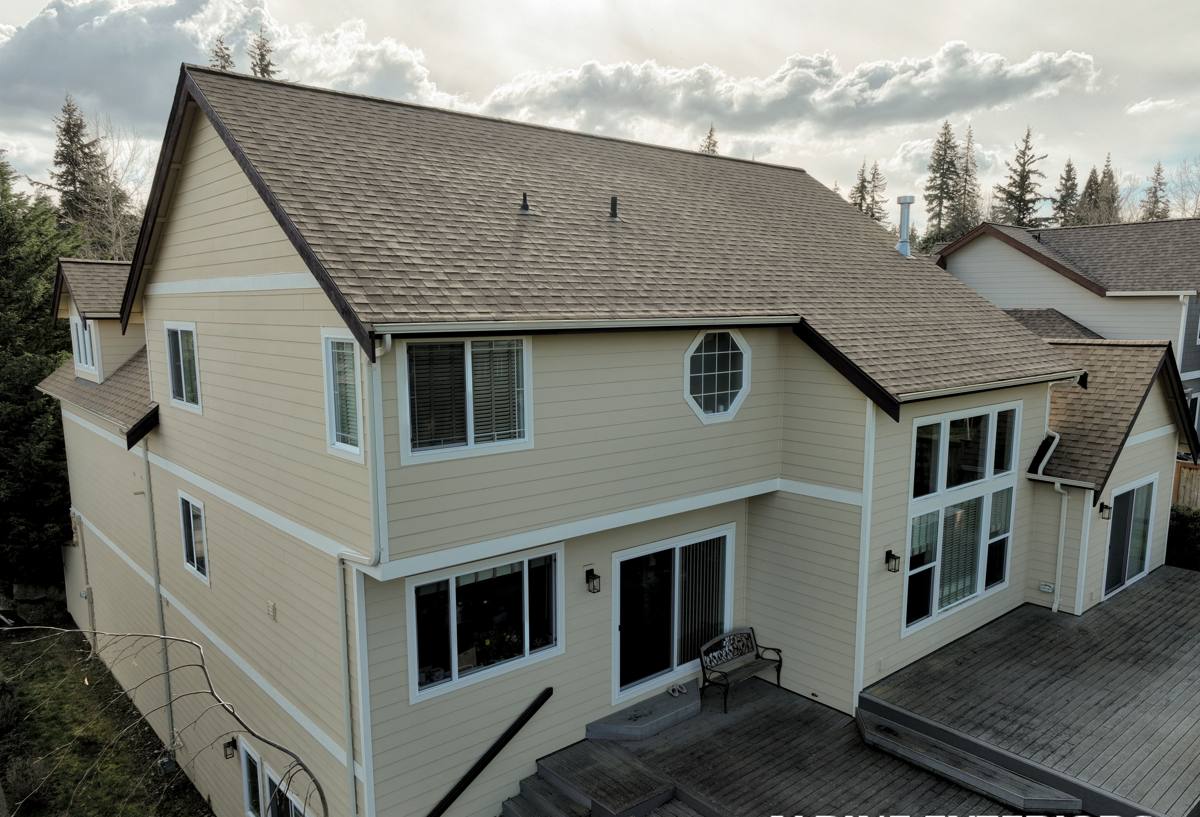
What a Correctly Installed Shingle Roof Needs in Blaine
Underlayment and Ice-and-Water Protection
A synthetic underlayment, not old-style felt, should cover the full deck. Felt absorbs moisture and can wrinkle under shingles over time, especially in a climate where the roof rarely gets a long dry stretch to fully release humidity. Self-adhering ice-and-water membrane belongs at the eaves, in every valley, and around every penetration, chimney, skylight, and vent pipe, since those are the spots where wind-driven rain is most likely to work its way sideways under the shingle tabs rather than run off the surface.
Ventilation That Actually Works
A roof deck that can't breathe traps moisture from inside the house against the underside of the shingles, which shortens shingle life from below at the same time salt air and rain are wearing on it from above. Balanced ventilation means enough intake at the soffits and enough exhaust at or near the ridge, sized to match the attic, not just a vent added because it looked like the roof needed one. Get this wrong and you can end up with premature curling or cupping on an otherwise well-installed roof, plus the moss and algae growth that comes easier on a deck that stays damp longer than it should.
Flashing and Fastener Choices
Flashing and fasteners are where a shortcut installation shows up first in a salt-air environment. Galvanized fasteners that would last decades in a dry inland climate can start showing surface corrosion within a few years this close to Semiahmoo Bay. We use corrosion-resistant fasteners and properly formed step flashing along every wall intersection, plus kick-out flashing anywhere a roof edge meets a wall, so water is directed into the gutter instead of behind the siding. This is a small material cost difference and a real difference in how long the roof actually holds up.
Shingle Selection: What Holds Up Near the Water
Not every asphalt shingle line is built the same, and the differences matter more here than in a sheltered inland yard. Wind rating, algae resistance, and how the shingle is laminated all affect how it performs against Blaine's combination of salt air and exposure.
| Shingle Type | Typical Wind Rating | Algae/Moss Resistance | Realistic Lifespan Here |
|---|---|---|---|
| 3-tab (standard) | Lower (60-70 mph class) | Standard granules only | Shorter end of the range; shows wear sooner in coastal exposure |
| Architectural/laminate | Mid-to-high (110-130 mph class) | Often available with algae-resistant granules | Solid middle-of-the-road choice for most Blaine homes |
| Impact-rated / high-wind laminate | Highest available in asphalt | Usually includes algae-resistant granules | Best fit for fully exposed, waterfront-facing roofs |
We generally steer homeowners on more exposed lots, especially those with a clear line to the bay, toward architectural or impact-rated products with algae-resistant, copper-infused granules. It costs more up front, but it's a straightforward trade-off: more material built into the shingle now versus more moss scraping and earlier granule loss later. That's our honest read on the trade-off, not a knock on any particular brand's standard product line.
Moss, Algae, and Long-Term Roof Maintenance
Moss is the most visible sign of a wet climate at work on a roof, and Whatcom County gives it everything it needs. North-facing slopes, shaded valleys, and any section of roof that stays damp longer than the rest will grow moss first. Left alone, moss lifts shingle edges as it grows, holds moisture against the granule surface, and accelerates the exact granule loss that shortens a shingle's life.
A few maintenance habits go a long way here:
- Have moss removed by hand or with a soft-bristle approach, not a pressure washer, which strips granules and voids most shingle warranties
- Consider zinc or copper strips near the ridge on shaded roofs; rain washing over them carries a mild moss inhibitor down the slope
- Keep overhanging branches trimmed back so more sun and airflow reach the roof surface
- Clean gutters and valleys at least twice a year so water isn't sitting against the shingle edge
- Schedule a roof check after major fall storms, when driving rain is most likely to expose a weak spot
Our Process for a Blaine Asphalt Shingle Roof
Whether it's a full replacement or a targeted repair, the sequence matters as much as the materials.
- On-site inspection of the existing roof, decking, flashing, and attic ventilation, with photos of anything that needs a closer look
- A written scope and honest recommendation, including whether a repair is enough or a full tear-off makes more sense long-term
- Complete tear-off of old shingles rather than a layover, so the deck can actually be inspected and any soft or rotted sheathing replaced
- Synthetic underlayment installed over the full deck, with self-adhering membrane at eaves, valleys, and penetrations
- New flashing at all walls, chimneys, and roof-to-wall intersections, with corrosion-resistant fasteners throughout
- Shingle installation to manufacturer spec, including proper nailing pattern and exposure, which affects both wind rating and warranty validity
- Ventilation check and correction if intake or exhaust is undersized for the attic
- Full cleanup, including a magnetic sweep for stray fasteners around the yard and driveway
- Final walk-through so you know exactly what was done and what to watch for going forward
What Drives the Cost of a Shingle Roof in Blaine
Two roofs of the same size can price out very differently once the details are accounted for. These are the factors that usually move the number most:
| Factor | Why It Matters |
|---|---|
| Roof pitch and complexity | Steeper roofs and more valleys, dormers, or hips mean more labor and material waste |
| Number of existing layers | Tearing off two layers of old shingles costs more in labor and disposal than one |
| Decking condition | Rotted or soft sheathing found during tear-off needs replacement before shingles go down |
| Ventilation upgrades | Adding proper intake or exhaust vents where none existed adds material and labor |
| Flashing and valley detail | More wall intersections and valleys mean more custom flashing work |
| Shingle tier chosen | Standard 3-tab, mid-grade architectural, and high-wind laminate all carry different material costs |
| Site access | Waterfront lots, narrow lanes, or limited staging space can add setup time |
We walk through these line by line during the estimate so you're not guessing at where the number came from.
Signs Your Roof Needs Attention
Most roof failures in this climate don't happen suddenly; they show warning signs for months or years first. Worth checking for:
- Granules collecting in gutters or at the base of downspouts
- Visible moss on north-facing or shaded slopes
- Shingles that are curling, cupping, or lifting at the edges
- Dark streaking across the roof surface, a sign of algae growth
- Soft or spongy spots when walking the roof or attic decking
- Daylight visible through the roof deck from inside the attic
- Water stains on ceilings after a wind-driven rainstorm
- Flashing that looks rusted, lifted, or separated from the wall or chimney
Any one of these on its own isn't necessarily an emergency, but catching them early is almost always cheaper than waiting for a leak to show up on the ceiling below.
Why Hiring a Crew That Already Works Blaine Matters
A roofing crew that mainly works drier, more sheltered areas doesn't always plan for what a roof faces this close to open water. A crew that regularly works Blaine and the rest of Whatcom County knows which slopes take the worst of the wind-driven rain, understands local permitting expectations for a full re-roof, and doesn't need to relearn the basics of building for salt air and a long moss season on your roof. That familiarity shows up in the small decisions, flashing detail, fastener choice, where ice-and-water shield gets extended, that separate a roof that holds up for its full expected life from one that starts needing attention years early.
It also matters after the job is done. A local crew is easier to reach for a warranty question, a storm-damage check, or simple maintenance advice a few years down the road, rather than having to track down an out-of-area company that already moved on to the next region.
If you're weighing a repair against a full replacement, or just want an honest read on how much life is left in your current roof, we're glad to take a look. The estimate is free, there's no pressure attached to it, and you'll get a straight answer either way. The form below is the fastest way to get that conversation started.