 Bellingham
 Siding Repair in Columbia: A Bellingham Neighborhood With Its Own Weather Problems
Homes in the Columbia area deal with a specific combination of exposures that wears on exterior siding faster than most homeowners expect. You're close enough to the water to catch salt-laden air, far enough into the Pacific Northwest weather pattern to get months of driving, wind-pushed rain, and shaded or tree-lined enough in many yards to grow moss on anything that stays damp for more than a day or two. None of these things alone would be a big deal. Together, over years, they find every weak point in a siding system — a nail popped slightly proud, a caulk joint that shrank, a corner where two pieces of trim never quite sealed.
This page is specifically about repairing existing siding on Columbia homes, not full replacement. A lot of siding damage in this neighborhood is fixable if it's caught and addressed correctly — the key word being correctly. A quick caulk-and-paint patch job might look fine for a season, but if it doesn't address what let water in in the first place, the same spot fails again, usually worse.
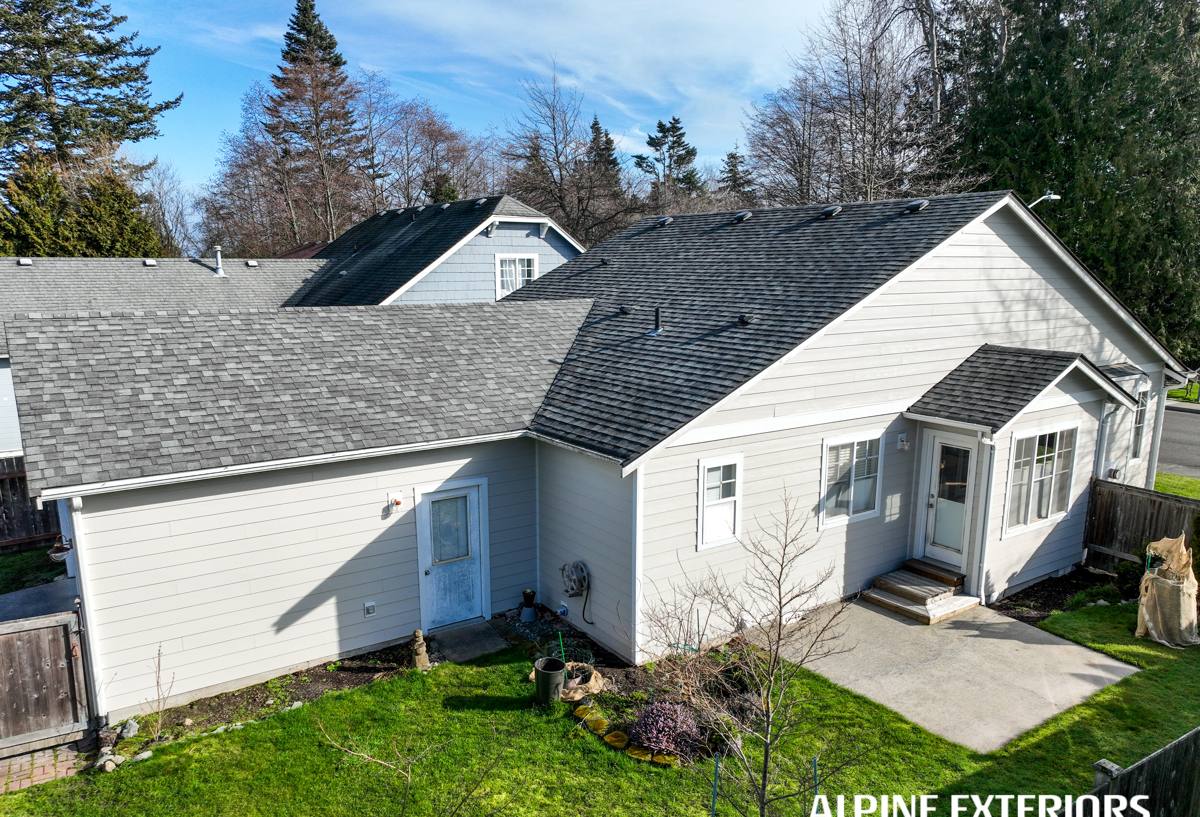
What Bellingham's Climate Actually Does to Siding
It helps to understand the mechanism, not just the symptom, because it changes what an actual repair should involve.
Salt Air
Even a few miles inland from Bellingham Bay, airborne salt accelerates corrosion on exposed metal fasteners, flashing, and trim hardware. Once a fastener starts to corrode, it loses grip, the siding around it works loose, and that small gap becomes a water entry point.
Driving Rain
Whatcom County doesn't just get a lot of rain — a good share of it comes in sideways during fall and winter storms. Wind-driven rain finds gaps that vertical rain never would: butt joints, unsealed corner boards, the underside of window trim, and any siding that was face-nailed or caulked instead of properly lapped and flashed.
Extended Moss Season
Cool, damp, shaded conditions for much of the year mean moss and algae get a long runway to establish themselves on north-facing walls, under eaves, and anywhere siding stays wet longer than it dries. Moss holds moisture directly against the siding surface and, on the wrong material, that constant dampness accelerates rot, swelling, and paint failure.
Individually manageable. Combined and left unaddressed for a few years, they're the reason a small repair now is so much cheaper than a large one later.
Signs a Columbia Home Needs Siding Repair, Not Just Cleaning
Pressure washing moss off siding treats the symptom, not the cause, and can actually force water behind panels if there's already a gap. Before cleaning, it's worth checking for damage that actually needs repair:
- Soft, spongy, or crumbling spots when you press on the siding, especially near the bottom courses and around window and door trim
- Visible gaps or separation at butt joints, corners, or where siding meets trim
- Paint that's bubbling, peeling, or flaking in a localized area rather than uniformly across a wall
- Streaking or dark staining below nail heads or fastener lines
- Persistent moss or dark algae growth that returns quickly after cleaning
- Visible warping, cupping, or bowing in individual boards or panels
- Caulk joints that have cracked, shrunk, or pulled away from the surface
- Interior signs — a musty smell, discoloration on interior drywall, or a soft spot on interior trim near an exterior wall
Any one of these on its own might be minor. Several together, especially clustered in one area, usually means water has been getting behind the siding for a while.
What a Correct Siding Repair Actually Involves
A repair that holds up through another Whatcom County winter isn't just swapping a damaged board for a new one. It means finding and fixing the reason the original section failed.
Find the Real Source First
Damaged siding is often a symptom of a flashing problem, a failed sealant joint, or a grading/drainage issue somewhere nearby — not a defect in the siding itself. Cutting out and replacing the visible damage without correcting the underlying water path just delays the next repair.
Matching Material and Finish
A patch that doesn't match the surrounding siding in profile, exposure, and color sticks out and can also create a mismatched moisture behavior between old and new material. This is one of the practical advantages of working with a single, consistent product line rather than whatever's available — it makes an honest, close match possible.
Correct Flashing and Water Management
Every seam, corner, and penetration (hose bibs, light fixtures, vents) needs to shed water outward and downward, not trap it. A repair that skips proper flashing or relies on caulk alone to do a flashing's job is a repair that will need to be redone.
Fastening to Manufacturer Spec
Fastener type, placement, and spacing matter more than most homeowners realize. Under-driven or over-driven nails, wrong fastener material, or incorrect spacing all create the small gaps that salt air and driving rain eventually exploit.
Repair or Replace? How to Think About It
Not every damaged section needs a full re-side. But once damage is widespread, repeated, or tied to an aging installation, patch repairs stop making financial sense. Here's a general framework:
| Situation | Repair usually makes sense | Replacement worth considering |
|---|---|---|
| Damage extent | Isolated to one or two areas | Spread across multiple walls or elevations |
| Underlying siding age/condition | Otherwise sound, well-installed | Original installation was flawed or near end of service life |
| Cause | One-time event (impact, isolated flashing failure) | Systemic moisture intrusion or chronic moss/rot |
| Material | Fiber cement in generally good shape | Older wood, vinyl, or a discontinued product that can't be matched |
| Cost pattern | First repair in years | Same area repaired more than once |
Repairs on a home in reasonably good shape are typically a modest, targeted expense. If a home is looking at a third repair to the same wall, or damage on several elevations, it's worth getting an honest opinion on whether ongoing patchwork is actually costing more than a planned replacement would.
Why We Repair Exclusively With James Hardie Fiber Cement
We install and repair only James Hardie fiber cement siding — we don't work in vinyl, LP SmartSide, Cemplank, Allura, or primed wood. For repair work specifically, that focus matters in a practical way: because Hardie's HZ5 product line is engineered for wet, marine-influenced climates like ours, a properly installed section holds up to the same salt air and rain exposure as the surrounding siding, rather than becoming the weak point again in a few years.
It also means a repair can genuinely disappear into the wall. Hardie's ColorPlus factory-finish system uses a consistent, baked-on finish, so a well-matched replacement plank doesn't stand out as an obvious patch the way a field-painted repair often does. And because fiber cement is non-combustible and dimensionally stable, it doesn't swell, cup, or warp the way some wood-based siding does when it takes on moisture — which is exactly the failure mode driving a lot of the repair calls we get in wetter neighborhoods like Columbia.
We're upfront that this means we can't patch every material we're called out for. If a home has vinyl or an older wood product with damage, we'll say so plainly and explain the options rather than force a mismatched material onto the wall.
How Our Columbia Repair Process Works
- Inspection. We look at the damaged area and the surrounding siding, flashing, trim, and any interior signs of moisture, so the repair addresses the cause, not just the visible spot.
- Honest assessment. We'll tell you plainly whether this is a straightforward repair, a sign of a bigger issue nearby, or a case where replacement is the more sensible long-term move.
- Written estimate. Scope, material, and cost before any work starts — no surprises once the wall is opened up.
- Correct repair. Damaged material removed, underlying cause corrected (flashing, sealant, drainage), new Hardie material installed and fastened to spec.
- Finish match. Color and profile matched as closely as the existing siding allows using Hardie's ColorPlus lines.
- Walkthrough. We show you what we found and what we did, including anything worth keeping an eye on going forward.
Why It Matters to Hire a Crew That Already Works in Columbia and Bellingham
Siding repair looks straightforward from the outside, but the details that make a repair last — how much flashing overlap a given wall orientation needs, how aggressively to seal against wind-driven rain on an exposed elevation, how to sequence a repair around the wetter months — are things a crew learns by doing this work repeatedly in this specific climate. A contractor who mostly works in a drier region and treats Whatcom County as an occasional job site is more likely to under-build for our rain and moss exposure, because that's what their experience tells them is normal.
A crew that regularly works Columbia and the surrounding Bellingham neighborhoods also knows what tends to go wrong on homes of a given age and construction type in this specific area — which is useful information when you're trying to figure out if a damaged section is an isolated problem or an early warning sign.
Keeping Repaired Siding From Failing Again
Once a repair is done correctly, a little routine attention goes a long way in this climate:
- Rinse moss and algae off gently at least once a year, before it has a chance to establish and hold moisture against the surface
- Keep gutters clear so overflow isn't running down the wall face during heavy storms
- Trim back vegetation and tree branches that keep a wall section shaded and slow to dry
- Re-caulk trim and penetration points as part of general exterior maintenance, not just when something looks obviously wrong
- Walk the exterior once a year, especially after a bad windstorm, and check the areas that were repaired plus any similar-facing walls
Fiber cement is low-maintenance compared to wood, but "low-maintenance" isn't "no-maintenance" — a few minutes of attention a year is what keeps a repair from becoming a recurring one.
If you're seeing damage, staining, or persistent moss on your Columbia home's siding, we're happy to take a look and give you a straight answer on what's actually going on and what it would take to fix it right. Reach out for a free, no-pressure estimate using the form below.