 Bellingham
 Fiber Cement Siding in Cordata: What This Climate Demands
Cordata sits in the newer, faster-growing end of north Bellingham, and a lot of the housing stock there reflects that — subdivisions and infill built over the past few decades rather than the older homes closer to downtown or Fairhaven. That newer construction age is exactly why fiber cement siding has become such a common question for homeowners in this part of the city: many of these houses are hitting the age where their original siding, whatever it was, is due for a real evaluation, and homeowners want to know what actually holds up here before they spend money twice.
Whatcom County's climate doesn't spare Cordata just because it sits a bit farther from the open water than some Bellingham neighborhoods. Salt-tinged marine air moves through the whole county on prevailing winds, driving rain comes in sideways during fall and winter storms regardless of exact elevation, and the moss season that runs most of the year on shaded, tree-covered walls is a function of tree cover and dampness more than proximity to the bay. Cordata has plenty of both. We install James Hardie fiber cement siding exclusively, and everything about how we detail a job here — fastening, flashing, gap spacing — is built around what this specific climate does to a wall over decades, not around what looks acceptable on the day it goes up.
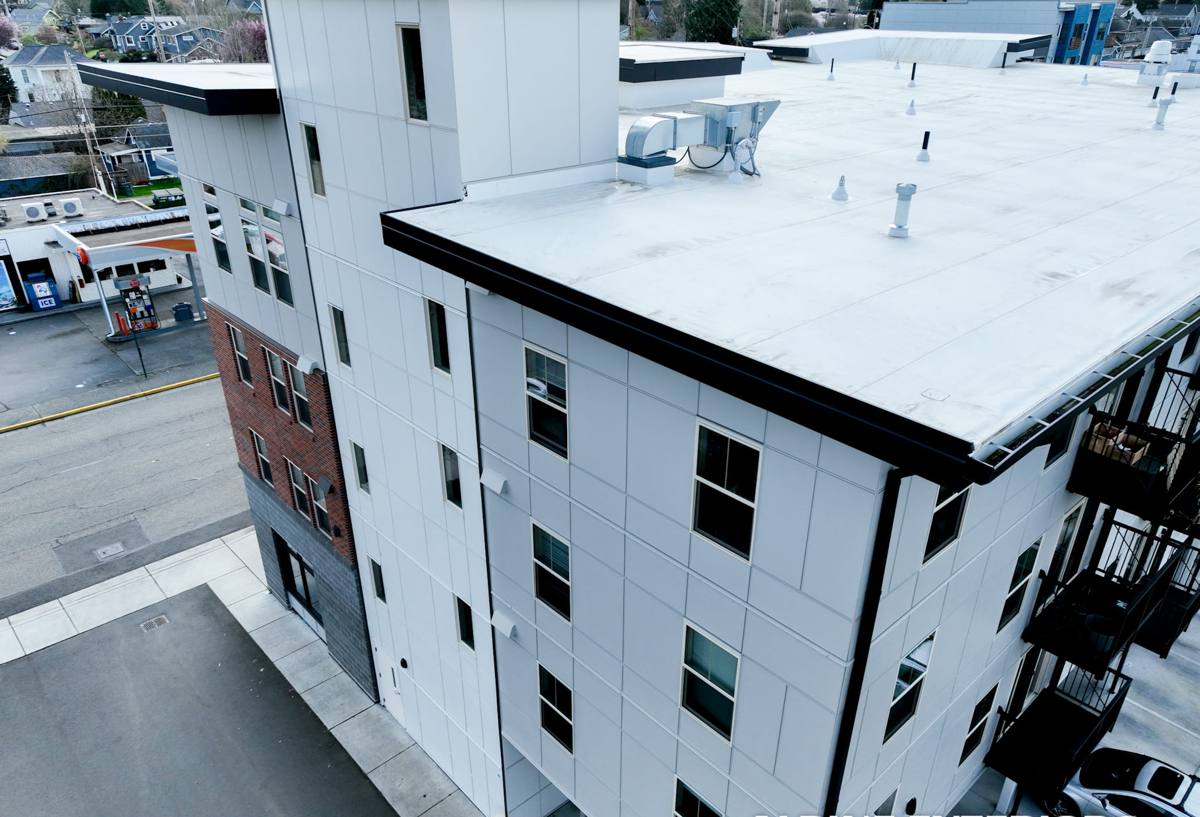
Why Cordata's Housing Stock Makes This a Common Replacement Question
A lot of homes in Cordata were built during periods when vinyl siding and engineered wood products were the standard, cost-driven choice for production and semi-custom builders. Those products aren't inherently defective, but they age on a shorter timeline than fiber cement, and Cordata's growth means a meaningful number of homes are now reaching that point at roughly the same time. That's part of why we get more fiber cement inquiries from this neighborhood than from some of the older, more slowly-turning-over parts of the city — the housing stock here is simply arriving at the replacement conversation in a concentrated wave.
The other factor is tree cover. Newer subdivisions in this part of Bellingham were often built into or adjacent to established tree lines, and mature trees plus newer construction is a combination that produces a lot of shaded, slow-to-dry wall surfaces. That's precisely the condition moss and mildew need, and it's a bigger factor in how long a given siding product actually lasts here than the manufacturer's marketing brochure usually lets on.
What James Hardie Fiber Cement Gets Right for This Neighborhood
Fiber cement's core advantage in a climate like this is that it doesn't behave like wood when it gets wet. It doesn't swell, cup, or rot at cut edges and fastener penetrations the way engineered wood products can, and it doesn't warp or become brittle the way vinyl can across temperature swings. For a neighborhood with a mix of sun-exposed south walls and deeply shaded, tree-lined north walls sitting on the same house, that dimensional stability matters on both sides of the building, not just the side that gets more weather.
| Material | Moisture Behavior | Maintenance Burden Here | Realistic Lifespan |
|---|---|---|---|
| James Hardie fiber cement | Dimensionally stable; resists swelling and rot at edges | Low; factory finish resists moss staining and fading | 30+ years with proper installation |
| LP SmartSide (engineered wood) | More sensitive to moisture at cut edges and fastener holes over time | Moderate; edge sealing and caulking need periodic upkeep | 15-25 years, climate-dependent |
| Vinyl | Doesn't absorb water, but can warp, gap, or crack with age and temperature cycling | Low visible upkeep, but hidden moisture behind panels is hard to catch | 20-30 years, variable |
| Cedar | Absorbs moisture readily without regular sealing or repainting | High; recurring maintenance cycle | 15-25 years with consistent upkeep |
We only install James Hardie, and specifically we spec the HZ5 product line for Whatcom County installations — Hardie engineers its HZ5 and HZ10 lines differently depending on regional freeze-thaw and moisture exposure, and HZ5 is built for climates like this one rather than the drier, more temperature-extreme regions HZ10 targets. That's a detail that gets missed when a product is ordered generically instead of specified for the region it's going on.
We don't offer LP SmartSide, vinyl, Cemplank, Allura, primed spruce, or cedar. Those are legitimate products, and other contractors install them competently. We made a standard for our own crews: one material system, installed the same correct way on every job, backed by a manufacturer warranty we understand completely rather than juggling install specs and warranty terms across several different products.
What a Correct Fiber Cement Install Actually Involves
The material is only part of the equation. A correct fiber cement installation in a climate like this has several details that don't show up in a walk-by inspection but determine whether the wall performs for thirty years or starts showing problems in five:
- House wrap or weather-resistive barrier installed and correctly lapped before any siding goes up
- A drainage gap or rainscreen behind the siding so moisture that gets past the surface can dry out instead of sitting against the wall sheathing
- Corrosion-resistant fasteners at Hardie's specified spacing and depth — not just "enough nails to hold it up"
- Proper clearance at the bottom of the wall and at grade so siding isn't wicking moisture from soil or hardscaping
- Correctly flashed and lapped transitions at windows, doors, corners, and roof intersections
- Field-cut edges primed before installation to protect the factory ColorPlus finish where it's been cut
- Butt joints and seams caulked or flashed per manufacturer spec, not just caulked shut and left
Skip any of these and the siding can look fine for a year or two. The problems that come from skipping them — soft spots at the base, staining at seams, paint or finish failure at cut edges — take a few wet seasons to surface, which is exactly why a rushed or corner-cutting install can pass a final walkthrough and still fail the homeowner years later.
Our Process for a Cordata Fiber Cement Project
Walkthrough and Assessment
We start by looking at your specific walls — which face prevailing wind and rain directly, which sit in shade from mature trees, and whether the existing wall assembly has any hidden moisture damage that needs addressing before new siding goes on. Installing new fiber cement over a wall with existing rot just buries the same problem under new material.
Detailing the Plan Before Install Day
We work out fastening pattern, flashing details, and how the siding meets windows, trim, and rooflines before crews start cutting material. Deciding these details on paper first avoids field improvisation, which is where corners tend to get cut on a rushed job.
Installation to Manufacturer Spec
Every fastener, gap, and flashing lap follows James Hardie's published installation requirements for this climate zone. That's what keeps the manufacturer's warranty valid, and it's the actual mechanism behind the siding performing for decades instead of years.
Final Walkthrough
We walk the finished job with you, explain what little maintenance fiber cement actually requires, and make sure you know what a healthy wall looks like if you ever want to check it yourself down the road.
Why Hire a Crew That Already Works Cordata and North Bellingham
The failure points on a fiber cement job are subtle and slow to show — a crew that's worked this specific part of Bellingham across multiple wet seasons has already seen which wall orientations in a tree-lined subdivision need extra drainage attention, how much clearance actually matters at grade in soil conditions common to this area, and where a generic national install guide undersells what this climate actually needs. That judgment doesn't show up on a spec sheet or a bid line item — it shows up in whether the wall still looks and performs the same in fifteen years or starts showing seam staining and soft spots by year five.
Cost Factors for Fiber Cement Siding in Cordata
Fiber cement siding costs more upfront than vinyl and is generally comparable to or somewhat more than engineered wood, largely because of the labor involved in correct fastening, flashing, and edge-priming. A few things move the price on a given Cordata home beyond base material and square footage:
| Factor | Why It Matters |
|---|---|
| Existing wall condition | Rot or moisture damage found during tear-off needs repair before new siding goes up |
| Tree cover and access | Mature trees close to the house can add labor for protection and cleanup, and limit access on some elevations |
| Wall complexity | Dormers, multiple gables, and window density all add cutting and flashing labor |
| Siding profile chosen | Lap, shingle, and panel profiles all price differently based on material use and install labor |
| Trim and accessory work | Matching trim, fascia, or soffit work adds to the scope beyond the field siding itself |
We'll walk your specific property and give you real numbers based on your walls, your tree cover, and your home's condition — not a rough per-square-foot estimate that ignores what actually drives cost on a given job.
Maintenance: What Ongoing Care Actually Looks Like Here
Fiber cement's biggest practical advantage in a neighborhood like Cordata is how little it asks of you. The factory-applied ColorPlus finish resists the moss and mildew staining that plagues untreated wood and some painted surfaces in this climate, so most homeowners find an occasional rinse is enough to keep walls looking clean. The exceptions are the same spots that cause problems on any siding material in a tree-heavy area: gutters and downspouts need to stay clear so water isn't overflowing onto walls, and any vegetation growing close against the siding should be trimmed back so walls can dry between rain events instead of staying damp against foliage. Neither of those is a fiber cement maintenance task specifically — they're just basic upkeep that matters more in a shaded, wet climate than it would somewhere drier.
Getting It Right the First Time
Redoing a siding job is disruptive and expensive in a way that dwarfs the cost of getting it right the first time. Because correcting a bad install often means pulling siding that's already fastened and flashed, we treat the assessment and planning phase of a Cordata project with the same seriousness as the installation itself. A wall installed correctly the first time, to spec, in a climate like this, is a decades-long decision — it's worth taking the time upfront to get it right.
If you're weighing fiber cement siding for a home in Cordata, we're happy to walk the property, talk through what your specific walls need given their orientation, tree cover, and age, and give you a straightforward, no-pressure estimate. There's a form below — reach out and we'll set up a time to take a look.