 Bellingham
 Building Decks for York Homes in Bellingham's Climate
York is one of Bellingham's older, established neighborhoods, close enough to the bay to pick up salt-laden air and shaded by enough mature tree canopy that moss and moisture are a year-round conversation, not a seasonal one. A deck built here has to handle more than looks — it has to shed water fast, resist the slow creep of moss and mildew, and stand up to metal hardware corroding faster than it would twenty miles inland. We've built and repaired decks across Whatcom County long enough to know that a deck designed for a dry-climate catalog photo doesn't hold up here. What does hold up is a build that treats drainage, ventilation, and material selection as the actual foundation of the project, not an afterthought.
This page covers what a correctly built custom deck looks like specifically for a York property — the framing details, the material trade-offs, the code requirements, and the maintenance reality — so you know what to expect and what to ask for before work starts.
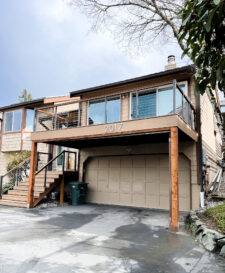
What Bellingham's Climate Actually Does to a Deck
Three things drive almost every deck problem we get called out to fix in this area:
- Driving rain that gets pushed sideways by wind off the bay, soaking ledger boards, rail posts, and any horizontal surface that isn't sloped to drain.
- Salt air that accelerates corrosion on fasteners, joist hangers, and railing hardware that isn't rated for it.
- A long moss season — often eight or nine months of the year in shaded yards — that turns any flat, damp surface into a slip hazard and a slow wood-rot problem if it isn't addressed.
None of these are dealbreakers. They're design inputs. A deck built with the right fastener grade, the right gap spacing, and the right slope will outlast one that wasn't — often by a decade or more.
Framing and Substructure: Where Most Deck Failures Start
Almost every deck failure we see in York and nearby neighborhoods starts below the decking boards, not on top of them. The framing is where water gets trapped, and trapped water is what actually rots a deck.
Ledger attachment and flashing
The ledger board — where the deck attaches to the house — is the single most common failure point in this climate. It needs proper flashing that directs water away from the house sheathing, not just caulk and a hope. We flash every ledger connection and never rely on sealant alone as a moisture barrier.
Joist protection
Untreated joist tops trap water under the decking and rot from the inside out, invisibly, for years. We use joist tape or an equivalent moisture barrier on top of every joist, and we use fasteners and hangers rated for the moisture and salt exposure this area sees — coated or stainless where corrosion risk is higher.
Footings and drainage
Whatcom County's clay-heavy, often waterlogged soils mean footings need to be set below frost depth and, just as important, that the ground around them can actually drain. A footing sitting in standing water year after year is a slow-motion problem, even if it doesn't show for a while.
Decking Material Choices for a York Property
There's no single "right" decking material — there's a right material for your budget, your shade level, and how much maintenance you're willing to do. Given the moss and moisture load in this area, here's how the common options actually compare:
| Material | Moss/Moisture Behavior | Maintenance | Typical Lifespan Here |
|---|---|---|---|
| Pressure-treated wood | Absorbs moisture; needs gaps and airflow to avoid cupping and rot | Annual cleaning and periodic staining/sealing | 10–15 years with upkeep |
| Cedar | Naturally rot-resistant but still needs sealing to fight moss staining | Sealing every 2–3 years, regular cleaning | 15–20 years with upkeep |
| Capped composite | Doesn't absorb water like wood; moss sits on the surface rather than growing into fibers | Periodic washing, no sealing or staining | 25+ years |
| PVC decking | Fully synthetic, sheds water and resists moss growth best of the common options | Occasional washing | 25–30+ years |
Composite and PVC cost more up front, but in a shaded, damp yard the maintenance savings and moss resistance often make them the better long-term value. Wood and cedar are still good choices for homeowners who want that traditional look and are willing to keep up with sealing and cleaning — plenty of York homes carry that look well and we're glad to build it right.
Why we're selective about certain composite products
Not all composite decking is built the same. Older or budget-tier composite boards without a full cap can absorb moisture at the core over time, which in a climate this wet can lead to swelling or surface breakdown years down the line. We install fully capped composite and PVC products specifically because their moisture behavior and warranty structure hold up to what this area throws at a deck — it's a standard we apply for durability reasons, not brand preference.
Railings, Stairs, and Code Requirements
Bellingham and Whatcom County follow the International Residential Code (IRC) for deck construction, and permits are typically required for a new deck above a certain height or attached to the structure — your project's exact requirements depend on size, height, and location, which we confirm before we start. Key code points that affect design:
- Guardrails are required on decks above a certain height off grade, generally built to a minimum 36" height for residential decks.
- Baluster spacing is limited to prevent a 4" sphere from passing through, for child safety.
- Stair stringers and landings have minimum width, rise, and run requirements.
- Ledger attachment and footing depth are inspected items, not optional extras.
We pull permits and handle inspections as part of the build so you're not left chasing paperwork or discovering a code issue after the deck is finished.
Moss, Mildew, and Long-Term Maintenance
Given how much of the year York stays damp and shaded, moss management is worth planning for at the design stage, not just after it shows up.
Design choices that reduce moss
Proper slope away from the house (typically a slight pitch built into the framing), consistent board spacing for airflow, and avoiding low spots where water pools all reduce how much moss takes hold. Grooved-edge composite boards with hidden fasteners tend to shed water better than boards with wide, flat gaps that collect debris.
What upkeep actually looks like
- Sweep debris and leaf litter off the deck regularly, especially in fall — trapped organic matter is what feeds moss.
- Wash the surface once or twice a year with a deck cleaner appropriate to your material (wood and composite need different products).
- Check railing hardware and fasteners periodically for corrosion, especially on older builds without upgraded coatings.
- Re-seal or re-stain wood decking on the schedule your material calls for — skipping a cycle in this climate shows up fast.
- Keep gutters and downspouts near the deck clear so runoff isn't dumping extra water onto or under it.
Our Process for a Custom Deck Build in York
We keep the process straightforward and specific to your property, not a generic template:
- Site visit and assessment — we look at grade, drainage, sun/shade exposure, and how the deck will tie into your home.
- Design and material selection — sized and shaped for how you'll use it, with material recommendations based on shade level and maintenance preference.
- Permitting — we handle the Whatcom County/City of Bellingham permit process and coordinate inspections.
- Framing and build — proper flashing, joist protection, corrosion-rated fasteners, and code-correct railings and stairs.
- Final walkthrough — we go over the finished deck and basic maintenance so you know what upkeep it actually needs.
Cost Factors for a York Deck Project
Every deck is priced on its own specifics, but these are the main factors that move the number:
| Factor | Why It Matters |
|---|---|
| Size and shape | Square footage and multi-level or angled designs increase framing and labor time |
| Decking material | Wood costs less upfront; composite and PVC cost more but need far less maintenance |
| Height off grade | Taller decks need more substantial footings, framing, and stair/railing work |
| Site access and grading | Sloped or hard-to-access yards, common in this area, add labor for footings and material staging |
| Railing style | Cable, glass, and custom rail designs cost more than standard baluster railings |
Rather than quote a number that doesn't account for your actual lot, we walk the site first so the estimate reflects your specific property.
Why a Crew That Already Works in York Matters
A deck built for a dry inland climate and one built for a shaded, damp Bellingham lot near the bay aren't the same project, even if they look identical on paper. Knowing which fastener grades hold up here, how much slope actually keeps a deck moss-free, and what Whatcom County's inspectors look for on ledger and footing details isn't something you get from a general contractor working from a national playbook — it comes from building decks in this specific climate, on this specific soil, repeatedly. That's the experience we bring to every York project.
If you're planning a new deck or replacing one that's showing its age, we're happy to take a look and put together a free, no-pressure estimate — just fill out the form below.