 Bellingham
 Why Decks Fail Faster in Cordata
Cordata sits in north Bellingham, close enough to the water and the marine weather pattern that decks here take a beating most inland homeowners never deal with. Whatcom County's climate isn't dramatic — no hurricanes, no extreme freezes — but it's relentless. Driving rain off the Sound soaks into end grain and fastener holes for months at a stretch. Salt-tinged air corrodes cheap hardware faster than the manufacturer's warranty ever assumes. And the long moss season, often running from October well into April, keeps deck boards damp and shaded far longer than a sunnier climate would allow.
None of this means decks in Cordata are doomed. It means a deck built or repaired without accounting for this specific climate is doomed. We've replaced enough decks in this neighborhood to know exactly where the failures start: at the ledger board, at fastener heads, in gaps between boards that trap wet moss, and in framing that was never rated for standing water contact in the first place.
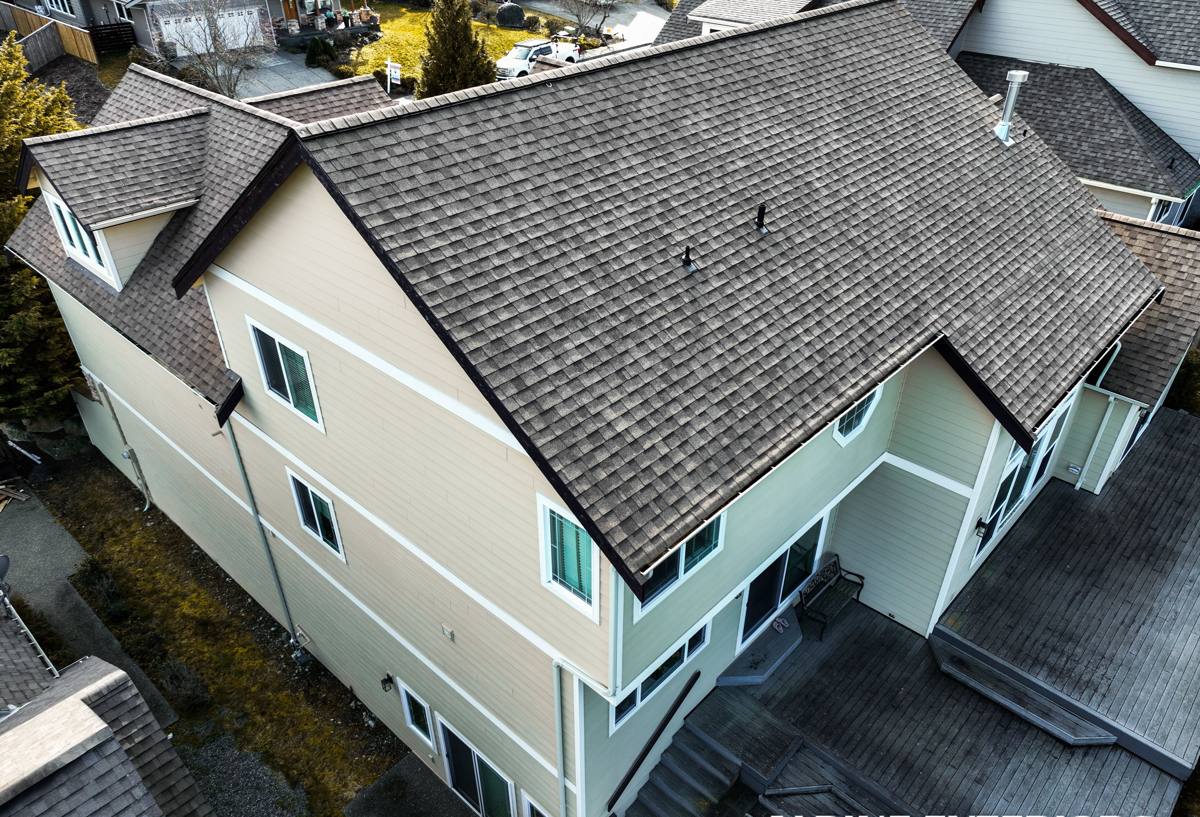
Signs a Repair Won't Cut It
A lot of Cordata homeowners call us for a repair quote and end up needing a full replacement instead. It's not an upsell — it's what the structure tells us once we get underneath it. Here's what usually means the deck is past patching:
- Soft or spongy spots in the decking that give underfoot, especially near the house
- Visible rot or dark staining around the ledger board where the deck meets the siding
- Rust streaking from joist hangers or fasteners, which usually means the metal is failing from the inside
- Persistent green or black moss growth that comes back within weeks of cleaning
- A deck that visibly sags, bounces, or has posts that have shifted or settled unevenly
- Railings that wiggle at the base — often a sign the post connections have rotted, not just the railing itself
Any one of these on its own might be repairable. Two or three together, especially on a deck more than 15-20 years old, usually means the framing has been absorbing water longer than the surface has shown.
What a Correct Deck Replacement Actually Involves
Framing and Structure
The framing is the part nobody sees and the part that determines whether the deck lasts. In this climate, we treat every framing member as if it will get wet repeatedly, because it will. That means pressure-treated lumber rated for ground or moisture contact where it's specified, proper joist spacing for the decking material chosen, and blocking added where boards need extra support to stay flat over time.
Ledger Board and Flashing
This is the single most common failure point on decks we tear out in Bellingham. The ledger board bolts the deck to the house, and if it isn't flashed correctly, water tracks behind it and rots both the ledger and the wall framing behind the siding. A correct install uses proper flashing that sheds water away from the house, not into it — sealant alone is never a substitute for physical flashing.
Fasteners and Hardware
Salt air corrodes ordinary hardware faster than people expect, even a few miles inland. We use fasteners and structural connectors rated for outdoor and coastal-adjacent exposure, not the cheapest galvanized option on the shelf. A deck is only as strong as the metal holding it together, and that metal is invisible once the decking goes down.
Guardrails and Code
Any deck over 30 inches off grade needs a compliant guardrail system, and stairs need proper rise, run, and graspable handrails. We build to current code requirements as adopted locally, not to whatever was standard when the original deck went up — codes have tightened over the decades, and an old deck's railing height or baluster spacing often won't pass if it were inspected today.
Choosing a Decking Material for This Climate
There's no single "best" decking material — there's a best fit for how much upkeep you want to do and how long you plan to stay in the house. Here's how the common options actually perform under Whatcom County's rain and moss pressure:
| Material | Moisture Behavior | Moss/Mildew Resistance | Maintenance | Typical Lifespan |
|---|---|---|---|---|
| Pressure-treated wood | Absorbs and releases moisture; prone to swelling/cupping if not sealed | Low — needs regular cleaning and re-sealing | Annual cleaning, re-stain/seal every 2-3 years | 10-15 years |
| Cedar | Naturally moisture-resistant but still needs sealing | Moderate — better than treated pine but still grows moss if shaded | Cleaning and oil/sealant every 1-2 years | 15-20 years |
| Composite decking | Doesn't absorb water into the board itself | Moderate to good — surface texture varies by brand and can still film with algae in deep shade | Periodic washing, no staining or sealing | 25-30 years |
| PVC/capped polymer | Fully water-resistant, no wood core to rot | Good — smoothest surfaces resist moss the best | Occasional washing | 25-30+ years |
We install all of the above depending on budget and preference, but for a deck that's shaded much of the day — common in wooded lots around Cordata — we steer clients toward composite or capped polymer specifically because it doesn't feed moss the way bare wood does. If you love the look and feel of real wood and are willing to maintain it, cedar with a proper annual cleaning schedule still holds up fine here; it just asks more of you over the years.
Our Deck Replacement Process
Every job starts the same way: we look at what's actually there before we quote what should replace it.
- On-site assessment — we inspect the framing, ledger connection, footings, and existing decking to determine what's structural and what's cosmetic.
- Written estimate — a clear scope covering demolition, framing repairs or replacement, decking material, railings, and any permit work needed.
- Permit filing — most full deck replacements in Bellingham require a permit, especially when framing or footings are involved; we handle that filing.
- Demolition and disposal — old decking, railings, and any rotted framing removed and hauled off.
- Framing and ledger work — structural repairs, proper flashing, and hardware upgrades before a single new board goes down.
- Decking and railing install — installed per manufacturer spacing specs to allow for drainage and seasonal movement.
- Final walkthrough — we go over the finished deck with you, including basic care specific to the material installed.
Permits and Local Code Considerations
Whatcom County and the City of Bellingham both have permitting requirements that apply to deck work, particularly when the deck is attached to the house, exceeds a certain height, or involves structural framing changes. Requirements can vary depending on exactly where a property falls relative to city limits, so we confirm the correct jurisdiction and permit path for each address before work starts rather than assuming. Skipping a required permit can create real problems later — at resale, at insurance claim time, or if the work needs to be inspected for an unrelated reason down the road.
Cost Factors Homeowners Should Understand
Deck replacement costs swing widely based on a handful of factors, and it's worth knowing what actually drives the number before you get quotes:
- Size and shape — square footage matters, but so does complexity; multiple levels, angles, or built-in features add labor beyond raw square footage.
- Framing condition — if joists, beams, or footings need replacing, not just the surface decking, that adds cost but isn't optional if the structure has failed.
- Decking material — pressure-treated wood is the least expensive up front; composite and PVC cost more initially but less over the deck's lifetime once you factor in staining and sealing.
- Railing style — basic wood or metal balusters cost less than cable rail or glass panel systems.
- Height and access — a deck well above grade with stairs, or one with difficult site access, takes more labor than a low, easily reached deck.
- Permit and inspection requirements — factored into most quotes but worth asking about explicitly so there are no surprises.
Broadly, a straightforward pressure-treated replacement runs at the lower end of the range, while a larger composite or PVC deck with upgraded railings runs toward the higher end. We'll give you real numbers for your specific deck rather than a generic range that doesn't reflect your framing condition or material choice.
Why a Crew That Already Works in Cordata Matters
A deck built for a dry inland climate and one built for Bellingham's marine layer aren't the same job, even if they look identical when finished. A crew that regularly works Cordata and the surrounding north Bellingham neighborhoods already knows which hardware holds up against the salt air, how much slope to build into decking so water actually sheds instead of pooling under moss, and which ledger flashing details keep water out of the wall behind the deck year after year.
We're not learning Whatcom County's climate on your project. We've seen what a decade of driving rain and moss does to decks built without these details, and we build every replacement to avoid repeating those failures.
Caring for Your New Deck
Whatever material you choose, a few habits make a real difference in this climate. Sweep off standing leaves and debris regularly, especially in fall, so moisture and moss don't get trapped against the surface. Rinse the deck a couple of times a year to knock back early moss growth before it takes hold. Check railings and stair connections annually for any looseness. And if you went with wood, keep to a sealing schedule rather than waiting until it visibly needs it — by the time wood decking looks weathered, it's already absorbing more water than it should.
If your deck in Cordata is showing any of the warning signs above, or you're just ready to stop maintaining an old one, we're happy to take a look. Reach out for a free, no-pressure estimate using the form below.