 Bellingham
 Why Ferndale Roofs Take More Punishment Than People Expect
Ferndale sits close enough to the water that salt-laden air is a real factor in how a roof ages, not just a talking point. Add in the driving, wind-pushed rain that comes through Whatcom County off the Salish Sea, plus a moss season that can run eight or nine months out of the year in the shade of the fir and cedar canopy so common here, and you've got a roofing environment that's genuinely harder on materials than most manufacturers' warranty language assumes. A roof that's installed correctly for this climate looks almost identical to one that isn't — until year six or seven, when the corners cut during installation start showing up as leaks, soft decking, or moss working its way under the shingle edge.
We install new roofs for homes in and around Ferndale and the rest of Whatcom County, and the details we pay attention to are specifically the ones that matter here: fastener corrosion resistance, underlayment choice, ventilation balance, and flashing work at every valley, chimney, and wall intersection. None of that is exotic. It's just easy to skip when a crew isn't used to building for this weather.
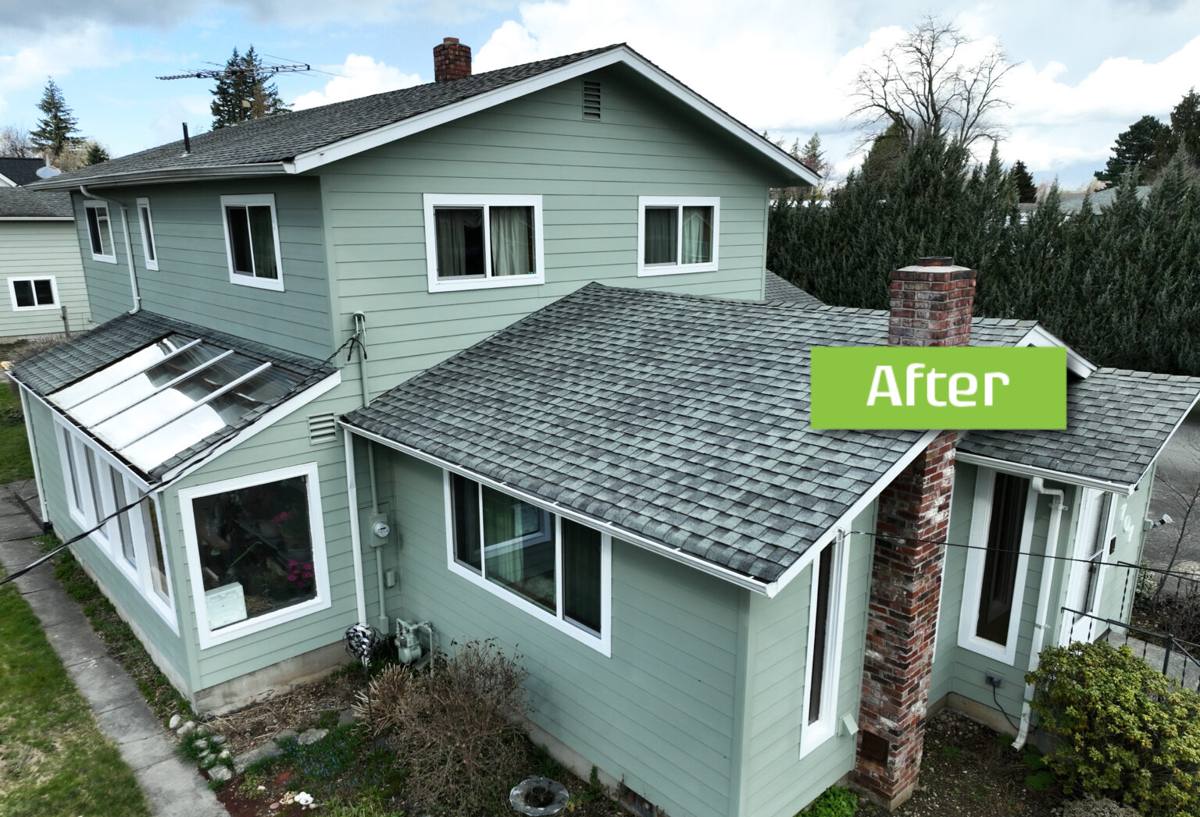
Signs a Ferndale Roof Needs Replacement, Not Another Patch
Not every roof problem calls for a full tear-off. But there's a point where patching becomes a way of spending money without actually solving anything, and it's worth knowing where that line sits.
- Granule loss heavy enough that you can see bare asphalt on multiple slopes, not just one weathered spot
- Moss growth that's lifted shingle edges rather than just staining the surface
- Soft or spongy decking felt underfoot during inspection, especially near valleys and eaves
- Daylight visible through the roof deck from the attic, or water staining on rafters after a storm
- A roof that's already had two or more repair visits for separate leaks within a couple of years
- Shingles original to a roof that's 20+ years old, regardless of how it looks from the ground
If you're only seeing one or two of these, a repair may still make sense. If you're seeing several at once, that's usually the deck and underlayment telling you they're past due, and a repair at that point just delays the same decision at higher cost.
What a Correct New Roof Installation Actually Involves
Tear-Off and Deck Inspection
A full tear-off is the only way to actually see the condition of the roof deck, and it's where a lot of the real decision-making happens. Any soft, delaminated, or water-stained sheathing gets replaced before anything new goes down — installing new roofing over compromised decking just hides the problem for a few more years and voids most manufacturer warranties anyway. In a climate that stays damp for long stretches, we'd rather find and fix deck issues now than have a homeowner find them later as a ceiling stain.
Underlayment and Flashing
Given how much wind-driven rain Whatcom County sees, we treat underlayment as more than a formality. Self-adhered ice-and-water membrane goes in valleys, along eaves, and around every roof penetration — chimneys, vents, skylights — where wind can force rain sideways under standard shingle coverage. New flashing gets installed at every wall and chimney intersection rather than reusing old flashing, since flashing failures are one of the most common causes of "mystery leaks" on roofs that otherwise look fine.
Ventilation
Balanced intake and exhaust ventilation matters everywhere, but it matters more in a climate that stays cool and moist much of the year, because poor ventilation traps moisture in the attic and accelerates both deck rot and moss growth from underneath. Part of a correct installation is checking that soffit intake vents aren't blocked and that exhaust venting is sized to match, not just adding a ridge vent and calling it done.
Choosing a Roofing Material for This Climate
There's no single "best" roofing material — the right choice depends on budget, how long you plan to stay in the home, and how much maintenance you're willing to do. Here's how the common options stack up specifically for salt air, driving rain, and moss exposure.
| Material | Typical Lifespan | Moss Resistance | Maintenance Needs | Relative Cost |
|---|---|---|---|---|
| Architectural asphalt shingle | 25–30 years | Moderate — benefits from copper/zinc strips | Periodic moss treatment, gutter checks | Lowest |
| 3-tab asphalt shingle | 15–20 years | Lower — flatter profile holds moisture longer | More frequent moss and granule monitoring | Low |
| Standing seam metal | 40–50+ years | High — smooth surface sheds moss and debris | Minimal; occasional fastener/seam check | Higher |
| Synthetic/composite shingle | 30–40 years | Moderate to high depending on product | Low; similar to architectural shingle | Mid to high |
For most Ferndale homes, architectural asphalt shingle remains the practical choice — it's proven in this climate, has a strong warranty structure, and the cost is predictable. We do install metal roofing for homeowners who want the longer service life and lower long-term maintenance and are comfortable with the higher upfront cost. What we generally steer away from are lower-grade 3-tab products on homes with heavy tree cover, simply because the flatter profile holds moisture and moss longer than the trade-off in savings is usually worth.
Our Installation Process, Start to Finish
Inspection and Estimate
We start with a full roof and attic inspection — not just a walk around the yard looking up. That includes checking the attic for existing moisture damage or ventilation problems, since those affect the scope of the job. The estimate breaks out material, labor, and any deck repair as a separate line item, so you know exactly what you're paying for and why.
Tear-Off and Prep
Old roofing comes off down to the deck, debris is contained and hauled off the same day where possible, and any damaged sheathing is identified and replaced before underlayment goes down.
Installation
Underlayment, flashing, and shingles (or metal panels) go in following manufacturer specification for fastener pattern and exposure — details that directly affect whether the warranty is actually valid if something goes wrong later.
Cleanup and Walkthrough
We run a magnetic sweep for stray nails, clean up the site, and walk the finished roof with you so you know what was done and what to watch for going forward.
Cost Factors That Actually Move the Number
Every Ferndale roof is a little different, but the estimate usually moves based on a handful of factors rather than the material alone:
- Roof size and number of slopes, valleys, and penetrations (chimneys, skylights, vents)
- Amount of deck repair needed once the old roofing is off
- Roof pitch and accessibility, which affect labor time and safety setup
- Layers of existing roofing to remove — a second tear-off layer adds disposal cost
- Material choice, from standard architectural shingle up through metal roofing
Broad honest range for a typical single-family home replacement here runs from the lower five figures for a straightforward asphalt shingle job up into the higher five figures for larger roofs, complex rooflines, or metal roofing. Anything more precise than that really does depend on the roof in front of us, which is why we inspect before quoting rather than estimating over the phone.
Why a Crew That Already Works Ferndale Matters
Roofing crews that work all over Western Washington aren't wrong for the job, but a crew that regularly works Ferndale and the surrounding parts of Whatcom County has already worked out the details that matter locally: which fastener and flashing choices actually hold up against the salt air and rain patterns here, how to sequence a tear-off around our wetter stretches of the year, and what the local permitting process expects. That familiarity shows up less in the sales pitch and more in the callback rate a year or two after installation.
Roof Maintenance After Installation
A correctly installed roof still needs a little upkeep to hit its full lifespan in this climate. Keep gutters clear so water isn't backing up under the shingle edge, especially during fall when trees are shedding. Have moss growth treated before it lifts shingles rather than after — a light annual check is far cheaper than moss remediation once it's established. And keep an eye on attic ventilation if you ever add insulation or do other attic work, since blocking soffit vents undoes a lot of what a good roof install is designed to prevent.
Before You Hire: A Quick Checklist
- Ask for proof of Washington state contractor licensing and current liability insurance
- Get the deck-repair pricing in writing as a per-sheet rate, not a vague allowance
- Confirm what underlayment and flashing materials are included, not just the shingle brand
- Ask how ventilation will be assessed and addressed, not just replaced like-for-like
- Get the manufacturer warranty terms in writing, including what voids them
- Check whether cleanup and nail sweep are included in the quoted price
If your Ferndale roof is showing its age or you just want an honest read on what shape it's really in, we're happy to come take a look. The estimate is free, there's no pressure attached to it, and you'll get a straight answer either way — just fill out the form below to get started.