 Bellingham
 Siding Installation Built for South Hill's Conditions
South Hill sits on a slope above the rest of Bellingham, and that elevation cuts both ways. Homes up here catch views, but they also catch more of what Whatcom County weather throws at a house: wind-driven rain off the water, salt-laden air working its way up from Bellingham Bay, and heavy tree cover on many lots that keeps siding shaded and damp longer than it should be. A siding installation here isn't a generic swap-out job — it has to account for a hillside microclimate that's harder on exterior materials than a flat, open lot a few miles inland.
We install siding on South Hill homes regularly enough to know the pattern: the north- and west-facing walls take the worst of the driving rain, the shaded sides under mature trees grow moss and algae faster, and any house with even moderate elevation gets more salt exposure than owners usually expect. None of that changes what siding you should buy in the abstract, but it changes how it needs to be installed to actually hold up.
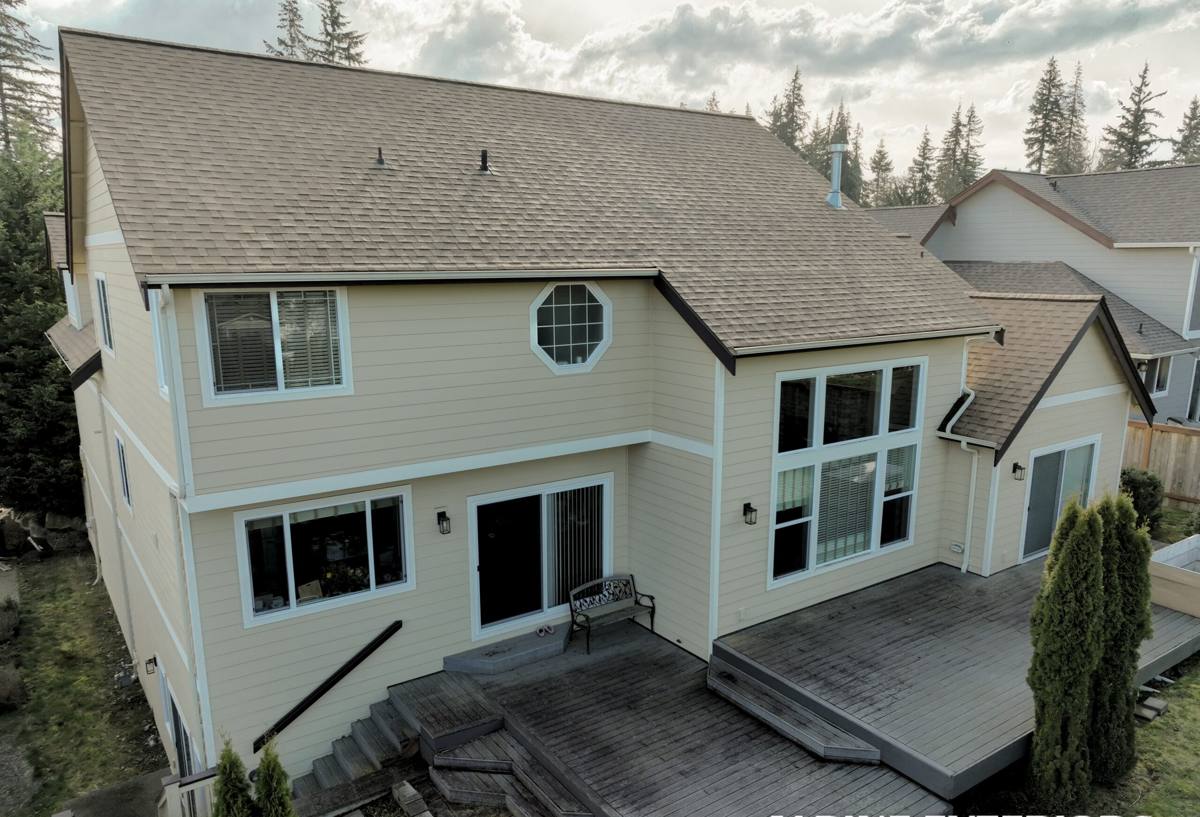
What "Correct" Installation Actually Means Here
Most siding failures we're called out to inspect on South Hill aren't material failures — they're installation shortcuts that a coastal, high-moisture climate eventually exposes. Getting this right isn't complicated, but it does require doing every step in order and not skipping the parts that don't show up in a final walkthrough.
Moisture Management Comes First
Before a single piece of siding goes up, the wall needs a continuous weather-resistive barrier, properly lapped and taped, with flashing integrated at every window, door, and penetration so water is directed out and down, never trapped behind the cladding. On a hillside home exposed to sustained wind-driven rain, a gap in the flashing sequence at one window head is often the difference between a wall that stays dry for decades and one with hidden rot in ten years.
Fastening, Clearances, and Fit
Fiber cement siding has specific fastening patterns, nailing zones, and minimum clearances from grade, roof lines, and horizontal surfaces — all of which matter more in a climate where standing moisture and organic debris (needles, moss spores, leaf litter) accumulate faster than they would in a drier region. Butt joints need to be caulked and back-primed correctly; siding installed too tight to a roofline or deck invites the kind of chronic dampness that feeds moss and mildew growth long before it causes structural damage.
Why We Install Only James Hardie Fiber Cement
We've made a deliberate call not to install vinyl, LP SmartSide, Cemplank, Allura, primed spruce, or cedar siding, even though all of them have a place in the market and each does some things well. For a hillside neighborhood dealing with sustained moisture, salt air, and a long moss season, we've found the trade-offs on those products — moisture sensitivity at cut edges, coating maintenance cycles, or organic material that needs ongoing sealing and treatment — aren't worth it compared to what James Hardie's fiber cement system delivers when installed to spec.
Hardie's HZ5 product line is engineered for exactly this kind of climate: freeze-thaw cycling, sustained damp exposure, and coastal air. It's non-combustible, it doesn't swell or rot the way wood-based products can when moisture gets past the surface, and the factory-applied ColorPlus finish is baked on and warrantied against fading and peeling — which matters on a wall that's going to sit shaded and damp under tree cover for months of the year.
| Consideration | James Hardie Fiber Cement | Vinyl / Wood-Based Alternatives |
|---|---|---|
| Moisture behavior | Engineered fiber cement resists swelling, warping, and rot even with sustained dampness | Wood-based products can absorb moisture at cut edges or damaged coatings; vinyl can warp under heat and doesn't stop moisture behind it |
| Moss and algae resistance | Factory finish sheds and resists organic growth better on shaded, damp walls | Untreated or resealed wood surfaces feed moss growth faster in shaded, humid conditions |
| Salt air exposure | Non-corrosive, stable in coastal air over the long term | Coatings and finishes on some alternatives need more frequent renewal near salt air |
| Maintenance cycle | Occasional wash; ColorPlus finish is warrantied against peeling and fading | Field-applied finishes and wood substrates typically need repainting or resealing on a shorter cycle |
| Fire resistance | Non-combustible material | Combustible in the case of wood-based products |
This isn't a knock on the other products — they're built to a price point and a use case, and plenty of homes wear them fine for years. It's that once you've replaced enough siding on hillside, high-moisture lots, the pattern of what holds up and what doesn't becomes hard to ignore, and we'd rather stand behind one system we trust completely than install several we have reservations about.
Matching Siding to South Hill's Housing Stock
South Hill has a mix of older, established homes alongside newer construction, and a lot of the architectural character up here leans toward traditional lap siding, shingle-style accents, and detailed trim rather than flat modern panel work. Hardie's product lines cover that range — lap siding in varying exposures, shingle-profile panels for accent areas, and trim boards that hold a crisp painted or ColorPlus edge — so a replacement can match the existing character of the house instead of looking like an obvious patch job. Where a home has decorative trim or gable detailing worth preserving, we plan the siding layout around it rather than defaulting to the fastest install pattern.
How Our South Hill Installation Process Works
- On-site assessment — we look at existing siding condition, sheathing and moisture barrier state underneath (where accessible), tree cover and shade exposure, and drainage around the foundation.
- Scope and product selection — full tear-off is usually the right call when the underlying moisture barrier or sheathing needs attention, which is common on older Bellingham homes; we'll tell you plainly if we think an overlay would be a mistake.
- Weather barrier and flashing detail — installed and inspected before any siding goes up, with particular attention to window and door heads given the amount of driving rain South Hill walls take.
- Siding installation — Hardie panels or lap siding installed to manufacturer fastening specs, correct clearances from grade and roofline, and properly caulked and sealed joints.
- Trim, flashing, and final detail work — corners, trim boards, and penetrations sealed and finished to shed water rather than trap it.
- Walkthrough — we go over what was done, what to expect from the finish over the first year, and basic upkeep specific to your lot's sun and shade exposure.
Hillside lots sometimes mean tighter access, retaining walls, or slopes that change how we stage material and set up scaffolding — we account for that in scheduling rather than treating every job like it's on a flat, open lot.
Cost Factors Specific to a South Hill Project
Siding installation pricing depends on the same core factors everywhere — square footage, number of stories, trim complexity — but a few things come up more often on South Hill specifically and are worth planning for.
| Factor | Why It Matters on South Hill |
|---|---|
| Tear-off condition | Older homes with decades of moisture exposure sometimes need sheathing repair once old siding comes off, which affects both cost and timeline |
| Hillside access | Slopes, retaining walls, and tighter lot layouts can affect scaffolding and material staging |
| Tree cover and shade | Heavily shaded walls often show more hidden moisture damage than sun-exposed walls, which isn't always visible until tear-off |
| Trim and architectural detail | Homes with decorative trim, multiple gables, or shingle accents take more labor than a simple lap-siding box |
| Number of stories | Taller hillside homes with view-oriented upper floors add access and safety requirements |
We give a firm, itemized quote after the on-site assessment rather than a rough estimate over the phone, because the tear-off condition on an older South Hill home is genuinely hard to predict without looking at the wall.
Living With the Finish: Maintenance in a Salt Air and Moss Climate
Correctly installed Hardie siding is low-maintenance, not no-maintenance. In a climate with this much moisture and organic growth pressure, a little seasonal attention goes a long way toward protecting the finish and catching problems early.
- Rinse siding down at least once a year, more often on shaded, north-facing walls where moss and algae build up fastest.
- Keep gutters clear so overflow doesn't run down the siding face or pool at the base of a wall.
- Keep vegetation and tree branches trimmed back from siding so walls get more sun and air movement, which slows moss growth.
- Check caulking at trim joints, windows, and corners annually — sealant is the first thing to wear, well before the siding itself.
- Watch for moss or debris buildup at the base of walls and in any horizontal trim ledges, since that's where moisture tends to sit longest.
- After major windstorms, do a quick visual check for loose trim or panels rather than waiting for the next scheduled look.
Why Hiring a Local Crew Matters for a South Hill Home
A siding crew that only occasionally works in Whatcom County will install to the same generic spec everywhere. A crew that works South Hill regularly knows which walls on a hillside lot take the worst of the wind-driven rain, understands how much shade and moss pressure a given exposure gets, and has already worked through the local permitting process for exterior work in Bellingham. That local knowledge shows up in small decisions — where to add extra flashing attention, how tight to keep clearances near grade on a sloped lot, which sides of the house need the most attention to trim sealing — that a generic install wouldn't necessarily catch.
It also matters for accountability. A local crew is easy to reach if a question comes up two years after the install, and we're not going anywhere — we live and work in this county, and we'd rather build a reputation on installs that hold up here than chase volume with shortcuts.
Get a Straight Answer on Your South Hill Siding Project
If your South Hill home's siding is showing moss, staining, warping, or you're just planning ahead, we're happy to take a look and give you a straightforward, no-pressure estimate — including whether a full replacement even makes sense yet, or whether targeted repairs would hold you over. Use the form below to get started.