 Bellingham
 Why Cordata Siding Takes More Punishment Than It Looks Like
Cordata sits on the north side of Bellingham, close enough to Bellingham Bay and the Puget Sound shoreline that homes here deal with a slightly salty, damp air year-round — not the fog-and-corrosion conditions you'd get right on the waterfront, but enough salt content in the air to accelerate rust on fasteners, trim, and any siding material that isn't built to shrug it off. Add in Whatcom County's driving, wind-pushed rain — storms here rarely fall straight down, they come in sideways off the water and find every gap in flashing, trim, and caulk joints — and you've got a climate that's actively working against whatever's on the outside of your house.
Then there's moss. Bellingham's long, mild, wet fall-through-spring stretch means shaded walls, tree-lined lots, and north-facing elevations stay damp for months at a time. That's exactly the environment moss and algae need to take hold, and once they're established on a siding surface they hold moisture against it, which speeds up whatever decay process was already underway. None of this means Cordata homes are doomed to constant repairs — it means the material and the workmanship matter more here than they would in a drier climate, and repairs need to actually address the moisture, not just cover it up.
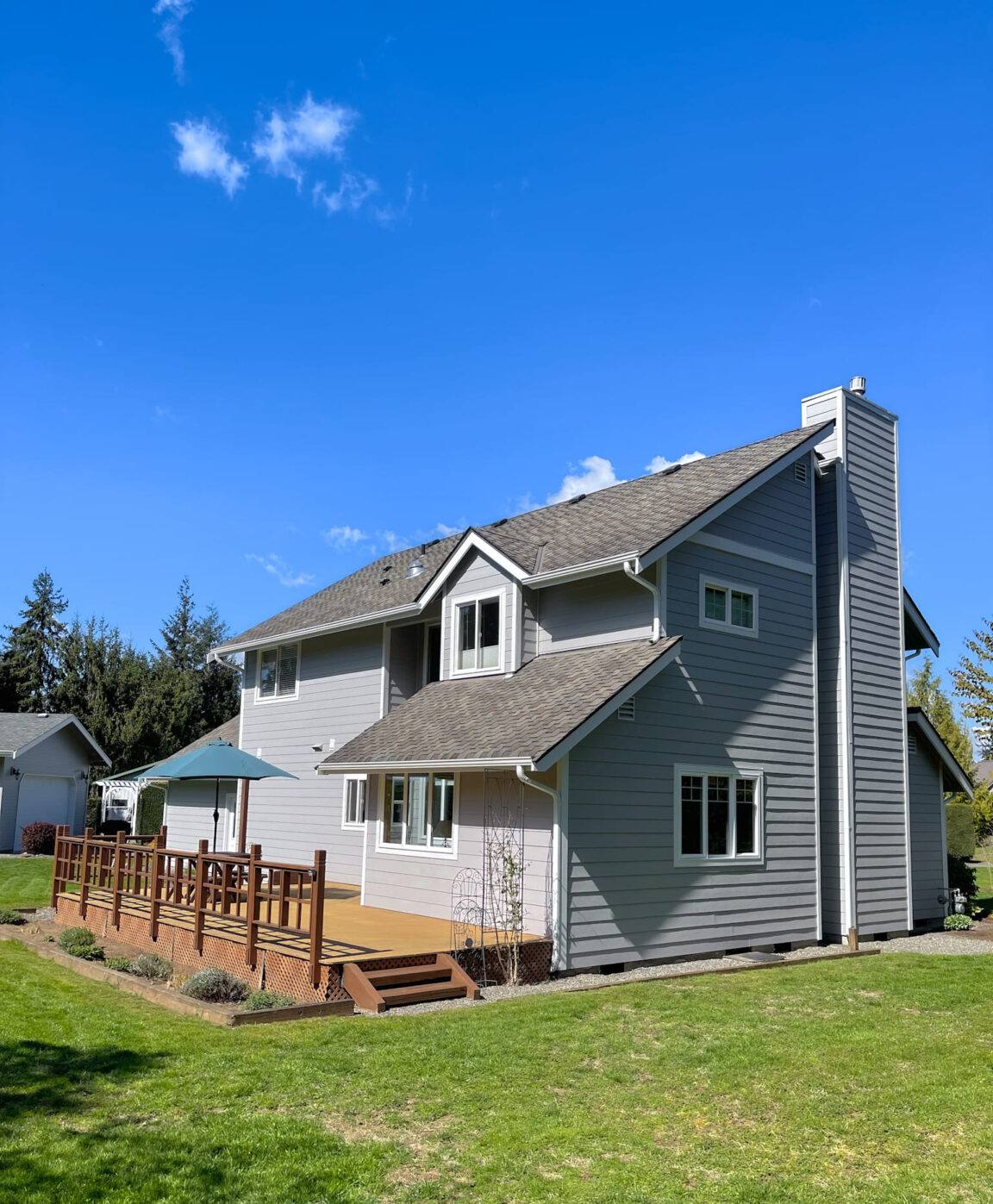
The Siding Problems We Actually See on Cordata Homes
Most repair calls in this neighborhood fall into a handful of categories, and almost all of them trace back to moisture finding a way in and staying there longer than it should.
Moss and Algae Staining
Dark streaking on shaded or tree-covered walls is usually the first visible sign. On its own it's mostly cosmetic, but moss holding water against a seam or a fastener for months at a time is how small problems become bigger ones.
Swelling, Buckling, or Delamination
Engineered wood and some composite sidings absorb moisture at cut edges and fastener points, then swell, bow, or separate in layers. Once a board has swollen it doesn't shrink back — that section needs to come out.
Cracked or Failed Caulking
Caulk joints around trim, windows, and panel seams are a wear item, not a permanent seal. In a climate with this much wind-driven rain, a failed joint is an open invitation for water to get behind the siding.
Rust Staining and Fastener Corrosion
Salt-influenced air speeds up corrosion on nails, screws, and metal trim. Rust streaks below a fastener line are a sign the fastener itself is failing, not just a stain to be cleaned off.
Hidden Rot Behind the Surface
The most serious issues aren't visible at all until siding is pulled back — soft or discolored sheathing, saturated house wrap, or framing that's been absorbing moisture for a long time. This is why a proper repair starts with more than a visual look at the outside.
What a Correct Siding Repair Actually Involves
A repair that only replaces the damaged board and repaints over it isn't a repair — it's a temporary patch that hides the symptom while the cause keeps working. A correct repair has three parts, in order.
1. Find the Water's Actual Path
Damage on the siding surface almost never lines up perfectly with where water is actually entering. A stain three feet below a window is often being fed by a flashing gap above it. Before anything gets removed, we trace where water is getting behind the cladding — not just where it shows up.
2. Repair What's Underneath, Not Just What's Visible
If the sheathing, house wrap, or framing behind the damaged siding has been compromised, that gets addressed before a single new board goes on. Reinstalling siding over wet or rotten substrate just restarts the clock on the same failure.
3. Match the Replacement Correctly
Profile, exposure, and finish all need to match the surrounding siding, or the repair sticks out and creates a new weak seam. This is one of the reasons material choice matters even on a "small" repair — mismatched or incompatible materials rarely blend in and can create new water paths where old and new meet.
Repair or Replace? How We Help You Decide
Not every damaged wall needs a full re-side, and not every problem is fixable with a patch. The honest answer depends on how much of the house is affected and how far the underlying moisture damage has spread. Here's roughly how the decision breaks down, with broad cost ranges to set expectations — every home is different, so a firm number comes from an actual inspection.
| Repair Scope | What's Typically Involved | Rough Cost Range |
|---|---|---|
| Small, isolated spot (a few boards) | Remove and replace damaged boards, correct fasteners, reseal and touch up finish | $300 – $800 |
| One wall section or elevation | Multiple boards, trim repair, flashing correction, color/profile matching | $800 – $2,500 |
| Larger repair with hidden damage | Sheathing or house wrap replacement behind several sections, extensive board replacement | $2,500 – $6,000+ |
| Damage spread across most of the home | Often more cost-effective — and longer-lasting — to reside the affected elevations than patch repeatedly | Full replacement quote |
If we get on a roof or pull a section of siding and find the damage is more widespread than expected, we'll tell you before doing extra work — not after the invoice.
Why We Repair and Replace with James Hardie — Even on Patch Work
This company installs only James Hardie fiber cement siding. We don't carry vinyl, LP SmartSide, primed spruce, cedar, or other fiber cement brands, and that standard applies to repair work too, not just full re-sides. When a section of Hardie siding needs replacing, factory ColorPlus finish boards from the correct product line let us match color and texture closely, and fiber cement doesn't absorb water the way wood-based or engineered-wood products can, which matters enormously in a climate where damp conditions can sit against a wall for weeks.
When we're called out to repair a home that has vinyl, LP SmartSide, or another material we don't install, we'll still diagnose the problem honestly and tell you what's going on. For a small, isolated repair where matching material is available, a like-for-like patch is often the practical short-term answer. But if the damage is from a pattern we see repeatedly with that material in this climate — moisture absorption at cut edges, panel warping, repeated caulk failure — we'll say so plainly, and if a section is bad enough to warrant more than a patch, our recommendation is to bring that wall over to Hardie rather than replace failing material with more of the same. That's not a sales pitch; it's the same standard we hold for every home we work on.
Our Process for a Cordata Siding Repair Call
- Inspection and moisture check: We look at the visible damage and check surrounding areas — moisture rarely stays contained to one spot.
- Diagnosis and written scope: You get a plain explanation of what's actually wrong, what caused it, and what fixing it involves — before any work starts.
- Sourcing matched materials: For Hardie repairs we source the correct ColorPlus-matched boards for your home's existing line and color.
- Removal and correction: Damaged material comes out, any compromised sheathing or flashing gets corrected, and the cause of the failure — not just the symptom — gets addressed.
- Replacement and finish: New siding goes in to manufacturer spec, with proper fastening, clearances, and sealant at seams and penetrations.
- Cleanup and walkthrough: We clear debris and walk the repair with you so you know what was done and why.
Checklist: Signs Your Cordata Home Needs a Siding Repair Inspection
- Dark green, black, or gray streaking on shaded or tree-covered walls
- Boards that feel soft, spongy, or visibly bowed when pressed
- Cracked, shrunken, or missing caulk at trim, corners, or window edges
- Rust streaks running down from nail or screw heads
- Paint that's peeling, bubbling, or failing in one specific area rather than evenly
- A musty smell near an exterior wall, especially after a stretch of rain
- Visible gaps, warping, or separation at panel seams
- Interior wall staining or peeling paint on the wall opposite a suspect exterior section
Why a Crew That Already Works in Cordata Matters
Siding repair isn't one-size-fits-all, and a crew that regularly works this part of Bellingham has already seen how the neighborhood's mix of tree cover, lot orientation, and exposure to wind-driven rain off the bay plays out on real houses. That's useful in practice: knowing which elevations in this area tend to take the brunt of southwest storms, recognizing moss patterns that come from shaded, low-airflow spots between houses, and having a working sense of how different construction eras in the neighborhood were originally sided and flashed. It also means fewer surprises on scheduling and materials — we keep working relationships with Hardie suppliers so a color-matched repair doesn't sit waiting on a special order longer than it needs to.
Keeping Repaired Siding Healthy Long Term
A good repair should be the last time that section of wall gives you trouble, but a little seasonal attention goes a long way in this climate. Keep gutters and downspouts clear so roof runoff isn't dumping extra water down a wall face. Trim back vegetation that's shading a wall and killing airflow — that's the single biggest thing you can do to slow moss growth. Do a walk-around after the first hard rains of fall and again at the end of the wet season, looking for the same signs listed above. And don't let a small caulk crack or a loose piece of trim sit for a full winter — in a climate this wet, small gaps don't stay small.
If you're seeing any of the signs above on a home in Cordata, we're happy to take a look and give you a straight answer on what's going on and what it would take to fix it — no pressure, no upsell, just an honest assessment. Use the form below to request a free estimate.