 Bellingham
 Why Edgemoor Homes Ask More of Their Siding
Edgemoor sits close to Bellingham Bay, on wooded, bluff-adjacent ground south of downtown, and that setting is exactly why siding here fails differently than it does inland. Homes get a steady dose of salt-laden air off the water, wind-driven rain that hits walls at an angle instead of just falling straight down, and heavy tree cover that keeps north- and west-facing walls shaded and damp for long stretches of the year. None of that is unusual for Whatcom County, but Edgemoor tends to get a concentrated version of it: waterfront exposure plus mature tree canopy in the same neighborhood.
That combination shows up as three distinct wear patterns on older siding: salt-air corrosion on fasteners and trim, paint and caulk failure from repeated wetting and drying, and moss or algae colonies on shaded walls and horizontal trim that hold moisture against the substrate. Any one of those speeds up decay. Together, they're why we see siding on Edgemoor homes failing years ahead of the same product installed on a dry, sunny lot elsewhere in Bellingham.
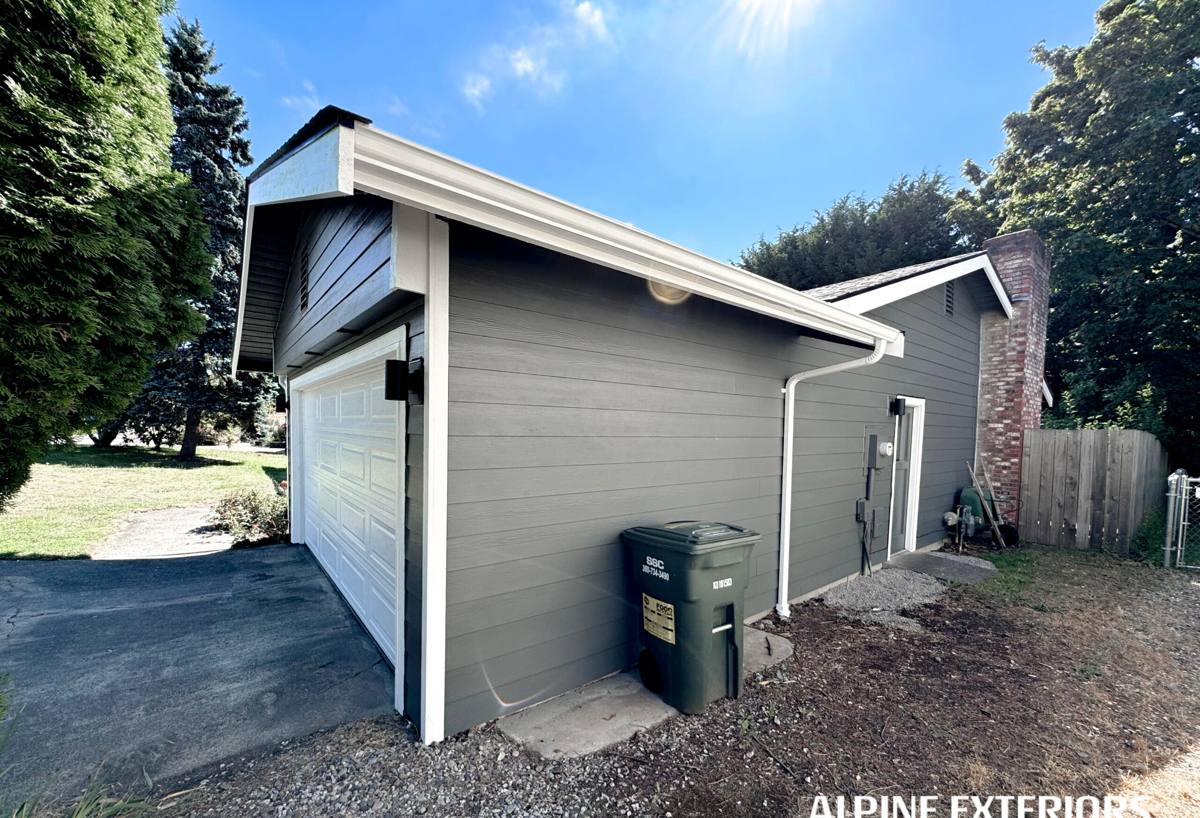
What's Usually Happening Underneath
By the time siding looks bad from the street — cupping boards, peeling paint, dark streaking, soft spots — there's almost always something going on behind it. On the older homes common in this part of Bellingham, that's typically one or more of the following:
- Original building paper or an aging weather-resistive barrier that has degraded past its useful life
- Sheathing that's absorbed moisture at seams, corners, or window openings and started to soften
- Flashing at windows, doors, and roof-to-wall intersections that was adequate when installed but was never designed for today's rain loads
- Siding installed tight to the wall with no drainage gap, so any water that gets behind it has nowhere to go
This is why we don't treat siding replacement as a cosmetic swap. Pulling the old siding is also the one chance to find and fix what's happening behind it before it turns into a structural repair.
What a Correct Siding Replacement Involves
Tear-off and inspection
We remove the existing siding down to the sheathing and inspect every wall plane — not just the sections that looked obviously bad from the outside. Moss and staining patterns on the old siding usually point to exactly where moisture has been getting in, so those areas get the closest look.
Sheathing and structural repair
Any soft, delaminated, or rotted sheathing gets cut out and replaced before anything new goes back on. Covering damaged sheathing with new siding just hides the problem for a few more years — it doesn't fix it.
Weather-resistive barrier and flashing
A new, code-compliant weather-resistive barrier goes on with properly lapped and sealed seams. Flashing at windows, doors, decks, and roof intersections gets rebuilt so water is directed out and away from the wall assembly, not just sealed with caulk and hoped for.
Rainscreen gap
Given how much wind-driven rain and shaded moisture Edgemoor walls deal with, we install with a drainage gap between the siding and the water-resistive barrier wherever the wall assembly allows it. That gap lets any water that does get past the siding drain and dry out instead of sitting against the substrate — it's one of the biggest differences between a siding job that lasts 10 years and one that lasts 40.
Installation to manufacturer spec
Fastener type, spacing, clearances at grade and roof lines, and caulking at butt joints all follow the manufacturer's published installation instructions, not shortcuts. This is also where warranty coverage is won or lost — most fiber cement warranty claims that get denied trace back to installation that didn't match spec, not a defect in the product itself.
Why We Install Only James Hardie Fiber Cement
We standardized on James Hardie fiber cement siding for every job we do, and Edgemoor's conditions are a good example of why. Fiber cement doesn't rot, and it isn't a food source for the moss and mildew that thrive in a shaded, damp environment the way wood-based products can be. It's also non-combustible, which matters to insurers and to homeowners thinking about wildfire-season smoke and ember exposure even on the wet side of the state.
Hardie's ColorPlus finish is baked on at the factory under controlled conditions, which gives it better fade and moisture resistance than field-applied paint — a real advantage on walls that spend half the year damp from shade or salt spray. Hardie also engineers specific product lines for different climate zones (their HZ5 and HZ10 formulations), so the material itself is built to handle the moisture cycling this coastal climate puts it through, rather than a one-size-fits-all board being asked to perform in conditions it wasn't designed for.
We get asked why we don't also install vinyl, LP SmartSide, cedar, or primed wood siding. Each of those products has real strengths, but each also comes with a trade-off we're not willing to build a reputation on: vinyl can warp and doesn't hold up structurally over decades the way fiber cement does; engineered wood products are more sensitive to sustained moisture exposure at cut edges and seams; and cedar or primed wood need a maintenance commitment — regular refinishing — that most homeowners underestimate until the siding is already showing it. Hardie's transferable warranty and track record in wet coastal climates are why it's the only product we put our name behind.
Siding Materials Side by Side for Edgemoor Conditions
| Material | Moisture/rot resistance | Moss/algae resistance | Maintenance | Typical lifespan here |
|---|---|---|---|---|
| James Hardie fiber cement | Does not rot; stable in wet-dry cycling | Not an organic food source; cleans up easily | Occasional wash; no refinishing needed | 30+ years with correct install |
| Vinyl siding | Doesn't rot, but can warp/crack with age and temperature swings | Can trap moisture behind panels if installed tight | Low, but panels aren't repairable individually if damaged | 15-25 years |
| LP SmartSide / engineered wood | Good if sealed edges stay intact; vulnerable if compromised | Moderate; wood-based substrate | Periodic caulk/paint upkeep at seams and edges | 15-25 years |
| Cedar / primed wood | Natural resistance varies; needs sealed finish to perform | Susceptible without regular treatment | Refinishing every few years | Highly maintenance-dependent |
Our Process, Start to Finish
- On-site assessment — we walk the whole exterior, not just the visibly bad sections, and check for moisture, past repairs, and shaded/high-exposure walls
- Written scope and estimate — what's being replaced, what sheathing repair is anticipated versus what might be found once we open the walls, and material selection
- Tear-off — old siding removed and hauled off, sheathing exposed for inspection
- Repair — any damaged sheathing, framing, or flashing addressed before new materials go on
- Weather barrier, flashing, and rainscreen installation — the layer that actually keeps water out, done right
- Hardie siding installation — installed to manufacturer spec for fastening, clearances, and joint treatment
- Final walkthrough — we review the finished work with you before calling the job done
What Drives Cost on an Edgemoor Job
Every home is different, but a few factors consistently move the price on siding replacement in this neighborhood:
| Factor | Why it matters here |
|---|---|
| Sheathing condition | Homes with long-term moisture exposure often need more sheathing replaced than what's visible from outside before tear-off |
| Wall height and access | Bluff-adjacent lots and multi-story homes often need staging or lift access, which affects labor time |
| Tree canopy and moss buildup | Heavily shaded walls may need extra prep to remove growth and address the moisture it's been trapping |
| Trim and detail work | Older homes often have more window and corner trim detailing to match or replace |
| Siding profile and color | Lap width, panel vs. plank style, and ColorPlus color selection affect material cost |
Why Local Experience in Edgemoor Specifically Matters
A crew that's already worked this neighborhood knows what to expect before the tear-off even starts. That means recognizing which wall orientations are most likely to have moss-driven moisture damage, understanding how salt air has typically affected fasteners and trim on homes of a certain age, and being realistic about access on wooded or sloped lots without it turning into surprise change orders. It also means being familiar with Bellingham's permitting expectations for exterior work, so the job doesn't stall on paperwork.
That familiarity doesn't replace inspecting your specific home carefully — every property still gets assessed on its own — but it means fewer surprises and a more accurate estimate from the start.
A homeowner's quick prep checklist
- Note any walls with visible moss, dark streaking, or peeling paint — flag them for the estimator
- Point out any past water intrusion, even minor, near windows or at the roofline
- Clear access around the house where staging or ladders will need to go
- Ask what sheathing repair contingency is included in the estimate versus billed if discovered
- Confirm the siding warranty is registered in your name after installation
Keeping New Siding Performing Long-Term
Correctly installed Hardie siding needs far less upkeep than wood-based alternatives, but a couple of habits go a long way in this climate: keep tree limbs trimmed back from walls to reduce shade and moss buildup, and rinse off any accumulated grime or salt residue on exposed walls once or twice a year. Beyond that, there's no refinishing schedule to maintain — the ColorPlus finish is built to hold up without it.
If your Edgemoor home's siding is showing its age — moss, staining, soft spots, or paint that won't hold anymore — we're glad to come take a look and give you a straightforward, no-pressure estimate for what a proper replacement would involve.