 Bellingham
 Deck Repair Built for South Hill's Weather
South Hill sits above the rest of Bellingham, which means more exposure to wind-driven rain and salt-tinged air moving in off Bellingham Bay. That combination is hard on decks. Wood fiber swells and contracts with every wet-dry cycle, fasteners corrode faster near the coast, and moss finds a foothold on any surface that stays damp for more than a day or two. If you own a deck on South Hill, you're not dealing with generic "deck aging" — you're dealing with a specific climate pattern, and repairs done without that in mind tend to fail again within a few seasons.
We work on decks throughout Whatcom County, but South Hill's mix of elevation, tree cover, and older housing stock gives it its own repair profile. Steep lots mean more decks built over sloped ground with limited airflow underneath. Mature trees mean more shade, more leaf litter, and slower drying times. Older homes mean original ledger boards, fasteners, and footings that were never built to current code.
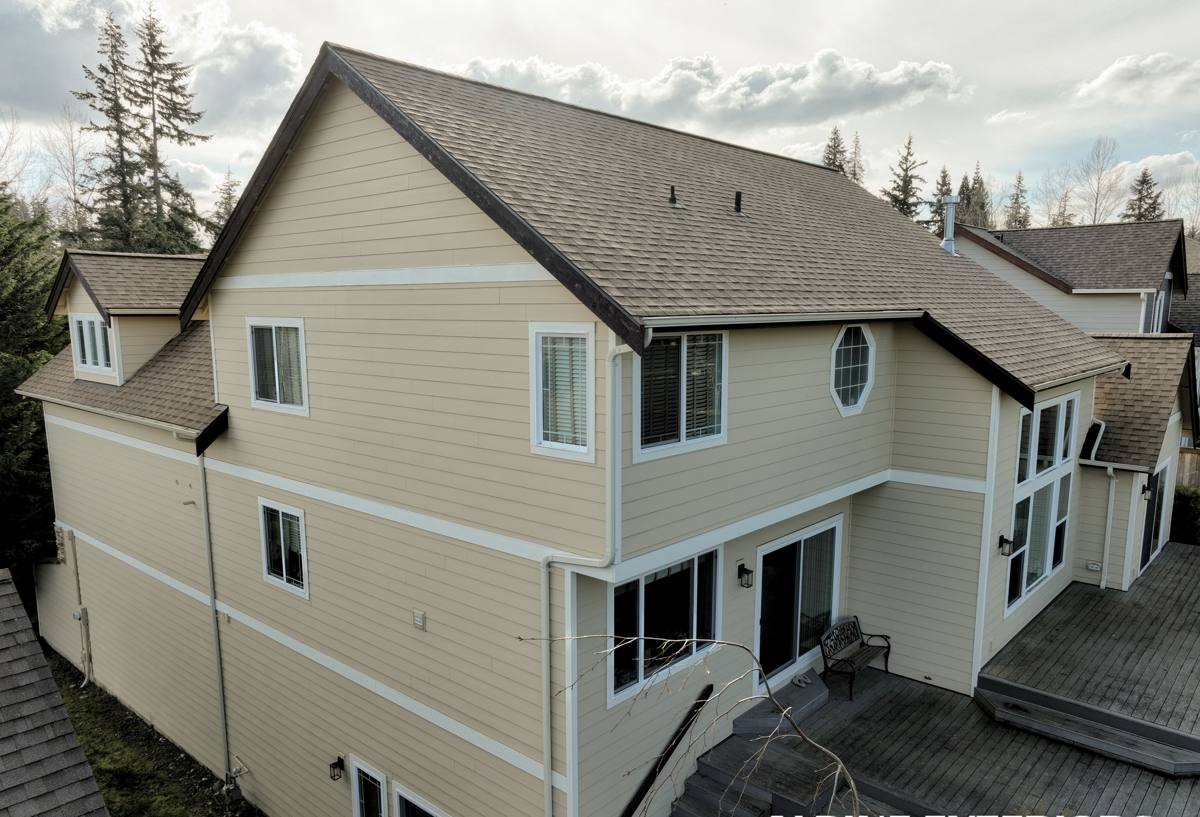
What Actually Fails on a Bellingham Deck
Before any repair, we look for the actual failure point rather than just patching the symptom. In this climate, the same handful of issues show up again and again.
Ledger Board and Rim Joist Rot
The ledger board — where the deck attaches to the house — is the single most important structural connection on most decks, and it's also the piece most exposed to trapped moisture. Old or missing flashing lets water run behind the siding and sit against the ledger. By the time you see soft or discolored wood at that joint, the rot has usually been progressing for a while.
Post Base and Footing Deterioration
Posts set directly in soil, or footings without proper standoff hardware, wick moisture up into the base of the post. On sloped South Hill lots, water also tends to collect and run toward downhill support posts, accelerating the problem on one side of the deck before the rest.
Moss, Algae, and Surface Decay
Shaded, north-facing, or tree-covered decks in this area grow moss fast — often within a single wet season. Left alone, moss holds moisture against the decking boards around the clock, which softens the wood surface and eventually opens the door to rot, especially around fastener holes and board ends.
Fastener and Hardware Corrosion
Standard or mismatched fasteners corrode faster in a marine-influenced climate. Rust streaking around screw heads, loose railings, or a deck that feels slightly "springy" underfoot are common signs that hardware has degraded faster than the wood around it.
Railing and Guard Post Movement
Guard posts take a lot of lateral load, and if the blocking behind them was ever undersized or the wood around the bolts has softened, you'll feel it as wobble. This is a safety issue, not just cosmetic, and it's one of the more common reasons we get called out.
Repair vs. Rebuild: How We Decide
Not every problem deck needs to be torn out. We assess condition, not age — a 20-year-old deck with solid framing and localized surface rot can often be repaired for a fraction of rebuild cost, while a newer deck with a rotted ledger connection or failing footings may need more invasive work regardless of how it looks on top.
| Condition | Typical Fix | What Drives the Decision |
|---|---|---|
| Isolated soft boards, no structural involvement | Board replacement | Framing underneath probes solid, decay hasn't spread to joists |
| Moss/algae staining, surface only | Clean, treat, reseal | Wood fiber underneath the discoloration is still sound |
| Ledger board soft or separating | Ledger repair/replacement with proper flashing | Structural connection to the house is compromised — not optional |
| Post base rot or missing standoff hardware | Post base repair, hardware upgrade | Support system integrity, especially on sloped lots |
| Railing wobble at guard posts | Blocking and fastener repair, or post replacement | Direct safety issue — code minimum load resistance |
| Widespread rot across multiple framing members | Partial or full rebuild | Repair cost approaches or exceeds rebuild cost |
Our Process on a South Hill Deck Repair
- On-site assessment. We walk the whole structure — decking, framing, ledger connection, posts, footings, and railings — and probe suspect wood rather than guessing from the surface.
- Honest scope of work. You get a plain-language explanation of what's failing, what's still sound, and what your real options are, in writing.
- Moisture source correction. We fix the reason the deck failed in the first place — usually flashing, drainage, or grading — not just the board that rotted because of it.
- Structural repair first. Ledger, framing, and post issues get addressed before any cosmetic work, since surface repairs on a compromised structure don't hold.
- Materials matched to the climate. Fasteners, flashing, and treated lumber selected for wet-climate performance, not just lowest cost.
- Final walkthrough. We show you what was done and what to keep an eye on going forward.
Materials: What We Use and Why
Material choice on a deck repair is a set of trade-offs, not a single "best" answer. Pressure-treated lumber is the standard for framing and is cost-effective, but it still needs proper flashing and airflow to perform in this climate — treatment slows decay, it doesn't stop it if water is trapped against the wood. Composite and PVC decking resist moss and rot better on the surface but have their own installation sensitivities around spacing, fastening, and substrate flatness, and repairs to composite boards need matching material, which isn't always available for older product lines. Cedar has natural rot resistance and a look a lot of South Hill homeowners want, but it's a softer wood that needs more regular sealing to keep performing in a wet, shaded lot.
Our standard is to match the repair material to the existing deck where that makes sense, and to recommend an upgrade only where the original material or hardware was clearly undersized for a marine-climate location — not because a manufacturer told us to sell it.
Fastener and Hardware Standards We Hold To
- Stainless steel or high-grade coated fasteners rated for treated lumber and coastal exposure
- Structural post base and joist hangers sized to current code, not just "what was there before"
- Self-adhering or metal flashing at every ledger and post-to-deck connection
- Standoff hardware keeping post bases off grade and out of standing water
- Guard post blocking sized to resist real lateral load, not just visual attachment
Moss and Drainage: The Maintenance Side of the Problem
A repair that doesn't address drainage and moss growth is a repair you'll be paying for again. Whatcom County's long wet season and Bellingham's tree cover mean moss isn't a one-time cleanup — it's an ongoing condition that needs to be managed. Part of a proper repair on a shaded or sloped South Hill lot includes making sure water actually moves off the deck surface and out from underneath it, and that any adjacent grading or gutter runoff isn't dumping extra water onto the structure.
We also look at what's above and around the deck. Overhanging branches that keep boards shaded and damp, gutters that discharge directly onto the deck surface, and low spots in the yard that push water back toward posts are all things we'll flag even if they're outside the scope of the repair itself.
A Homeowner's Quick Inspection Checklist
Between professional inspections, these are worth checking yourself, especially heading into or coming out of the wet season:
- Press a screwdriver into decking boards near fastener holes and board ends — sound wood resists, soft wood gives easily
- Check the ledger board area at the house for staining, gaps, or soft spots
- Look at post bases for green or black staining, softness, or standing water nearby
- Grab railings and posts and check for any movement or flex
- Note any spots where moss or algae stays green and damp longer than the rest of the deck
- Check flashing and caulking at the ledger for cracking or separation
Why a Local Crew Matters Here
Deck repair advice that works in a dry climate can actively cause problems in Bellingham. A crew unfamiliar with the region might seal a deck too early in the season, trapping moisture underneath fresh finish, or use standard-grade fasteners that look fine for a year and then start rusting through. We work South Hill and the surrounding Bellingham neighborhoods regularly enough to know which lots hold water longest, which framing details fail first in this climate, and which materials genuinely hold up against year-round rain and moss pressure versus which just look good on installation day.
That local pattern recognition is what shortens the assessment and keeps the repair from being guesswork. It's also why we can tell you honestly when a deck needs a full rebuild versus when a targeted repair will genuinely hold — because we've seen how both outcomes actually perform a few winters later, not just at handoff.
Get a Straight Answer on Your Deck
If you're dealing with soft boards, a wobbly railing, or a deck that's just never quite dried out the way it should, we're happy to take a look and tell you plainly what's going on. Use the form below to request a free, no-pressure estimate for your South Hill deck repair.