 Bellingham
 Why Sudden Valley Asks More of a Roof
Sudden Valley sits in a pocket of Whatcom County that gets its own version of our regional weather. The lake holds humidity in the air longer than you'd get a few miles into town, the tree canopy over most lots keeps roofs shaded and damp well after a storm has passed, and the same marine-influenced weather pattern that brings driving rain off the water to greater Bellingham reaches the valley too. None of that is dramatic on its own. Added together over years, it's exactly the combination that shortens the life of a roof that isn't detailed correctly, and it's why we treat a Sudden Valley metal roof differently than one going on a dry, open lot elsewhere in the county.
A metal roof handles this environment well when it's installed right. It handles it poorly when it isn't. The metal itself is rarely the weak point — the flashing, the underlayment, and the fastening pattern are where a correct install and a corner-cut install go different directions over ten or fifteen years.
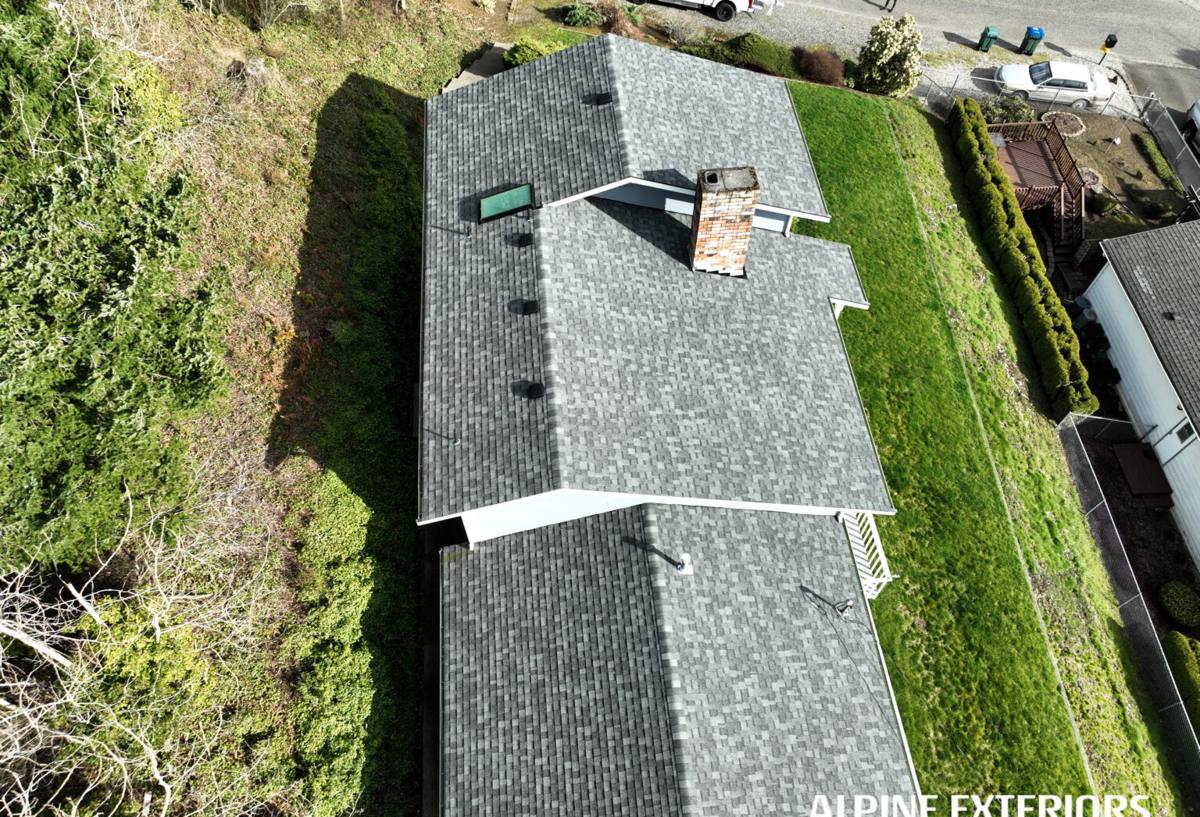
What This Climate Actually Does to a Roof
Moss and organic growth
Heavy tree cover means needle and leaf litter collecting in valleys, around penetrations, and along low-slope transitions. Wet organic debris sitting against any roofing material for months at a time is a slow, steady problem — it holds moisture against the surface, and on shaded north-facing sections it can support moss growth even on metal, particularly at seams and fastener heads where debris tends to bank up.
Driving rain and wind-driven moisture
Rain that comes in sideways during a windstorm doesn't behave like rain falling straight down. It gets pushed up under shingle laps, into open seams, and around poorly flashed penetrations. Metal roofing has an advantage here because a properly seamed panel system sheds wind-driven rain far better than lapped materials, but only if the seams, ridge caps, and flashing details are actually built for it.
Long wet season, short dry window
Whatcom County's install season is real — there's a stretch of the year when conditions are dry and stable enough to do the work properly, and a much longer stretch when they aren't. Underlayment that's rated for extended exposure and a crew that plans around the weather window matters more here than in drier parts of the state.
What a Correct Metal Roof Install Involves
A metal roof is a system, not just a panel. Skipping or downgrading any one part of it undermines the rest.
Underlayment
Synthetic underlayment rated for extended UV and moisture exposure goes down first, with self-adhered ice-and-water membrane at eaves, valleys, and any low-slope transitions where standing water or ice damming could occur. This is the roof's backup layer if wind ever drives water past the panel seams — it should never be treated as an afterthought.
Fastening and panel layout
Exposed-fastener panels rely on gaskets and correct torque at every screw; over-driven or under-driven fasteners are one of the most common causes of early leaks. Standing seam systems use concealed clips instead, which avoids putting holes in the panel field at all. Panel layout also needs to account for thermal movement — metal expands and contracts with temperature swings, and a system that doesn't allow for that will eventually work fasteners loose or oil-can the panel surface.
Flashing and penetrations
Chimneys, vents, skylights, and valleys are where the vast majority of roof leaks actually start, on any roofing material. Custom-bent flashing that matches the panel profile, proper step flashing at walls, and sealed (not just caulked) penetrations are non-negotiable in a wet climate.
Ventilation
A cold, well-ventilated attic under a metal roof reduces condensation risk and helps the roof shed moisture from underneath as well as from above. In heavily shaded, humid lots like much of Sudden Valley, attic ventilation is part of the moisture strategy, not an optional upgrade.
Comparing Metal Roofing Options for This Environment
Not every metal roofing system performs the same way in a wet, shaded, tree-heavy setting. Here's how the common options stack up on the factors that matter most for Sudden Valley conditions.
| System | Moisture Performance | Moss/Debris Resistance | Typical Lifespan | Relative Cost |
|---|---|---|---|---|
| Standing seam (concealed fastener) | Best — no exposed fastener penetrations, seams mechanically locked | Smooth vertical seams shed debris well | 40-70 years | Higher |
| Exposed-fastener panel | Good if fasteners are maintained; gaskets degrade over time | Horizontal ribs can trap some debris | 25-40 years | Moderate |
| Metal shingle/shake profile | Good, more seams than standing seam | Textured profile can hold moss longer in deep shade | 30-50 years | Moderate to higher |
For heavily shaded, tree-covered lots that make up a lot of Sudden Valley, we generally steer homeowners toward standing seam when budget allows, specifically because it has the fewest places for moisture and debris to sit still. That's a maintenance and moisture-behavior judgment on our part, not a claim that the other systems are inadequate — they're solid choices too, and the right one still depends on your roof's slope, shade, and budget.
Cost Factors Worth Understanding
| Factor | Why It Moves the Price |
|---|---|
| Roof pitch and access | Steeper roofs and lots with limited driveway or lakeside access take longer and need more safety setup |
| Number of penetrations | Every vent, skylight, and chimney needs custom flashing labor |
| Tear-off vs. overlay | Removing old roofing adds cost but lets us inspect and fix the decking underneath |
| Panel gauge and finish | Heavier gauge steel and better paint systems (Kynar-type finishes) cost more up front and hold up longer |
| Tree cover management | Overhanging limbs sometimes need trimming before work starts to protect the new roof and the crew |
The Tree Cover Question
Sudden Valley's wooded lots are part of what makes the area appealing, but they're also the single biggest factor in how a roof there ages. Overhanging branches drop needles and debris continuously, keep sections of the roof shaded and damp, and occasionally drop limbs directly onto the roof during windstorms. We look at tree proximity as part of the estimate, not as a separate problem — recommending a limb trim-back isn't us upselling landscaping, it's a direct way to extend the life of the roof we're installing.
Our Process for a Sudden Valley Metal Roof
- On-site assessment — we look at slope, shade patterns, existing roof condition, and access before quoting anything
- Deck inspection — on tear-offs, we check the decking underneath for rot or soft spots before any new material goes down
- Underlayment and ice-and-water membrane — installed to current standards, with extra attention at valleys and low-slope sections
- Flashing fabrication — custom-bent on site to match your roof's actual penetrations rather than forced from stock pieces
- Panel installation — laid out and fastened (or clipped, for standing seam) to spec, accounting for thermal movement
- Ventilation check — confirming intake and exhaust airflow is adequate for the attic space
- Final walkthrough — we go over the completed roof and what maintenance, if any, it'll need
Keeping a Metal Roof Sound Once It's On
Metal roofing needs less upkeep than most materials, but "less" isn't "none," especially under a tree canopy.
- Clear needle and leaf debris from valleys and low points at least once or twice a year
- Keep gutters and downspouts flowing freely so water isn't backing up under the eave edge
- Trim back branches that overhang or touch the roof surface
- Watch for moss starting in shaded valleys or around fastener heads and address it early rather than letting it establish
- Have flashing and sealant at penetrations checked periodically — sealant is the one component that ages faster than the metal itself
- After major windstorms, do a visual check (from the ground is fine) for lifted panels or fallen debris
Why Local Experience in Sudden Valley Matters
Sudden Valley has its own quirks that a crew unfamiliar with the area has to learn on your dime: private road access, HOA considerations for exterior work and staging, driveways and lots with real grade to them, and lake-adjacent lots where drainage and runoff planning matter more than on a flat in-town lot. A crew that's already worked the area knows how to stage materials and equipment without blocking narrow roads, knows Whatcom County's permitting expectations, and isn't guessing at how the local weather window affects scheduling. That familiarity shows up as fewer surprises and fewer change orders once the work actually starts.
Get a Straightforward Estimate
If you're weighing a metal roof for a home in Sudden Valley, we're happy to take a look and give you an honest read on what your roof actually needs — no pressure, no inflated scope. Fill out the form below and we'll set up a time to come out and walk it with you.