 Bellingham
 Why Sudden Valley Roofs Take a Different Kind of Beating
Sudden Valley sits back in the trees along Lake Whatcom, and that setting cuts both ways. The tree canopy blocks a lot of direct wind, but it also means roofs here deal with things a roof out in the open doesn't: falling limbs, needle and cone buildup in valleys and gutters, and shade that never really lets a roof dry out between storms. Add in Whatcom County's long wet season, the driving rain that comes with each windstorm, and the moist air moving off the lake, and you get roofs that hold moisture longer, grow moss faster, and take damage in ways that are easy to miss from the ground.
We've worked on enough roofs in this community to know the pattern: it's rarely one big dramatic storm that takes out a whole roof. It's usually a series of smaller hits — a windstorm that lifts a few tabs, a branch that comes down in a wind event, months of moss holding water against the shingle mat — that add up until a leak finally shows up inside the house. A crew that treats every call as a one-off inspection misses this pattern; we look at the roof's overall history, not just the spot that's actively dripping.
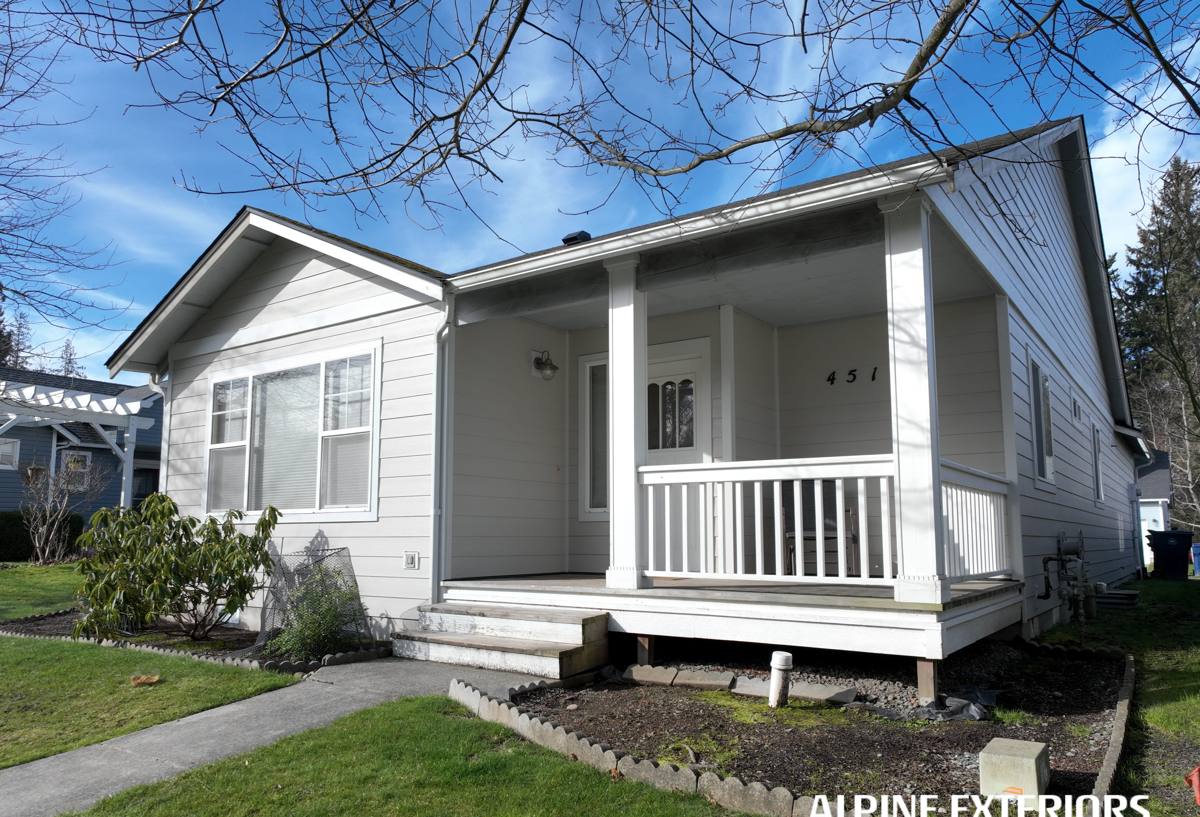
What Storm Damage Actually Looks Like on a Sudden Valley Roof
Wind-Lifted and Torn Shingles
Whatcom County doesn't see hurricane-force wind, but it does see repeated windstorms with gusts strong enough to break a shingle seal, especially on roofs that back up to clearings or sit near the top of a slope where wind funnels off the lake. Once that seal breaks, the shingle can lift every time the wind picks up again, even on an otherwise calm day, and each lift works the nail holes a little looser.
Impact Damage from Falling Limbs and Debris
Homes tucked under mature conifers are more likely to take a hit from a falling branch than homes in open subdivisions. A limb doesn't have to be large to crack a shingle, punch through underlayment, or knock loose a section of flashing. That damage is often small and localized — good news for the repair, bad news for spotting it before it leaks.
Moss, Needle Buildup, and Slow Leaks
This is the damage that isn't caused by any single storm, but by the season between storms. Shaded, north-facing slopes and roofs under heavy tree cover hold onto moisture far longer than a roof in full sun. Moss roots into the shingle surface, lifts tabs at the edges, and holds water against the mat through the wet months. Needles and cone debris pack into valleys and behind chimneys, backing up water until it finds a way under the shingles instead of off the roof.
What a Correct Storm Damage Repair Actually Involves
Inspection Before Anything Gets Fixed
A repair that starts with a patch and skips the inspection almost always ends up as a callback. Before we touch anything, we get eyes on the whole roof plane — not just the spot that's leaking — because wind and impact damage rarely stays confined to one shingle. We check the decking underneath for soft spots, the underlayment for tears, and the flashing at every penetration for movement.
Matching Materials and Getting the Flashing Right
Patch repairs fail most often at the transitions — where new shingles meet old, where flashing meets shingle, where a valley meets a sidewall. Matching the shingle profile and color is part of it, but the bigger issue is the water path: every course has to shed onto the one below it, and every flashing detail has to be rebuilt correctly, not just sealed over. Caulk is not a flashing repair; it's a temporary stall that fails within a season or two in a climate this wet. It's also worth checking that ridge vents and other roof ventilation weren't compromised in the same event — wind strong enough to lift a shingle can just as easily crack a ridge vent baffle, and a repair that misses it leaves the attic without proper airflow through the wettest months of the year.
Repair vs. Full Replacement
Not every storm-damaged roof needs a full tear-off, and not every roof can be saved with a repair. The decision comes down to the age of the roof, how much of the roof plane is affected, and whether the decking underneath took on water. Asphalt shingle roofs in this climate typically run somewhere in the 20-25 year range depending on ventilation and moss control, and that baseline matters when we're deciding whether a storm hit is worth patching or whether it's closer to the tipping point toward a full replacement. Here's generally how we weigh it:
| Factor | Leans Toward Repair | Leans Toward Replacement |
|---|---|---|
| Roof age | Under 10-12 years | Past two-thirds of its rated life |
| Extent of damage | One slope or a localized area | Multiple slopes or scattered wind damage |
| Decking condition | Dry, solid to the touch | Soft, delaminated, or stained from long-term moisture |
| Moss/algae history | Light, surface-level growth | Heavy growth that has lifted shingle tabs |
| Insurance involvement | Isolated storm event, single claim | Repeat claims or an adjuster recommending replacement |
We'll tell you plainly which side of that table your roof falls on. A roof that only needs a repair doesn't need to be sold a replacement, and a roof that's actually done doesn't do anyone favors by patching it one more time.
Our Process When You Call Us After a Storm
- Phone assessment. We ask what you're seeing — active leak, missing shingles, a branch on the roof — so we know whether emergency tarping is the priority.
- On-site inspection. We walk the roof and check the attic when possible, photograph the damage, and look for anything beyond the obvious.
- Temporary protection if needed. If there's an active leak or exposed decking, we get it covered before we leave, not on a "we'll get to it" schedule.
- Written scope and estimate. You get a clear description of what's damaged, what we recommend, and why — repair or replacement, with the reasoning laid out.
- The repair itself. Matched materials, correct flashing details, and a cleanup that includes clearing debris from valleys and gutters while we're already up there.
- Documentation for your records. If you're filing an insurance claim, you get photos and a written scope that supports it.
Storm Damage and Insurance Claims: What to Know
Most homeowners' policies cover sudden, storm-caused roof damage — wind, falling limbs, hail — but they draw a hard line at damage from long-term neglect, like a roof that's been slowly failing under moss for years. That's one more reason the inspection matters: it separates a legitimate storm claim from ongoing maintenance, and an honest contractor tells you which is which instead of writing up every repair as storm-related.
If you do file a claim, an adjuster will usually want to see the damage and wants a contractor's scope alongside it. We provide photo documentation and a written estimate that lines up with what the adjuster is looking for, but we don't inflate a scope to chase a bigger payout — that approach tends to slow claims down and create problems with your insurer later, not solve them. It also helps to document damage yourself as soon as it's safe to do so — photos from the ground, notes on when the storm hit — since some evidence, like debris in the yard, gets cleaned up or blown away within days.
A Homeowner's Post-Storm Roof Checklist
After any significant wind event, a quick check from the ground can catch problems before they turn into interior leaks:
- Look for shingle pieces or granules collecting in gutters or on the ground below the eaves
- Check for visible gaps, curled edges, or shingles that look out of alignment
- Scan for branches or debris resting on the roof, even small ones
- Look in the attic, if accessible, for daylight, water stains, or damp insulation
- Check ceilings and around chimneys or skylights for new discoloration
- Note any change in how water drains off the roof or out of the downspouts
None of these replace a professional inspection, but they tell you whether one needs to happen this week or can wait for a routine check.
Why Hire a Crew That Already Works in Sudden Valley
Sudden Valley isn't laid out like a typical Bellingham subdivision. Much of the community sits on private, HOA-maintained roads, lots are often sloped and tucked among mature trees, and getting a ladder truck or material delivery to a hillside lot takes some local knowledge to do right the first time. A crew that's already worked in the neighborhood knows how to get equipment in without tearing up a driveway, and isn't learning the access on your dime.
Familiarity with the microclimate matters just as much. A crew used to roofs in full Bellingham sun will sometimes underestimate how much moss and moisture damage a shaded, lake-adjacent roof takes on compared to one a few miles away in the open. That difference changes what we look for during an inspection and how we prioritize a repair. There's also a practical follow-up angle: if a question comes up about the repair six months later, you're not trying to track down a crew that worked one job in the neighborhood and moved on.
If a recent storm left you with missing shingles, a leak, or just a nagging feeling that something's not right up there, we're glad to take a look. Fill out the form below for a free, no-pressure estimate — we'll tell you plainly what we find and what it actually needs, whether that's a straightforward repair or something bigger.