 Bellingham
 Why Birch Bay's Waterfront Climate Is Hard on Exterior Walls
Birch Bay sits right on the water, which means the siding on a Birch Bay home is doing a different job than siding a few miles inland. Wind off the bay carries salt spray onto walls and trim year-round, not just during storms. Add Whatcom County's long wet season — months of driving rain pushed sideways by wind, followed by a short, humid summer that never fully dries things out — and you get a wall assembly that's under near-constant moisture load. On top of that, tree cover and north-facing walls in low-light spots stay damp long enough for moss and algae to take hold, sometimes even on siding that's only a few years old.
None of that is unusual for this stretch of coast. But it does mean a siding product and installation that would be perfectly fine in a drier part of the state can fail early here — through cupping, swelling, paint failure, or hidden rot behind the cladding. Any siding job in Birch Bay has to be planned around salt exposure, wind-driven rain, and moss, not treated as an afterthought.
What James Hardie Brings to a Coastal Home
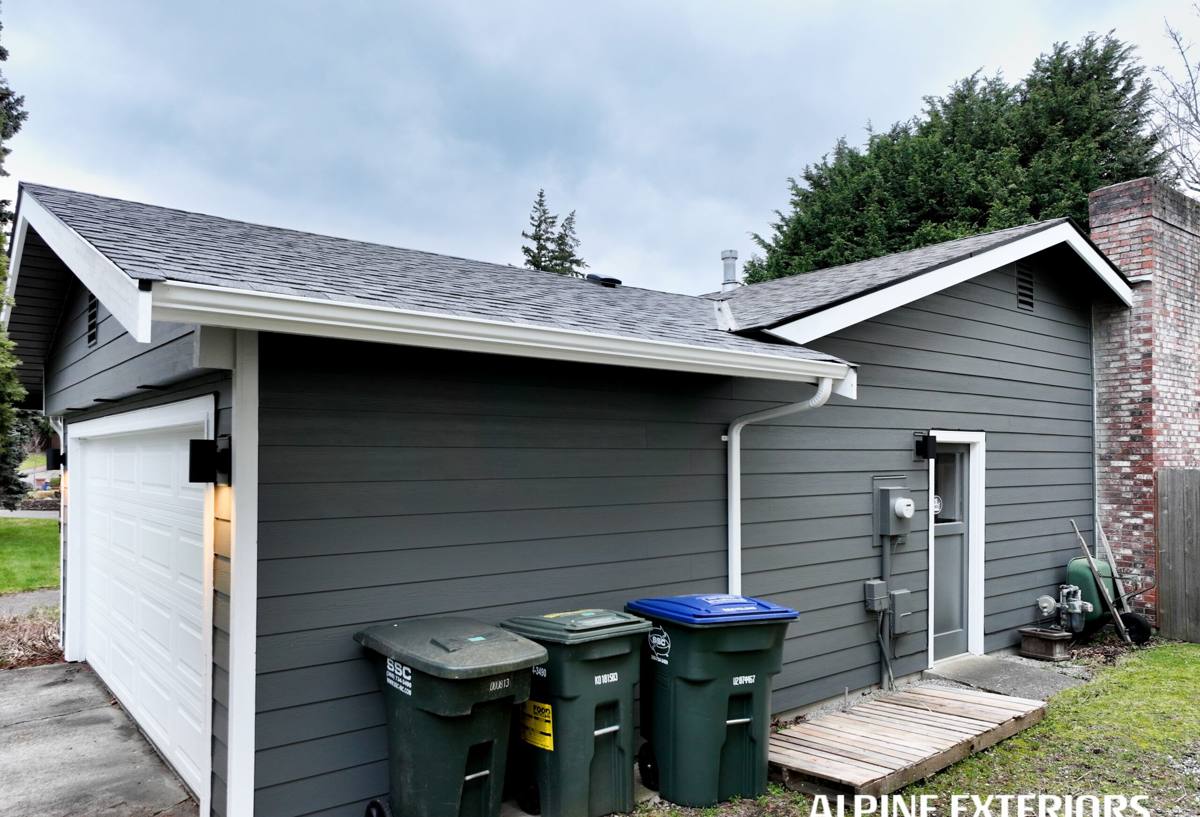
We install James Hardie fiber cement siding exclusively, and Birch Bay is exactly the kind of environment Hardie's product line was engineered to handle. A few things matter specifically for a marine climate:
- Non-combustible, dimensionally stable material. Fiber cement doesn't expand and contract with moisture the way wood-based products do, so it holds paint and caulk lines better over time in a wet climate.
- HZ5 engineered formulation. James Hardie makes climate-specific versions of its siding. The HZ5 line is formulated for wetter, harsher climates — including the Pacific Northwest coast — with a moisture-resistant composition suited to areas like Birch Bay.
- ColorPlus factory finish. A baked-on, factory-controlled finish resists fading and chipping better than field-applied paint, which matters when salt air and UV are both working against a painted surface.
- A material that doesn't feed rot. Unlike wood-based siding, fiber cement isn't an organic food source, so even where moss and algae grow on the surface, they're not breaking down the substrate underneath.
Fiber cement isn't magic — it still needs to be installed correctly and maintained. But it starts from a materially better position for a site like Birch Bay than wood, wood-composite, or vinyl siding does.
Matching the Right Hardie Products to the House
"James Hardie siding" isn't one product — it's a system, and picking the right pieces matters as much as the brand name. For most Birch Bay homes, a project draws from a handful of core products:
| Product | Typical Use | Why It Fits Birch Bay |
|---|---|---|
| HardiePlank lap siding | Main field siding on most wall areas | The workhorse product; HZ5 formulation and factory finish handle sustained moisture and salt exposure |
| HardiePanel vertical siding | Accent walls, gables, modern facades | Fewer horizontal laps means fewer joint lines exposed to wind-driven rain |
| HardieTrim boards | Corners, window and door trim, fascia | Matches the siding's stability so trim joints don't open up and let water in |
| HardieSoffit panels | Eaves and overhangs | Resists the sustained dampness common under shaded, wind-sheltered eaves near the water |
The right mix depends on the home's design, existing overhangs, and how exposed each wall is to prevailing weather off the bay. Part of a good estimate is walking the exterior and identifying which walls take the worst of the wind and rain, since those are the areas where detailing matters most.
What Correct Installation Actually Involves
Fiber cement siding is only as good as the installation behind it, and in a coastal environment the margin for error is smaller. A correct Hardie install on a Birch Bay home includes:
Water management behind the siding
A drainage plane and rainscreen gap between the siding and the weather-resistive barrier let any water that gets past the cladding drain and dry out, instead of sitting against the wall sheathing. This matters more on a house that's routinely hit by sideways rain than on a home sheltered further inland.
Flashing at every penetration
Windows, doors, hose bibs, light fixtures, and deck ledgers are the points where water most often finds its way behind siding. Each one needs proper flashing and integration with the water-resistive barrier — not just a bead of caulk over the gap.
Manufacturer-spec fastening and clearances
James Hardie publishes specific fastener types, spacing, and minimum clearances from grade, roof lines, and other surfaces. Following those specs — rather than treating them as optional — is what keeps the warranty valid and keeps the siding performing as designed.
Joint and seam treatment
Butt joints, corners, and trim intersections are where moisture problems usually start. Correctly sized gaps, the right sealant, and factory-mitered or properly flashed joints keep those seams from becoming entry points.
Moss, Algae, and Ongoing Maintenance
Moss and surface algae are a fact of life on shaded, moisture-prone walls anywhere near Birch Bay, and Hardie siding isn't immune to growth on its surface even though the material itself doesn't rot. A few things reduce the problem:
- Keeping vegetation trimmed back from walls so air can move and surfaces can dry between rain events
- Periodic gentle washing (low-pressure, not a pressure washer aimed directly at siding) to clear organic buildup before it stains the finish
- Checking caulking at trim and joints annually, since UV and constant damp cycles break down sealant faster here than in drier climates
- Addressing gutter and downspout issues quickly — overflow and splash-back are a common, avoidable source of localized moss and streaking
None of this is unique to Hardie siding — any exterior on this stretch of coast needs the same basic upkeep. The difference is that fiber cement gives you a surface that can be cleaned and maintained without the material itself degrading underneath.
What Drives Cost on a Birch Bay Hardie Project
Every home is different, so we don't quote sight-unseen numbers, but a few factors consistently move the price on a project like this:
| Factor | Why It Matters |
|---|---|
| Existing siding removal | Tear-off of old wood, vinyl, or damaged siding adds labor and disposal time before installation can start |
| Sheathing and framing condition | Water-damaged sheathing found once old siding comes off needs to be repaired before new siding goes on — common on older waterfront homes |
| Wall complexity | Gables, dormers, multiple roof lines, and lots of trim take more time to detail correctly than a simple rectangular wall |
| Product mix | Lap siding, vertical panel accents, and custom trim combinations each carry different material and labor costs |
| Site access | Waterfront lots with limited staging area or steep grades can add setup time |
The only way to get an accurate number is an in-person look at the home, which is what a free estimate is for.
How Our Process Works
- On-site assessment. We walk the exterior, check existing siding and trim condition, and note which walls take the most weather exposure.
- Product and scope proposal. We recommend the specific Hardie products and detailing the house needs, with a written scope and price.
- Sheathing and moisture check. Before new siding goes on, we confirm what's underneath the old cladding is sound — or flag repairs needed first.
- Installation to manufacturer spec. Proper drainage plane, flashing, fastening, and joint treatment, done in the sequence James Hardie's installation guidelines call for.
- Final walkthrough. We go over the finished work with the homeowner before calling the job done.
Why It Matters That We Already Work in Birch Bay
A crew that's worked on other homes in Birch Bay has already seen how wind comes off the water on this stretch of coast, which walls tend to take the worst of the rain, and where moss shows up first on a shaded elevation. That's not something you can fully substitute with a manual — it comes from having stood on ladders in this specific microclimate. It also means fewer surprises mid-project: we're not guessing at how a Whatcom County coastal winter treats an improperly flashed window, we've seen it.
Hiring locally also matters for follow-up. If a question comes up about caulking, a trim joint, or how the siding is holding up a few years in, you're not trying to track down a crew that worked the job once and left the area.
Questions Worth Asking Before You Hire
- Do you install James Hardie exclusively, or do you also install other siding brands and materials?
- Which specific James Hardie products (and climate designation) do you recommend for this house, and why?
- What's your plan for the drainage plane and flashing behind the siding — not just the finished look?
- Have you worked on other homes in Birch Bay or similar waterfront/coastal locations in Whatcom County?
- What does the manufacturer's warranty cover, and does your installation meet the requirements to keep it valid?
- What will you do if you find water damage in the sheathing once the old siding comes off?
If your Birch Bay home's siding is showing moss, chalking paint, soft spots, or open joints, or you're planning ahead for a replacement, we're glad to take a look. We offer free, no-pressure estimates — walk the house with you, tell you honestly what we see, and lay out what a correct James Hardie install would involve for your specific walls.