 Bellingham
 Roofing in Birchwood: A Different Set of Problems Than Roofing Elsewhere
Birchwood sits inland enough from Bellingham Bay to feel like it's sheltered, but it isn't really. Salt-laden air still moves through on the prevailing westerlies, tree cover in and around the neighborhood keeps roofs shaded and damp longer than open lots, and the rain here isn't the polite, straight-down kind — it comes in sideways during fall and winter storms and finds every weak lap, nail pop, and worn seal on a roof. Add in a moss season that can run eight or nine months of the year in Whatcom County, and you've got a roofing environment that's genuinely harder on asphalt shingles than most manufacturers' warranty literature assumes.
None of that means asphalt shingles are the wrong choice for Birchwood homes. They're still the most practical, cost-effective roofing material for the vast majority of houses here. It means the installation has to account for local conditions instead of following a generic spec sheet, and the roof needs a maintenance rhythm that matches how fast moss and moisture actually move in this climate.
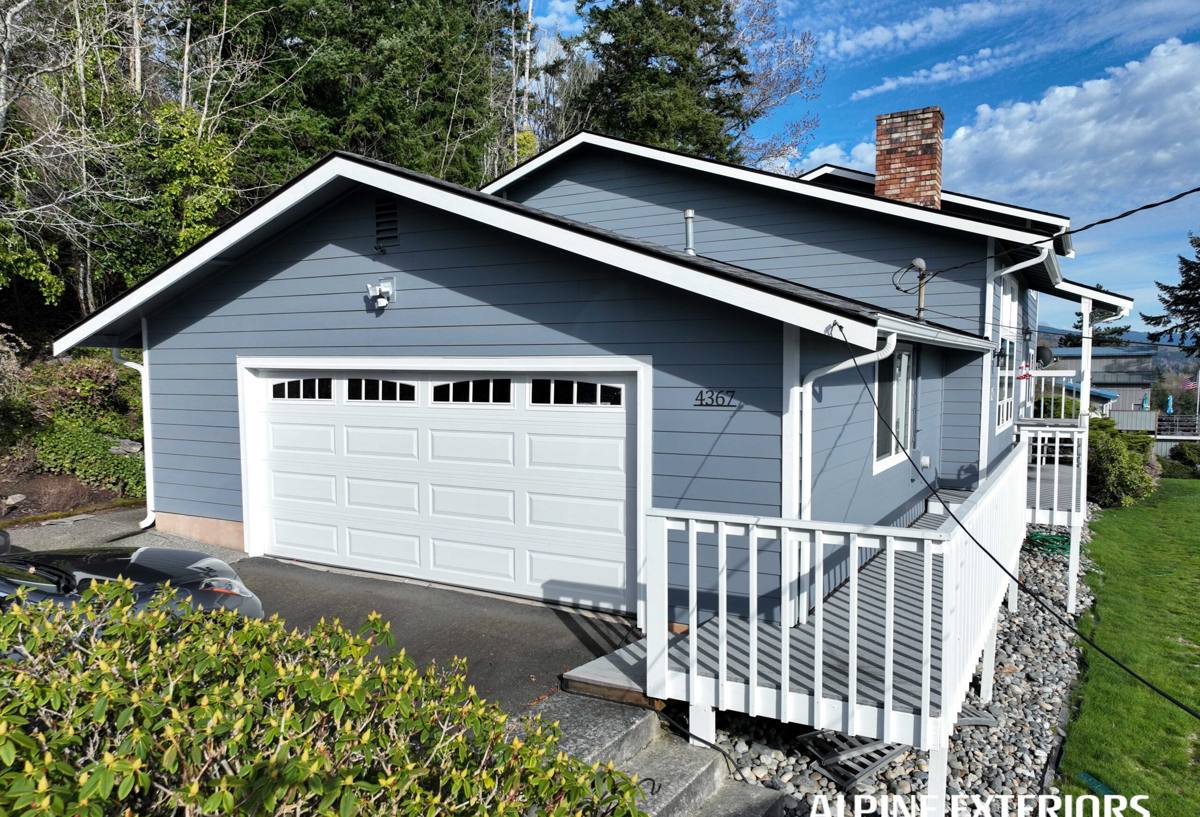
What Birchwood's Climate Actually Does to a Roof
Salt Air and Corrosion
Bellingham Bay is close enough that salt-bearing moisture reaches Birchwood roofs, especially on west- and south-facing slopes that catch the weather. Salt air accelerates corrosion on exposed metal — flashing, nail heads, vent stacks, gutter hardware — well before the shingles themselves are due for replacement. A roof that looks fine from the ground can have flashing that's rusting from the inside of a lap joint.
Driving Rain
Wind-driven rain doesn't just run off a roof — it gets pushed uphill under shingle tabs, into open laps, and through fastener holes that aren't sealed properly. This is why underlayment quality and fastening pattern matter more here than in drier climates. A roof that would hold up fine in Eastern Washington can leak in Birchwood simply because it wasn't detailed for wind-driven moisture.
Moss and Shade
Birchwood's mature trees are part of what makes the neighborhood pleasant to live in, but they also mean roofs stay shaded and damp for long stretches, especially north-facing slopes and valleys where two roof planes meet. Moss doesn't just sit on top of shingles — it roots into the granule surface, lifts tabs, and holds water against the mat underneath. Left unchecked over a few seasons, it shortens the life of an otherwise sound roof.
What a Correctly Installed Shingle Roof Needs Here
A roof built for Birchwood's conditions isn't a different product — it's the same asphalt shingle system installed with a few non-negotiable details that generic installers sometimes skip to save time.
- Ice-and-water shield membrane at eaves, valleys, and any roof-to-wall transition, not just the code-minimum strip
- Synthetic underlayment with proper overlap, run in the correct direction relative to prevailing wind and rain
- Balanced intake and exhaust ventilation so moisture from inside the attic isn't adding to what's landing on the roof from outside
- Corrosion-resistant flashing and fasteners at every penetration, valley, and wall intersection
- Proper nailing pattern and placement — high-nailing or underdriving fasteners is one of the most common causes of early wind and rain damage
- Drip edge at eaves and rakes to keep water off the fascia and out of the roof deck edge
Skip any one of these and the shingles themselves can be top quality and the roof will still underperform in this climate.
Signs a Birchwood Roof Needs Attention
Most roofing problems in this area show up gradually, not as a sudden leak. Worth checking for, especially after the first hard storms of fall:
- Dark streaking or green-black growth on north-facing slopes or shaded valleys
- Granules collecting in gutters or at downspout outlets
- Shingle tabs that look lifted, curled, or cupped at the edges
- Rust staining below metal flashing or vent stacks
- Soft or spongy spots when walked, or visible sagging between rafters
- Daylight visible through the roof deck from inside the attic
- Ice buildup or water staining along eaves during cold snaps
Any one of these on its own isn't necessarily an emergency, but they're worth a professional look rather than waiting for a ceiling stain to show up.
Shingle Options: What We Recommend and Why
Not every asphalt shingle line handles Birchwood's moss and moisture load the same way. Here's how the common tiers compare for this specific climate:
| Shingle Type | Typical Lifespan | Moss/Algae Resistance | Best Fit |
|---|---|---|---|
| 3-Tab (economy) | 15-20 years | Low unless treated | Budget-driven projects, secondary structures |
| Standard Architectural | 25-30 years | Moderate | Most Birchwood homes — good balance of cost and durability |
| Algae-Resistant Architectural (copper/zinc-infused granules) | 25-30 years | High | Shaded lots, north-facing roofs, homes near mature trees |
| Premium/Designer | 30-50 years | High | Homes where appearance and longevity both matter |
For most Birchwood properties, especially anything with tree cover or a shaded slope, we lean toward algae-resistant architectural shingles as the practical standard rather than an upsell. The granule treatment that resists moss and algae growth is inexpensive relative to the total job cost, and in this climate it's one of the few upgrades that pays for itself in reduced maintenance and a longer effective service life.
A Note on Cheaper Roofing Products
We don't install every product on the market, and it's not because a given shingle is "bad" — it's a professional standard we hold ourselves to. Some economy lines have thinner mats, less consistent granule adhesion, or warranty structures that shrink fast once wind or algae exposure is factored in. In a climate like Birchwood's, those trade-offs show up sooner than they would in a drier region, and we'd rather steer a homeowner toward a product that holds up than install something that looks the same on day one and performs worse by year five.
Our Process for a Birchwood Roofing Job
1. On-Site Assessment
We walk the roof and the attic, not just the yard. That means checking deck condition, existing ventilation, flashing condition, and moisture history before quoting anything — a roof estimate based only on a ground-level look misses the details that actually determine cost and scope.
2. Tear-Off and Deck Inspection
Full tear-off lets us see the deck itself. Any soft, delaminated, or water-damaged sheathing gets replaced before anything goes back down — covering a compromised deck with new shingles just hides the problem for a few years.
3. Underlayment and Flashing
This is where the climate-specific detailing happens: ice-and-water membrane at vulnerable areas, correctly lapped synthetic underlayment, and new flashing at every valley, wall, and penetration rather than reusing old metal that's already corroding.
4. Shingle Installation
Manufacturer nailing specs, correct exposure, and attention to valleys and hips — the details that determine whether wind-driven rain stays out or finds a way in.
5. Ventilation Check
We confirm intake and exhaust are balanced before calling the job done. A new roof with poor attic ventilation will still trap moisture and shorten its own lifespan regardless of shingle quality.
6. Final Walkthrough
We go over what was done, what to expect, and what basic upkeep — mainly moss control and gutter clearing — will keep the roof performing through Whatcom County's wet seasons.
What This Actually Costs
Every roof is different, but the factors that move price on a Birchwood asphalt shingle job are consistent:
| Factor | Why It Matters |
|---|---|
| Roof size and pitch | Steeper roofs take longer and require more safety setup, adding labor cost |
| Deck condition | Rotted or delaminated sheathing found during tear-off adds material and labor |
| Shingle tier | Algae-resistant and premium lines cost more per square than economy 3-tab |
| Number of valleys, penetrations, and roof planes | More flashing detail work means more labor time |
| Access and tree cover | Roofs shaded by mature trees may need branch clearance for safe work and moss prevention |
| Ventilation upgrades | Adding or correcting intake/exhaust vents is often worth doing while the roof is already open |
We'll always give a straight number after we've actually looked at the roof and attic — not a phone quote based on square footage alone.
Why a Crew That Already Works Birchwood Matters
Roofing crews that mostly work drier, less shaded parts of the state don't always default to the underlayment and ventilation choices that matter most here. A crew that regularly works Birchwood and the surrounding Bellingham neighborhoods already knows which slopes hold moss longest, how far wind-driven rain travels up a shingle lap in a Whatcom County storm, and which older homes in the area tend to have marginal attic ventilation from a past re-roof. That local pattern recognition shows up in fewer callbacks and a roof that's built for the actual weather it has to survive, not a textbook average.
It also means being reachable after the job is done. Roofing problems in this climate rarely show up as a dramatic failure — they show up as a slow moss patch or a small stain that's easier to deal with early. A local crew is the one you can actually call when that happens.
Ready for a Straight Answer on Your Roof?
If your Birchwood roof is showing moss, rust staining, lifted shingles, or you're just not sure how much life is left in it, we're glad to take a look and give you an honest read — no pressure, no upsell. Use the form below to request a free estimate.