 Bellingham
 Building Decks for Columbia's Particular Climate
Columbia sits close enough to the water and to the weather patterns that roll through Whatcom County that a deck here takes a different kind of beating than one built twenty miles inland. Salt-tinged air corrodes hardware faster than people expect, driving rain finds its way into every gap in flashing and framing, and the long stretch of gray, damp months each year gives moss and algae months of uninterrupted growing time on any horizontal surface that doesn't drain well. None of this is exotic knowledge to anyone who has lived in Bellingham a while, but it matters enormously when you're choosing materials, fasteners, and a build sequence for a deck that's supposed to last decades, not years.
A deck built to a generic national spec sheet will often look fine for the first year or two in Columbia. The problems show up later — soft spots where water pooled against a ledger board, streaking and discoloration from moss that never got scrubbed off, rust bleeding out of fastener heads onto the decking. Building it right the first time costs a bit more up front and saves a lot of headache down the road.
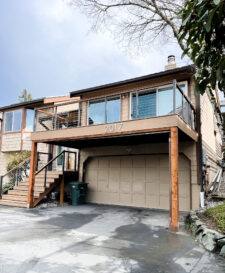
What Local Homes Actually Need From a Deck
Drainage Comes First
Every deck we build in this part of Whatcom County starts with drainage, not aesthetics. That means gapping boards correctly for water to pass through, sloping ledger connections and structural framing away from the house, and making sure nothing traps standing water against wood or metal. Decks that fail early in this climate almost always fail because water sat somewhere it shouldn't have.
Materials That Tolerate Moisture Cycling
Wood in Columbia doesn't get one long dry season — it gets repeated cycles of soaking and drying, sometimes within the same week. That cycling is harder on lumber and fasteners than constant dampness would be, because it's the expansion and contraction that works joints loose and opens up hairline cracks for water to enter. Whatever material you choose needs to handle that cycling gracefully, not just resist rot in a lab test.
Framing and Structure: Getting the Bones Right
The parts of a deck nobody sees are the parts that determine whether it's still solid in fifteen years. That starts with footings sized and set to current code depth for our frost and soil conditions, not just poured to "what's always worked." Ledger board attachment to the house needs proper flashing that sheds water away from the rim joist, not flashing that just gets tucked in and caulked over — caulk fails, flashing geometry doesn't.
Joist hangers, structural screws, and post bases all need to be rated for exterior, corrosion-prone environments. In a lot of decks we've corrected after the fact, the visible decking was fine but the hardware underneath had already started rusting because someone used interior-rated or bargain-grade fasteners to save a few dollars on a job that's supposed to hold a deck up for a generation.
Ventilation Under the Deck
Low decks built tight to grade with no airflow underneath trap moisture against joists and beams year-round. Where the site allows it, we build in enough clearance and, where needed, venting so the structure can actually dry out between rain events instead of staying damp from October through May.
Choosing a Decking Material for This Climate
There's no single "right" decking material — it depends on your budget, how much maintenance you're willing to do, and how the deck will be used. Here's how the common options actually perform in a Bellingham-area coastal climate, based on how they behave over time rather than how they're marketed.
| Material | Upfront Cost | Maintenance | Moisture Behavior Here |
|---|---|---|---|
| Cedar | Moderate | Annual cleaning and re-sealing recommended | Naturally rot-resistant but still needs upkeep against moss and graying |
| Pressure-treated pine | Lowest | Regular sealing; more prone to warping/splitting over time | Handles moisture cycling less gracefully than cedar or composite |
| Composite | Higher | Low — occasional washing | Doesn't rot, but needs proper airflow underneath to avoid moisture and mold buildup at the boards' underside |
| PVC/capped composite | Highest | Lowest | Best resistance to moisture absorption; strongest warranty structures, but installation is less forgiving of mistakes |
We don't push one material over another as a rule — we tell you honestly what each one will actually cost you in upkeep over ten years, not just what it costs to install. As a rough starting point, most custom deck projects in this area land somewhere in the neighborhood of a few thousand dollars for a small, simple deck up to well into five figures for a large, multi-level composite deck with built-in features. Your actual number depends heavily on size, material, height off grade, and site access.
Why We're Selective About Certain Composite Products
Not every composite or capped product on the market is installed the same way, and some are far more sensitive to installation error than others — expansion gaps, fastener spacing, and substructure spacing all have to be exact or you end up with buckling or gapping down the line. We stick to a shorter list of products we've installed enough times to know their installation tolerances and warranty terms cold, rather than switching brands based on whoever's cheapest that month.
Railings and Hardware: Where Salt Air Does the Most Damage
If you want to see where a coastal climate attacks a deck first, look at the hardware. Standard zinc-coated screws and brackets can start showing rust streaks within a couple of seasons this close to salt air. We spec stainless or coastal-rated hardware for connections that are hard to inspect or replace later — post bases, structural screws, and railing hardware — even though it costs more than standard-grade fasteners. Railing systems get the same treatment: cable rail and metal balusters need a finish and hardware grade that's actually rated for a marine-influenced environment, not just "exterior."
Moss, Mold, and Long-Term Deck Care
Whatcom County's damp season gives moss and algae a long runway on any deck surface that stays shaded or doesn't drain quickly. A well-built deck fights this two ways: design (gapping, drainage, sun exposure where possible) and maintenance (periodic cleaning before growth gets established). We'll walk you through a simple seasonal care routine appropriate to your specific material — what a cedar deck needs is different from what a capped composite deck needs, and giving you generic advice from a box store doesn't help you keep your deck looking good.
- Confirm the ledger board flashing is a true water-shedding detail, not just caulked
- Ask what grade of fastener and hardware will be used, and get it in writing
- Verify footing depth meets current local code for our frost line, not just "what's typical"
- Check that under-deck airflow or venting is part of the plan, especially for low decks
- Get the decking material's real maintenance schedule, not just its warranty length
- Make sure a building permit will actually be pulled — decks over a certain height or attached to the house generally require one here
Our Process, Start to Finish
We start with a walk of your property to look at grade, drainage, sun exposure, and how the deck will connect to the house. From there we talk through material options honestly, including what each one will cost you in upkeep, not just at closing. Once you've settled on a design, we handle the permitting, build the structure to code with corrosion-appropriate hardware throughout, and install the decking and railings to the manufacturer's actual installation spec — not a shortcut version of it. We walk the finished deck with you before we consider the job done, and we're straightforward if something on-site changes the plan partway through.
Why a Crew That Already Works in Columbia Matters
A contractor who's built decks throughout Columbia and the rest of Bellingham already knows how the local permitting process works, what footing depths and inspection expectations look like here, and how differently a deck ages a few blocks from the water versus further inland. That's not something you can fully substitute with a generic national franchise or a crew that mostly works in a drier climate elsewhere in the state. It shows up in small decisions — how flashing gets detailed, what hardware grade gets specified by default, how much venting a low deck gets — that add up to whether your deck is still tight and solid in fifteen years or needs board replacement in five.
If you're planning a new deck or replacing one that's failing in Columbia, we're happy to come take a look and give you a straightforward, no-pressure estimate — just fill out the form below.