 Bellingham
 Why Fairhaven Siding Wears Differently Than the Rest of Bellingham
Fairhaven sits close enough to Bellingham Bay that its homes take on a combination of exposures you don't see in the same intensity further inland. Salt-laden air off the water accelerates corrosion on fasteners, flashing, and any exposed metal trim. Driving rain off Puget Sound hits siding at an angle, not straight down, which pushes water into laps, seams, and butt joints that were only ever designed to shed water falling vertically. And Whatcom County's long, wet shoulder seasons keep siding damp for weeks at a stretch, which is exactly the condition moss and algae need to take hold on north-facing walls and anything shaded by mature trees.
None of that means Fairhaven siding fails faster across the board. It means the damage patterns are specific, and a repair that doesn't account for them tends to fail again within a couple of seasons. A patch that looks fine the day it's finished but doesn't address trapped moisture behind it, or doesn't re-establish proper flashing at a joint, is a repair that's already counting down to a second visit.
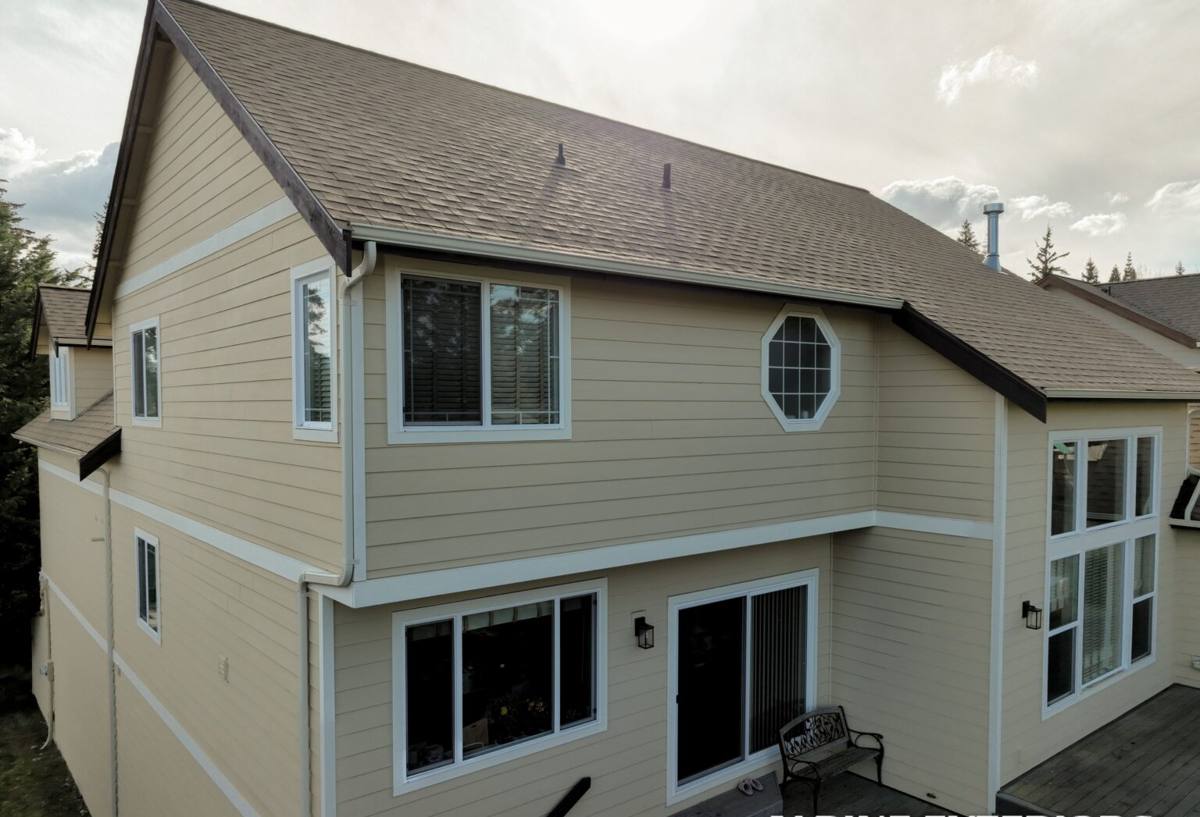
The Damage Patterns We See Most in This Neighborhood
Salt Air and Fastener Corrosion
Homes within a mile or so of the water see faster corrosion on nails, screws, and any galvanized or untreated metal flashing. Once fasteners start rusting, they can loosen, stain the siding face, or lose their grip entirely, which lets a board start to work loose in wind. This is a slow process, so it's often invisible until a board is already moving.
Wind-Driven Rain at Laps and Corners
Storms coming off the Sound don't just fall on a wall, they push against it. That pressure forces water up and under laps, around outside corners, and through any caulk joint that's cracked or undersized. Over time this shows up as soft spots, staining, or bubbling paint near butt joints, corner boards, and window trim.
Moss, Algae, and Trapped Moisture
Shaded walls, especially north and east exposures near tree cover, stay damp longer after every rain. Moss doesn't just sit on the surface — its root structure holds moisture against the siding face, and on absorbent materials that moisture works its way behind the surface layer. This is one of the more common reasons a board that looks fine from ten feet away turns out to be soft when you press on it.
Ground-Level and Foundation Splash
Fairhaven's older housing stock includes plenty of homes with landscaping or grade changes that push splash-back onto the bottom courses of siding. Combined with the region's rainfall totals, the lowest few feet of a wall often show wear well before the rest of the elevation does.
How to Tell a Real Repair Need From a Cosmetic One
Not every mark on a wall means something structural is happening behind it. Here's a practical way to sort what needs attention now from what's just weathering:
- Press gently on discolored or stained areas — if the material gives or feels spongy, moisture has likely gotten behind the surface
- Check for gaps or separation at butt joints, corners, and around window and door trim
- Look for boards that have visibly bowed, cupped, or pulled away from the wall
- Note any spots where paint is peeling or bubbling in a pattern rather than evenly across a wall
- Check for moss or algae that's thick enough to hold visible moisture, not just surface discoloration
- Look at flashing above windows, doors, and any horizontal trim for rust streaks or gaps
- Check the bottom few courses near grade for splash staining or softness
Surface staining and light moss growth on otherwise sound siding is usually a cleaning and maintenance issue, not a repair issue. Softness, separation, or repeated staining in the same spot after cleaning usually means water is getting in somewhere and needs to be traced back to its source before anything gets patched over.
What a Correct Repair Actually Involves
A repair that's done right isn't just about replacing the board that looks bad. It has a few steps that get skipped when someone's trying to do a fast, cheap patch:
Find the Water Path First
Damaged siding is usually a symptom. Before anything gets replaced, the real job is figuring out how water is getting behind the siding in the first place — a failed caulk joint, missing or damaged flashing, a gap at a penetration, or a grading issue pushing splash-back onto the wall. Replace the board without fixing the path and the same spot fails again.
Check What's Behind the Siding
Once a section is opened up, the housewrap or building paper, the sheathing, and any framing underneath need to be checked for rot or sustained moisture damage. Siding repair that stops at the visible surface and never looks at what's behind it is incomplete by definition.
Match the Existing Material
Color, texture, and reveal (the exposed width of each course) all need to match the surrounding siding, or a repair becomes a visible patch rather than an invisible fix. This matters more on Fairhaven's older homes, where original siding profiles aren't always something you can order off a shelf.
Re-Flash and Re-Seal Properly
Any joint, corner, or penetration that gets opened up during a repair needs flashing and sealant reinstalled to current standards, not just caulked over. This is the step most likely to get shortcut on a quick patch job, and it's usually the reason a "fixed" spot fails again within a year or two.
Repair or Replace: How to Think About the Decision
Isolated damage on an otherwise sound wall is almost always a repair. Widespread staining, multiple soft spots across different elevations, or siding that's original to a much older home are signs the whole system may be past the point where patching makes financial sense. Here's a general way to weigh it:
| Factor | Leans Toward Repair | Leans Toward Replacement |
|---|---|---|
| Extent of damage | One or two isolated sections | Multiple walls or elevations affected |
| Age of existing siding | Under 15-20 years, otherwise sound | Original to an older home, near end of service life |
| Cause of damage | A single identifiable failure point (flashing, caulk joint) | Systemic moisture issues across the wall assembly |
| Material match | Matching material is available or close enough | Discontinued profile or material no longer manufactured |
| Underlying sheathing | Sound, no rot found | Rot or sustained moisture damage found behind siding |
We'll always tell you honestly which side of that line your home is on. A repair that's likely to need redoing in two years isn't a favor to anyone, and we'd rather say so upfront than sell a patch we don't believe in.
Our Process for Fairhaven Repair Calls
- Walk the exterior and identify every area of concern, not just the spot you called about — problems near the water tend to show up in more than one place at once
- Check suspect areas for moisture and softness, and open up representative sections where needed to see what's happening behind the surface
- Trace visible damage back to its likely water source — flashing, caulk, grading, or a penetration — rather than treating the symptom alone
- Give you a clear, honest picture of what's repair-worthy and what isn't, in plain terms
- Repair using material that matches your existing siding as closely as possible, with proper flashing and sealant details, not just a patch over the hole
Why Material Choice Still Matters on a Repair
We only install James Hardie fiber cement siding, and that shapes how we approach repairs, too. When a section of Hardie siding needs patching, we're working with a non-combustible, engineered material that's built for this climate and holds its factory ColorPlus finish for years, so a well-matched repair blends in and stays that way. When a home has older wood, vinyl, or another fiber cement product that's failing in a way that keeps recurring, we'll say so honestly and explain why we'd recommend moving toward Hardie on that section or elevation rather than continuing to chase the same failure point with patch after patch. That's not upselling — it's the same standard we hold for every home we work on, and it's why we don't install products we don't think hold up long-term in Whatcom County's weather.
Why a Local Crew Matters for This Kind of Work
Siding repair depends on knowing what's normal for a given neighborhood's housing stock and what's a warning sign. A crew that regularly works in Fairhaven has a feel for the age and construction of homes here, the exposures that matter most near the water, and how moss, salt air, and driving rain actually behave on these walls over a full year, not just on the day of the estimate. That local familiarity is part of what makes a repair diagnosis accurate instead of a guess.
If you're seeing a soft spot, staining, or a section of siding that's pulled away from the wall, we're glad to take a look and give you a straightforward assessment — no pressure, no upsell, just an honest read on what your home actually needs. Reach out for a free estimate using the form below.