 Bellingham
 Why Ferndale Homes Wear Out Siding Faster Than the Brochures Admit
Ferndale sits close enough to Bellingham Bay and the Strait of Georgia that salt-laden air is a daily fact of life for a lot of homes here, not an occasional nuisance. Add Whatcom County's long wet season, frequent driving rain off the water, and the shaded, damp microclimates that show up under mature trees and along north-facing walls, and you've got a combination that's genuinely tough on exterior siding. Homeowners who moved here from drier climates are often surprised at how much faster paint fails, caulk cracks, and wood-based products start showing rot compared to what they're used to.
None of that is a knock on Ferndale as a place to live — it's a beautiful area for exactly the reasons that make the weather rough on a house. But it does mean a siding replacement here isn't a cosmetic decision. It's a systems decision: water management, material choice, and installation detail all have to work together, or you're back to painting and patching within a few years.
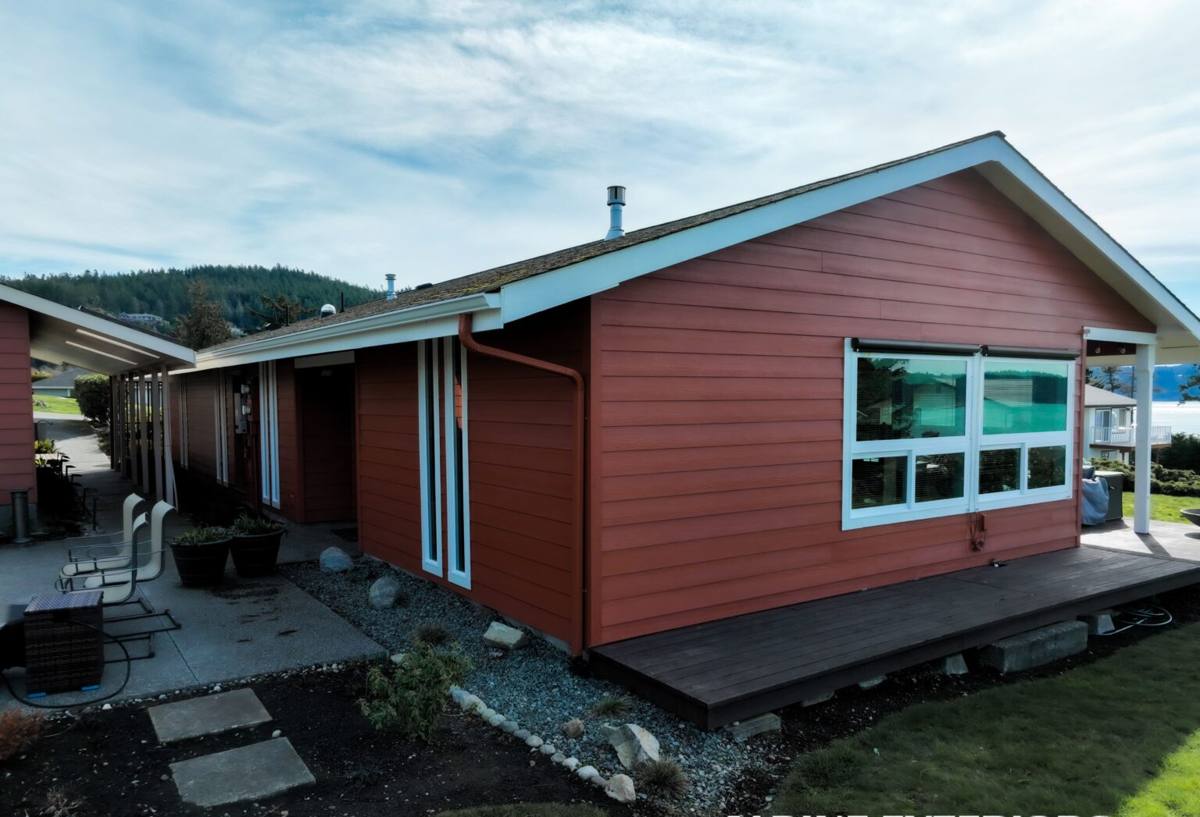
What the Local Climate Actually Does to Siding
Salt Air and Airborne Moisture
Proximity to Bellingham Bay means a steady low-level exposure to salt-carrying air, especially on west- and north-facing elevations that catch wind off the water. Salt accelerates the breakdown of paint films, corrodes fasteners and metal trim that aren't rated for coastal exposure, and speeds up the general weathering of any porous or absorbent siding material.
Driving Rain
Storms coming off the water don't just fall straight down — they drive rain sideways into wall assemblies, which puts real stress on seams, laps, and penetrations. A siding system that's fine in a calm rain climate can still leak here if the laps, flashing, and caulk joints aren't detailed for wind-driven water.
Moss and Prolonged Dampness
Whatcom County's moss season runs long — shaded walls, north sides of houses, and anything under tree cover can stay damp for weeks at a stretch during fall and winter. Moss and algae growth on siding isn't just cosmetic; on wood-based or wood-fiber products, sustained moisture contact is exactly the condition that leads to swelling, delamination, and rot at the edges and butt joints.
What "Correct" Siding Replacement Looks Like in This Climate
A proper siding replacement in Ferndale isn't just stripping old material and nailing up new. It's an opportunity to fix the water-management layer that's usually the real reason the old siding failed in the first place. That means:
- Removing old siding down to the sheathing so the wall can actually be inspected, not just re-covered
- Checking for and repairing any rot, soft sheathing, or hidden moisture damage before anything new goes on
- Installing a code-compliant weather-resistive barrier (housewrap or equivalent) as the primary drainage plane
- Adding a rainscreen or drainage gap where conditions call for it, so any water that gets behind the siding has somewhere to go
- Flashing every window, door, and penetration correctly, with proper lapping so water sheds down and out, never in
- Using corrosion-resistant, coastal-rated fasteners and trim hardware, not standard interior-grade fasteners
- Sealing and caulking joints with the appropriate materials for the siding system being installed — not just "whatever caulk was in the truck"
Skip any one of these steps and you can end up with brand-new siding hiding the exact same moisture problems that took out the old siding — just delayed a few years.
Why We Only Install James Hardie Fiber Cement
We standardized on James Hardie fiber cement siding for every job we do, including here in Ferndale, and we don't install LP SmartSide, vinyl, Cemplank, Allura, primed spruce, or cedar. That's not a marketing position — it's a professional standard based on how these products actually perform over years of coastal Pacific Northwest exposure.
Non-Combustible Core
Fiber cement is engineered from cement, sand, and cellulose fiber — it doesn't burn, which matters in a region where wildfire risk and insurance underwriting increasingly factor exterior materials into coverage and premiums.
Climate-Engineered Product Lines
Hardie makes HZ10 and HZ5 formulations specifically calibrated for different climate zones, including the wetter, milder zones that cover Western Washington. That means the product is formulated for the moisture exposure Ferndale actually sees, rather than a one-size-fits-all national spec.
ColorPlus Factory Finish
Instead of relying on field-applied paint — which is exactly what fails fastest under salt air and UV exposure — Hardie's ColorPlus finish is baked on at the factory under controlled conditions, with a finish warranty that follows the product. That's a meaningful difference in a climate where paint failure is the single most common complaint we hear about older siding.
Dimensional Stability
Fiber cement doesn't swell, warp, or absorb water the way wood-based products can. In a climate with a genuine moss season and long stretches of sustained dampness, that stability is what keeps butt joints tight and paint (or ColorPlus finish) from cracking at the seams year after year.
Being Honest About the Alternatives
We're not going to pretend the products we don't install are without merit — each has a real place in the market. LP SmartSide and cedar have genuine wood character and can perform reasonably well when maintained aggressively. Vinyl is inexpensive and low-maintenance in dry climates. Cemplank and Allura are also fiber cement and share some of Hardie's core advantages. Here's the honest trade-off picture as we see it for this specific climate:
| Material | Where It Struggles Here | Why We Don't Install It |
|---|---|---|
| Vinyl siding | Can warp or crack in temperature swings; seams can allow wind-driven rain intrusion | Long-term moisture performance and appearance don't hold up to our standard for coastal wind-driven rain |
| LP SmartSide / engineered wood | Edge and cut-end moisture absorption in sustained damp/moss conditions | Higher long-term maintenance burden in a climate that stays wet for weeks at a time |
| Cedar / primed spruce | Requires frequent refinishing; vulnerable to rot at joints and lower courses | Maintenance demands and moisture sensitivity don't fit a "replace it right, once" approach |
| Cemplank / Allura fiber cement | Comparable core material to Hardie | We standardized on one manufacturer for warranty, color-match, and supply consistency across all our jobs |
The point isn't that other products are unusable — it's that when we're the ones putting our name on the installation and warranty, Hardie is the system that lines up best with what this climate demands.
Our Ferndale Siding Replacement Process
- On-site assessment — we walk the exterior, check for existing rot or moisture damage, and note problem areas (north walls, shaded sides, low clearance spots) specific to your property
- Tear-off and inspection — old siding comes off, sheathing gets inspected, and any damaged framing or sheathing is repaired before moving forward
- Water management installation — housewrap, flashing, and rainscreen detailing installed to current best practice for wind-driven rain exposure
- Hardie installation — panels or lap siding installed to manufacturer spec, with correct fastener spacing, clearances, and caulking
- Trim, corners, and detailing — window and door trim, corner boards, and transitions finished for both appearance and water-tightness
- Final walkthrough — we review the completed job with you before considering it done
What to Expect for Timeline and Disruption
A typical single-family siding replacement runs from several days to a couple of weeks depending on house size, complexity of trim work, and how much sheathing repair turns up once the old siding is off. Weather windows matter here — we plan around Whatcom County's wetter stretches rather than fighting them, which protects both the schedule and the quality of the installation.
Why Hiring a Crew That Already Works Ferndale Matters
Siding installation instructions look the same on paper everywhere in the country. What differs is judgment calls in the field — how tight to run a rainscreen gap on a shaded north wall, where a coastal property needs upgraded fasteners versus standard ones, which walls in a given yard are going to hold moss and need extra flashing attention. A crew that regularly works Ferndale and the surrounding Whatcom County communities has already made those calls dozens of times and knows which details matter most for this specific coastline and rainfall pattern, rather than applying a generic Pacific Northwest playbook.
There's also a practical service-area benefit: a contractor already established in the area can typically get to a warranty callback or a question after the job faster than a crew that has to travel in from farther afield.
Signs Your Ferndale Home May Need Siding Replacement Now
- Paint that's peeling, chalking, or needs repainting more often than every few years
- Soft spots, especially near the bottom courses, corners, or below windows
- Persistent moss or algae staining that comes back shortly after cleaning
- Visible gaps, warping, or buckling in the siding panels or boards
- Rising energy bills that suggest the wall assembly is no longer doing its job
- Cracked or missing caulk at seams, trim, and penetrations
Any one of these on its own might just need a repair. Several at once, especially combined with visible moisture damage, usually means the underlying water-management layer has failed and a full replacement is the more honest fix than another round of patching.
Cost Factors Worth Understanding Before You Get a Quote
| Factor | Why It Affects Cost |
|---|---|
| House size and wall complexity | More square footage and more corners, gables, and trim details mean more labor and material |
| Extent of hidden damage | Rotted sheathing or framing found during tear-off adds repair work not visible in an initial estimate |
| Siding profile and finish | Lap siding versus panel systems, and standard versus premium ColorPlus finishes, carry different material costs |
| Water-management upgrades | Adding or upgrading a rainscreen system adds labor but reduces long-term moisture risk |
| Site access | Tight lots, tree cover, or difficult access can affect labor time and equipment needs |
We'd rather walk your specific property and give you real numbers than quote a broad range that doesn't mean much until we've seen the house.
If your Ferndale home is due for a siding replacement, we're happy to take a look and give you a straightforward, no-pressure estimate — just fill out the form below and we'll get in touch.