 Bellingham
 Why Ferndale Siding Has to Work Harder Than the Catalog Photos Suggest
Ferndale sits close enough to Bellingham Bay and the open water of the Salish Sea that salt-laden air is a normal part of the weather, not an occasional event. Add Whatcom County's long, wet shoulder seasons and the mossy, shaded microclimates found throughout the area, and you have a combination that wears down siding faster than most manufacturers' marketing materials account for. Salt air accelerates corrosion on fasteners and trim metal. Driving rain, often pushed sideways by wind off the water, finds every gap in a wall assembly that wasn't detailed correctly. And moss doesn't just grow on roofs here — it colonizes anything organic that stays damp long enough, including wood and wood-composite siding that can't dry out between rain events.
None of this means siding is doomed in Ferndale. It means the material and the installation both have to be chosen with this specific climate in mind, not a generic "Pacific Northwest" average. That's the case we want to make on this page, specific to fiber cement siding and specific to this area.
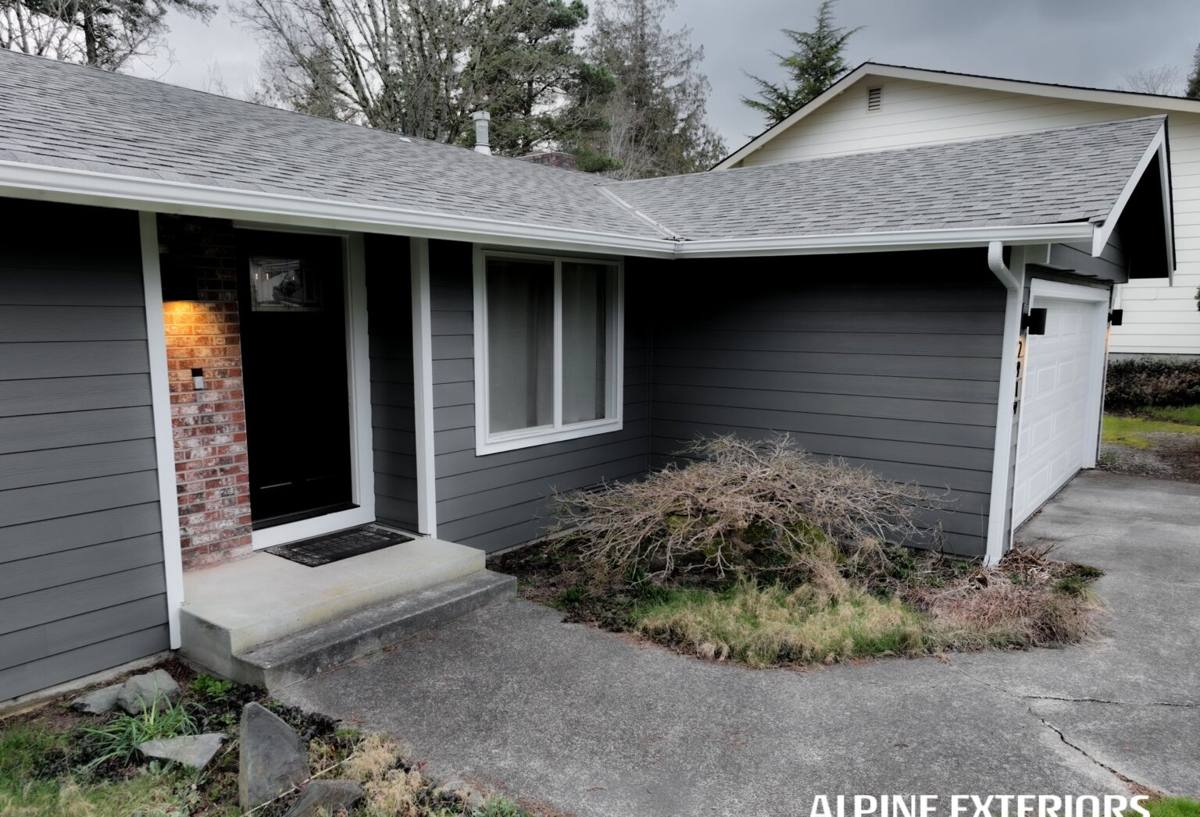
What Ferndale's Climate Actually Does to a Wall System
| Climate Factor | What It Does Over Time | What the Siding System Needs |
|---|---|---|
| Salt-laden air off Bellingham Bay | Corrodes exposed fasteners, staples, and untreated trim metal; accelerates finish breakdown on lower-grade coatings | Corrosion-resistant fasteners and factory finishes engineered to hold up in coastal air |
| Driving, wind-pushed rain | Forces water sideways into laps, seams, and penetrations rather than letting it run straight down | Correct lap exposure, flashing at every penetration, and a properly lapped weather-resistant barrier behind the siding |
| Long moss season | Organic growth holds moisture against the wall surface, especially on shaded north- and west-facing walls | A siding material that doesn't feed moss the way bare wood or paper-faced composites can, plus enough standoff for airflow |
| Freeze-thaw swings | Repeated cycles stress any siding that has already absorbed moisture, cracking brittle or waterlogged material | A material with low water absorption and dimensional stability through temperature swings |
Fiber cement is not automatically immune to any of this. It's a strong material for this climate specifically because it's non-combustible, dimensionally stable, and doesn't swell, rot, or delaminate the way wood-based products can when they take on moisture. But that advantage only holds if the installation respects every item in the right-hand column above.
Why We Install Only James Hardie, Not Generic Fiber Cement
"Fiber cement" is a category, not a single product, and the difference between brands shows up over years, not on install day. We standardized on James Hardie for Ferndale and the rest of our Whatcom County service area for a few specific reasons:
- Climate-engineered product lines. Hardie's HZ5 formulation is engineered for regions with the kind of moisture and freeze-thaw exposure common in this part of Washington, rather than a one-size-fits-all national mix.
- ColorPlus factory finish. The finish is baked on in a controlled factory environment, which holds up better against UV and moisture than field-applied paint, and it comes with its own finish warranty separate from the substrate warranty.
- Track record and warranty structure. Hardie backs its products with a strong, transferable limited warranty, which matters if a home changes hands, and it reflects a manufacturer with decades of real-world performance data behind the product.
- Consistency for installers. Because we install this system exclusively, our crew isn't relearning fastening patterns, clearances, and flashing details across three different brands. That consistency is part of what keeps installation quality high.
We're not going to tell you every other fiber cement product is bad. We are telling you that after years of doing this work in exactly this climate, Hardie's combination of product engineering, finish quality, and warranty backing is what we're willing to put our name behind.
What a Correct Fiber Cement Job Actually Involves
The material is only half the equation. Most siding failures we get called out to inspect in this area aren't material failures — they're installation shortcuts that let water get behind a wall that should have kept it out. A correct fiber cement installation for a Ferndale home includes:
Behind the Siding
A continuous, properly lapped weather-resistant barrier is installed over the sheathing first, with every seam, window, and door opening flashed so water sheds outward and downward, never inward. This layer is what actually keeps a home dry — the siding is the first line of defense, not the only one.
Fastening and Clearances
Fiber cement needs to be fastened per manufacturer specification — correct nail or screw type, spacing, and depth — and held to proper clearances from grade, roof lines, decks, and other siding transitions. Fastening it too tight or too loose, or letting it contact grade or roofing material directly, is one of the most common causes of early failure we see.
Joints, Caulking, and Trim
Butt joints, corners, and trim transitions need to be treated correctly — some sealed, some designed to be left as drainage gaps — following Hardie's published details rather than whatever is fastest for the crew. Getting this backwards is a slow leak that often doesn't show up for a couple of years.
Fasteners and Hardware
Given the salt air this close to the water, we pay particular attention to corrosion-resistant fastener specification. Cutting corners on fastener grade to save a few dollars is exactly the kind of shortcut that shows up as rust streaks and loosening panels a few years down the road.
How the Project Runs, Start to Finish
- On-site assessment. We walk the home, check existing siding and sheathing condition, note moss and moisture patterns specific to the lot, and identify any rot or water damage that needs to be addressed before new siding goes on.
- Product and color selection. We go over Hardie's plank, panel, and shingle options and the HZ5 product line, along with ColorPlus finish colors, so you're choosing based on what actually fits the home and the climate.
- Written estimate. A clear scope covering removal, any sheathing or barrier repair, materials, and installation — no vague allowances.
- Prep and removal. Old siding comes off, sheathing is inspected and repaired as needed, and any hidden moisture damage gets addressed before anything new goes up.
- Weather barrier and flashing. This is the step that determines whether the wall stays dry for the next several decades — it does not get rushed.
- Siding installation. Installed to Hardie's fastening and clearance specifications, with attention to the corners, joints, and penetrations that cause most real-world failures.
- Final walkthrough. We review the finished work with you, including care and maintenance specific to your home's exposure.
What Drives Cost on a Ferndale Fiber Cement Project
| Factor | Why It Affects Price |
|---|---|
| Condition of existing sheathing | Rot or water damage found during tear-off adds repair scope that can't be accurately priced until walls are opened up |
| Home size and wall complexity | More corners, dormers, and trim transitions mean more labor and more places requiring careful flashing |
| Siding profile chosen | Lap siding, panel systems, and shingle-style products differ in material and labor cost |
| Height and access | Two-story walls, steep lots, or limited equipment access add time and staging cost |
| Existing siding removal | Removing and disposing of old wood, vinyl, or composite siding is a separate line item from new installation |
We don't quote a project without seeing it — anyone who gives a firm number over the phone for a home they haven't walked is guessing. What we can tell you upfront is that fiber cement generally costs more than vinyl at install but requires far less repainting and repair over the life of the siding, especially in a climate that's hard on lower-grade materials.
Why Hiring a Crew That Already Works in Ferndale Matters
Siding installation isn't just a spec sheet — it's judgment calls made on-site about where water will actually travel on a specific wall, given the wind direction, shade pattern, and grade around that particular house. A crew that regularly works Ferndale and the surrounding Whatcom County communities has already seen how salt air treats fasteners two winters out, which walls hold moss longest through a wet spring, and where driving rain off the water tends to find weak details in older wall assemblies. That's the kind of pattern recognition that isn't in a manufacturer's install guide, and it's the difference between a job that looks right on day one and one that's still performing right in year fifteen.
Living With Fiber Cement Siding in This Climate
Fiber cement is genuinely low-maintenance compared to wood, but "low-maintenance" isn't "no-maintenance," especially with a moss season as long as this region's. A few habits keep a correctly installed system performing the way it should:
- Rinse shaded, moss-prone walls once or twice a year with a garden hose — avoid pressure washers, which can force water behind laps and trim
- Keep gutters clear so overflow doesn't run down the siding face repeatedly during heavy rain
- Trim back vegetation and tree cover that keeps north- and west-facing walls damp and shaded longer than necessary
- Inspect caulking at trim joints and penetrations every couple of years and have any cracked or missing sealant addressed promptly
- Watch for any early rust staining at fastener heads or trim metal, which is often the first visible sign of a fastener or flashing issue
None of this is heavy upkeep — it's the kind of occasional attention that keeps a well-installed system living up to its warranty for decades, even in a climate that doesn't make it easy on siding.
Get a Straight Answer on Your Ferndale Home
If your current siding is showing moss buildup, soft spots, or paint that won't hold anymore, or you're planning ahead for a replacement, we're happy to come take a look and give you a straightforward, no-pressure estimate specific to your home and its exposure. Use the form below to get started.