 Bellingham
 Siding Repair in Lynden
Lynden sits in a part of Whatcom County where siding takes a slow, steady beating rather than a dramatic one. There's rarely a single storm that wrecks a wall. Instead it's months of damp air, a long moss season, and repeated freeze-thaw cycles working on the same weak points year after year until a small problem — a cracked board, a gap at a trim joint, a soft spot near the ground — turns into something bigger. Siding repair here isn't just about patching what's visible. It's about understanding why that spot failed in the first place and making sure the fix doesn't fail again next winter.
This page covers what siding repair actually involves for homes in and around Lynden, what we look for, and how to tell the difference between a legitimate repair and a wall that's telling you it's time to replace.
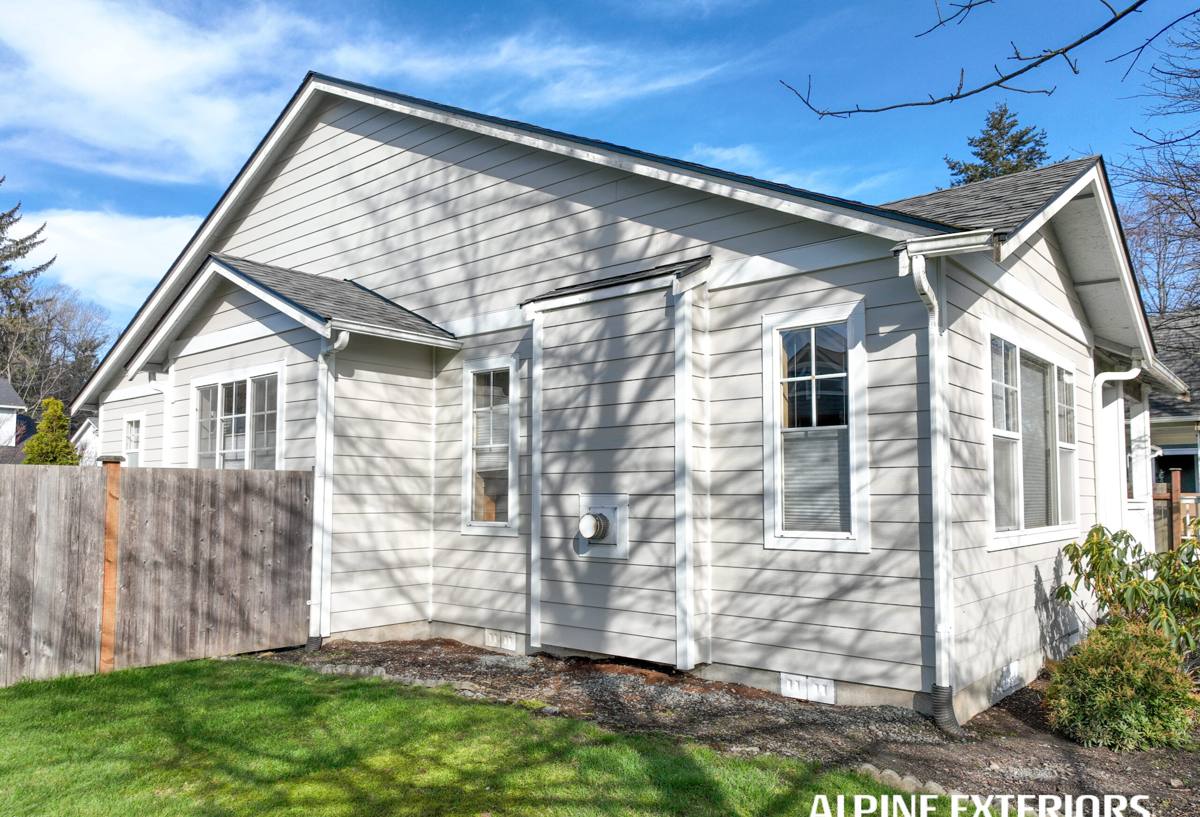
What Whatcom County's Climate Does to Siding
Lynden doesn't get the coastal storms that batter the immediate shoreline, but it shares the same regional pattern that wears down siding across Western Washington: long stretches of driving rain, high humidity that never fully lets up, and a moss and algae season that can run most of the year in shaded or north-facing spots. Add in salt-laden air that drifts inland off the Sound during wet weather, and you've got a combination that's hard on paint, hard on seams, and especially hard on any siding material that wasn't built to handle sustained moisture exposure.
A few climate-driven patterns show up again and again on Lynden homes:
- Moss and algae staining on north- and west-facing walls, fence lines, and anywhere tree cover blocks direct sun and airflow.
- Trim and corner rot where caulking has failed and water has been sitting against wood or wood-composite siding for one too many wet seasons.
- Swelling and delamination in siding with exposed edges — a common failure point on cut boards, corners, and around windows.
- Cracked or split boards from repeated freeze-thaw cycling during cold snaps combined with saturated material.
- Fastener staining and popped nails where seasonal expansion and contraction has worked panels loose over time.
None of these are unusual for the area. What matters is catching them before the underlying sheathing or framing gets involved.
The Difference Between a Cosmetic Fix and a Real Repair
Anyone can caulk a crack and paint over it. That's not a repair — it's a delay. A correct siding repair starts by figuring out whether the damage you can see is the actual problem or just the symptom.
What we check before touching anything
- Whether water has tracked behind the siding and reached the house wrap or sheathing
- Whether the framing or sheathing underneath has softened, stained, or started to rot
- Whether the damage is isolated or part of a pattern that shows up elsewhere on the same wall
- Whether the flashing at windows, doors, and trim boundaries is doing its job or has failed
- Whether the existing material and finish can be reasonably matched, or whether a patch will always look like a patch
If moisture has gotten past the surface, a cosmetic patch just seals a wet problem inside the wall. That's how a $400 repair turns into a $4,000 sheathing replacement two years later. A real repair means opening things up enough to see what's actually happening, not just covering the symptom and moving on.
Common Repair Scenarios We See in Lynden
Wood and wood-composite siding
Cedar and primed wood products look great when they're new, but they depend entirely on paint and caulking staying intact. Once the finish cracks — which happens faster under Whatcom County's rain load than in drier climates — water gets into the wood fiber and doesn't fully dry out between storms. Repairs here often mean cutting out and replacing whole sections, not just spot-patching, because rot spreads along the grain further than it looks from the outside.
LP SmartSide and OSB-based products
Engineered wood siding relies on edge sealant to keep moisture out of the strand board core. Where that sealant has worn thin — cut ends, corners, low clearance from grade — swelling and soft spots show up. Repair is possible if it's caught early, but once the board has visibly expanded or delaminated, the section needs to come out.
Vinyl siding
Vinyl doesn't rot, but it cracks in cold snaps, warps near heat sources like dryer vents, and can pop loose from wind cycling over the years. Matching old vinyl to new is often the hardest part of the repair — sun exposure fades panels unevenly, and manufacturers change color runs over time.
Fiber cement siding
Properly installed fiber cement holds up the best of any siding type in this climate, but it isn't immune to damage — impact cracks, failed caulking at joints, or issues from an installation that wasn't done to spec. Repairs are usually straightforward: cut out the damaged section, replace with matching material, and restore the joint detailing correctly.
Repair or Replace? How We Help You Decide
Not every repair should be a repair. Sometimes patching one more section on a wall that's already failed in three other spots is just spending money to delay a bigger decision. Here's how we think through it:
| Factor | Leans toward repair | Leans toward replacement |
|---|---|---|
| Scope of damage | Isolated to one or two areas | Recurring across multiple walls |
| Sheathing condition | Dry, sound framing underneath | Soft, stained, or rotted sheathing found |
| Material age | Siding is well within its expected service life | Siding is near or past the age where it typically starts failing |
| Material match | Discontinued or unmatched material won't be visually obvious | Patch would create a visible mismatch on a prominent wall |
| Root cause | A one-time or fixable cause (impact damage, one bad seam) | A systemic issue — chronic moisture, poor original installation |
We'll tell you honestly which side of that table your house falls on. If a repair will hold, we'll do the repair. If the underlying siding is past the point where patching makes sense, we'll say so instead of billing you for a fix that won't last.
Our Repair Process
- On-site assessment. We walk the affected area, check moisture readings where needed, and look at adjacent sections that might be showing early signs of the same issue.
- Diagnosis, not guesswork. We identify why the damage happened — failed caulking, bad flashing, grade clearance, material fatigue — so the repair addresses the cause, not just the symptom.
- Honest scope and pricing. You get a clear explanation of what needs to happen and why, before any work starts.
- Correct execution. Matching material where possible, proper flashing and water-shedding detail at every seam, and fastening to manufacturer spec.
- Final check. We confirm the repair blends acceptably with the surrounding siding and that water management at that section is actually restored, not just cosmetically closed up.
When Repair Reveals a Bigger Story
Sometimes what starts as a repair call turns into a longer conversation. If we open up a section and find the same moisture damage repeating across a wall, or the siding material itself is the reason the damage keeps happening, patching that one spot doesn't solve anything — it just moves the next repair call a season or two down the road.
This is part of why we install James Hardie fiber cement siding exclusively when the work moves to replacement. It's a non-combustible material engineered specifically for climates like this one — the HZ5 product line is built for the Pacific Northwest's moisture and temperature patterns, the factory-applied ColorPlus finish resists the fading and cracking that leads to repeat repair calls, and the warranty is transferable if the home sells. We're not going to recommend a full siding replacement when a repair will genuinely hold. But when the underlying material is the actual problem, we'll tell you that plainly and explain what we'd put on the house instead.
Why Hire a Crew That Already Works in Lynden
Siding repair is detail work, and details are exactly what suffers when a crew is unfamiliar with how a specific area's weather behaves. A contractor who works Whatcom County regularly already knows which wall orientations collect moss first, how grade clearance issues tend to show up on older homes here, and what a normal amount of weathering looks like versus damage that needs real attention. That local pattern recognition is the difference between a repair that gets it right the first time and one that misses the actual cause.
It also matters for material sourcing and matching — knowing what's available locally, what's been discontinued, and how to blend a repair into existing siding without it standing out like a patch.
Signs it's time to call for a repair estimate
- Soft or spongy spots when you press on the siding, especially near the ground or below windows
- Visible cracking, splitting, or gaps at seams and corners
- Persistent moss or algae growth that keeps coming back after cleaning
- Peeling or bubbling paint concentrated in one area rather than the whole house
- Staining on interior walls near an exterior wall — a sign water has already gotten past the siding
- Boards that have visibly swelled, warped, or pulled away from the wall
If any of that sounds like your house, it's worth having someone take an honest look before it turns into a bigger job. We offer free, no-pressure estimates for siding repair in Lynden and the surrounding area — fill out the form below and we'll take it from there.