 Bellingham
 South Hill sits up on the slope above downtown Bellingham, which means the homes here take weather a little differently than houses down closer to the water or tucked into the flats. Elevation brings more exposure to wind-driven rain off Bellingham Bay, more direct sun in summer, and — because much of the tree canopy up here is mature fir and cedar — more shade and moisture sitting on north-facing walls for long stretches of the year. If you're building new construction in this neighborhood, the windows you choose and how they're installed will do more to determine your long-term maintenance headaches than almost any other single decision on the house.
This page is about one job specifically: installing new-construction windows in South Hill homes, done right the first time, by a crew that already understands what Whatcom County weather does to a building envelope.
Why South Hill's Conditions Matter for Window Installation
New-construction window installation is different from a replacement job. On new construction, the window unit and the flashing system around it are installed before the siding goes on, which means there's no going back to fix a mistake without tearing into finished exterior work later. Get the flashing sequence wrong on a South Hill build, and the problem won't show up for a year or two — it shows up as a soft spot in the sheathing, a stain creeping down an interior wall, or moss and algae taking hold around a window opening that's staying damp longer than it should.
Three regional factors drive most of what we plan around on South Hill jobs:
- Driving rain — Bellingham gets rain that comes in sideways off the water, not just straight down. Window flashing has to be built to shed water that's hitting the wall at an angle, not just running down the face of the building.
- Salt air — Being close enough to Bellingham Bay means airborne salt accelerates corrosion on cheap fasteners, uncoated flashing, and lower-grade hardware. It's a slow process, but it's real, and it shows up first at metal-to-metal contact points.
- Long moss season — Whatcom County's wet stretch runs long, often eight months or more of the year with regular moisture. Anywhere water can pool or linger — a poorly sloped sill, a gap in caulking, a low spot in trim — becomes a place moss and mildew get a foothold.
What a Correct New-Construction Window Job Actually Involves
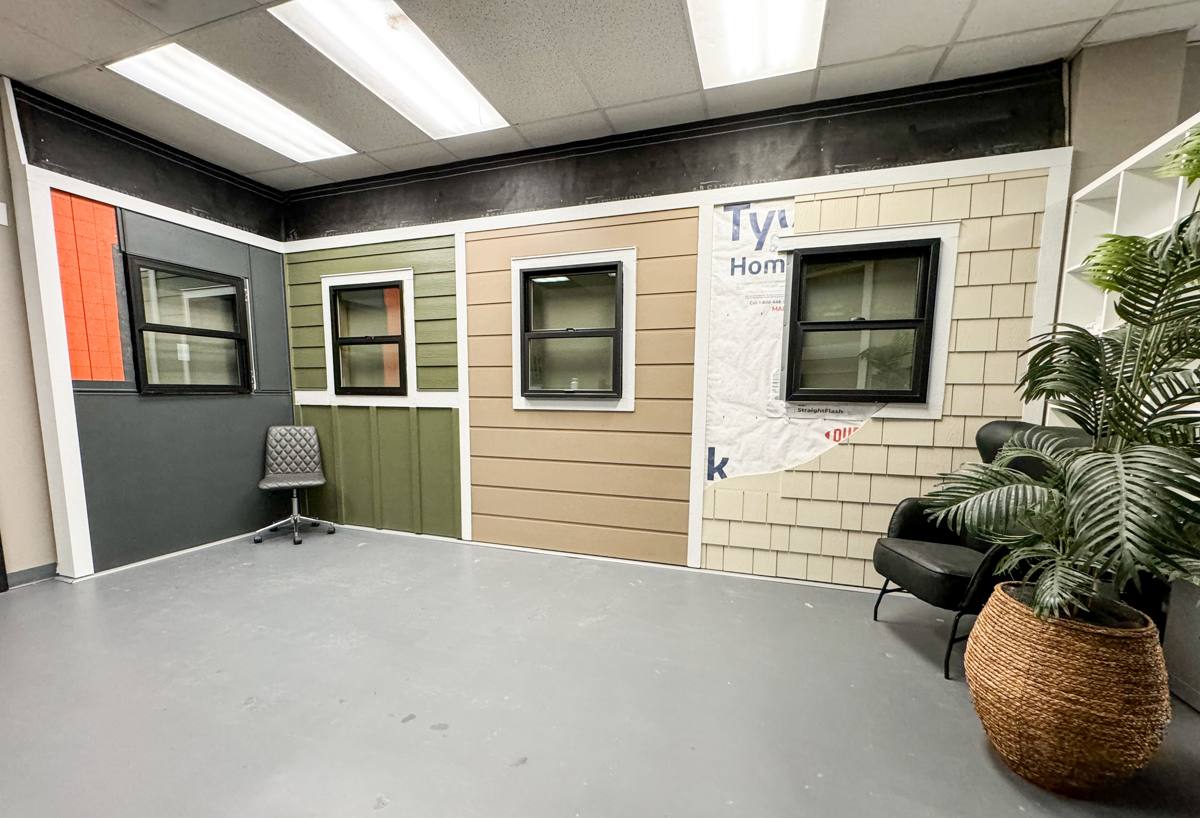
New-construction windows have a nailing fin around the perimeter of the frame, which gets fastened directly to the sheathing and integrated into the house wrap and flashing system before siding covers it. Done correctly, this creates a continuous drainage plane — water that gets behind the siding has a clear path down and out, never toward the framing.
The Sequence We Follow
- Rough opening check. We verify the opening is square, plumb, and sized correctly before the window ever goes near it. An opening that's off by even a little forces shims and compromises the seal.
- Sill pan flashing. A sloped, self-sealing sill pan goes in first, so any water that ever reaches the bottom of the frame drains outward instead of pooling on the sheathing.
- Window-grade weather barrier integration. House wrap gets cut and folded into the opening in a specific order — sides first, then head flashing lapped over the top — so every layer sheds water onto the layer below it, never behind it.
- Window set and fastened. The unit goes in level and plumb, fastened through the nailing fin per the manufacturer's schedule, not just "enough screws to hold it."
- Flashing tape over the fin. Self-adhering flashing tape seals the nailing fin to the wall, with head flashing lapped over the top so water always runs down and over, never up and under.
- Interior and exterior sealant. Low-expansion foam or backer rod and sealant at the interior gap for air sealing; exterior sealant only where the manufacturer specifies it — sealing the wrong joint can trap water instead of keeping it out.
- Final inspection before siding. We check every opening before the next trade covers it up, because once siding is on, mistakes are expensive to find.
Window Materials and Glass: What Holds Up in This Climate
South Hill homes see enough moisture and enough temperature swing between summer sun and winter damp that not every window product performs the same over time. We steer new-construction clients toward vinyl or fiberglass frames with welded (not mechanically fastened) corners, because welded corners don't have a seam where water can work its way in over the years. Wood-frame windows without a clad exterior are a harder sell for us on this side of the county specifically — they look great on day one, but they need consistent repainting and caulk maintenance to keep moisture out of end grain, and that's a maintenance burden a lot of homeowners underestimate until it's overdue.
| Frame Material | Moisture Behavior | Maintenance | Typical Fit for South Hill |
|---|---|---|---|
| Vinyl | Doesn't absorb moisture; welded corners seal well | Low — occasional cleaning | Strong default for most new builds |
| Fiberglass | Very stable, minimal expansion/contraction | Low | Good upgrade for larger openings or higher-end builds |
| Clad wood (wood interior, metal/vinyl exterior) | Good if cladding is intact; interior wood can suffer from condensation if not ventilated | Moderate | Works if the homeowner wants a wood interior look and stays on top of upkeep |
| Bare wood | Absorbs moisture at exposed joints and end grain | High — regular repainting/sealing | Not our first recommendation for this climate |
On glazing, double-pane with a low-E coating and argon fill is the baseline we'd recommend for any new build in this area — it manages both the summer heat gain on south- and west-facing walls and the winter heat loss on the shaded, damp north side. Triple-pane is worth discussing for homes with a lot of glass facing prevailing weather, but it's a cost-versus-benefit conversation, not a must-have for every wall.
Where South Hill Homes Are Most Exposed
Because of the terrain, we pay closer attention to a few specific conditions on South Hill builds:
- Uphill or wind-facing walls catch more driving rain, so we're stricter about head flashing overlap and sealant detailing on those elevations.
- North-facing walls under tree cover stay damp longer, which is exactly where moss and mildew take hold first — good drainage detailing and adequate roof overhangs matter more here than anywhere else on the house.
- Large window walls (increasingly common in newer South Hill builds for the view) mean more linear feet of flashing and more seams — more places for a shortcut to become a problem. Big openings deserve extra time at the flashing stage, not less.
Common Mistakes We See on New Construction
Most window failures on new builds aren't the window's fault — they're installation shortcuts that don't show up until the house has been through a wet season or two. The ones we see most often around Whatcom County:
- Skipping or improperly sloping the sill pan, so water sits against the sheathing instead of draining out.
- House wrap taped in the wrong order (top layer tucked under the layer below instead of over it), which reverses the drainage path.
- Nailing fins fastened without enough flashing tape coverage, leaving gaps where wind-driven rain can get behind the wall.
- Sealant applied at the wrong joint, trapping moisture that got in rather than giving it somewhere to escape.
- Under-fastening at the corners of larger units, which lets the frame flex over time and opens hairline gaps in the seal.
Our Estimate and Installation Process
For new-construction work, we coordinate directly with your builder or general contractor so window installation lines up with the framing and siding schedule — this isn't a job that can happen out of sequence without creating delays for everyone else on site.
What to Expect
- Plan review. We look at your window schedule and rough opening sizes before anything is ordered, so there are no surprises at install time.
- Free on-site or plan-based estimate. We'll walk the site if it's framed, or work from plans if it's earlier in the process, and give you a straightforward written quote.
- Material selection. We'll talk through frame material, glass package, and any performance considerations specific to your lot's exposure.
- Installation. Our crew handles the full flashing and install sequence described above, coordinated with your builder's timeline.
- Documentation. We note what was installed and how, which matters for warranty claims down the road and for whoever does siding or trim work after us.
A Practical Checklist Before You Finalize Your Window Order
- Confirm frame material and finish color match your siding and trim plan.
- Confirm glass package (low-E coating, argon fill, and whether any elevations need upgraded glazing for sun or noise exposure).
- Confirm rough opening sizes match the actual framed openings, not just the plan set.
- Ask your installer how sill pan flashing and house wrap integration will be sequenced.
- Ask what fastening schedule will be used, especially on larger units.
- Confirm who is responsible for exterior sealant and trim after windows are set — this is a common gap between trades.
- Get the manufacturer's warranty terms in writing, including what voids it (this is often tied to installation method).
Why Local Installation Experience Matters Here
A window installed to a generic national standard will hold up fine in a lot of the country. South Hill's combination of elevation, wind-driven rain, salt-tinged air, and a moss season that runs most of the year asks more of the flashing details than a drier climate does. A crew that's worked this specific part of Bellingham has already seen which elevations catch the worst weather, which flashing sequences actually shed water here, and which shortcuts turn into callbacks two winters later. That's not something you can substitute with a manufacturer's install manual alone — it's judgment built from doing this work, in this county, on homes like yours.
If you're building new in South Hill and want your windows installed by a crew that already knows how Whatcom County weather treats a building envelope, we're happy to take a look at your plans or your site and put together a free, no-pressure estimate. There's a form below — reach out and we'll get back to you.