 Bellingham
 Why Sudden Valley Puts Extra Demands on Siding
Sudden Valley sits in a setting that's beautiful to live in and genuinely hard on a house exterior. Mature tree canopy shades large stretches of most lots for much of the day, homes sit close to Lake Whatcom where humidity lingers longer than it does in open, sunnier parts of Whatcom County, and the same marine-influenced weather pattern that brings driving rain and salt-tinged air across the broader Bellingham region still reaches inland communities like this one through prevailing wind and moisture-laden air masses. The combination is a long moss season, slow-drying wall surfaces, and siding that's rarely given a real chance to dry out between storms.
That matters more than most homeowners realize. Siding doesn't fail because of one bad storm — it fails because of thousands of small wet-dry cycles over years, and homes with heavy shade and lake-adjacent humidity go through more of those cycles per season than homes in open, sun-exposed neighborhoods. Wood-based products soften and swell. Vinyl doesn't rot, but it doesn't stop moss and algae from taking hold on its surface either, and it can't be pressure-washed aggressively without damage. Whatever goes on a Sudden Valley home needs to tolerate sustained dampness, resist moss and mildew growth, and hold its finish without repainting every few years in an environment where a ladder job under tree cover isn't anyone's favorite Saturday project.
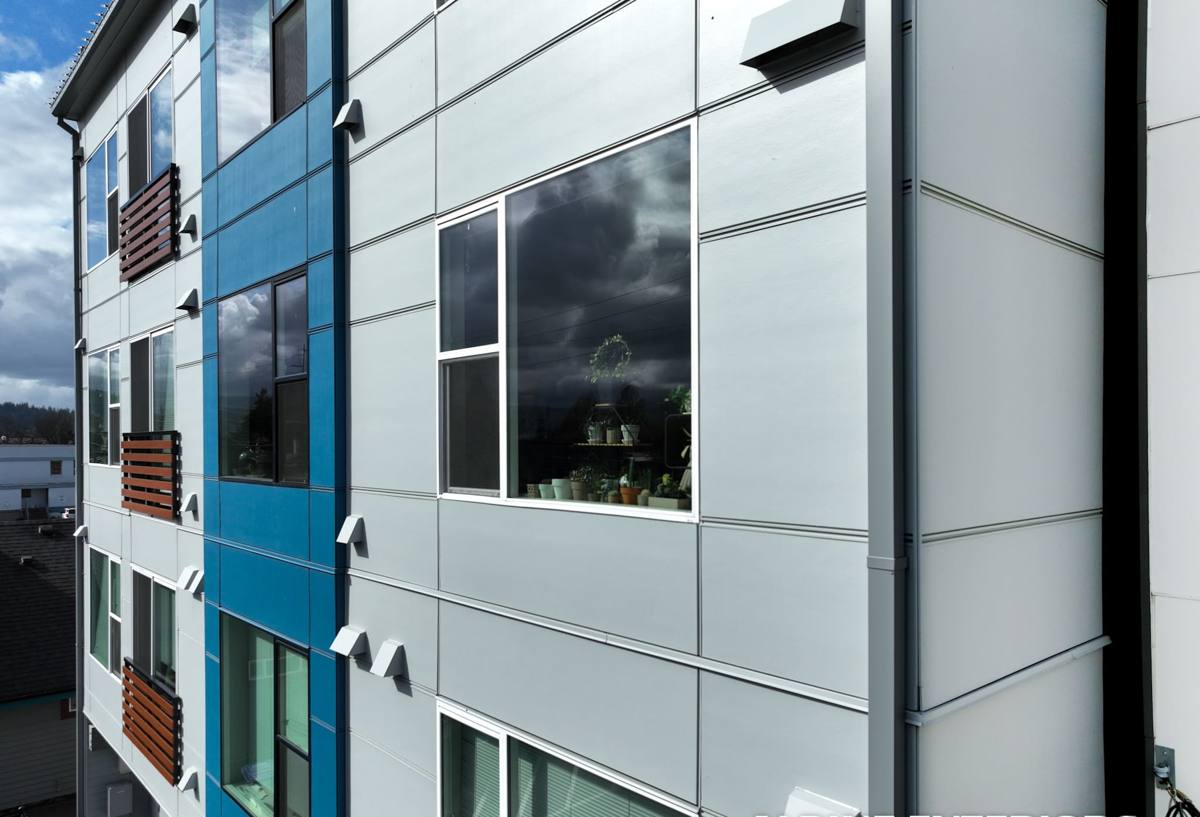
Why We Only Install James Hardie Here
We install James Hardie fiber cement exclusively — not vinyl, not LP SmartSide, not cedar or primed spruce, not Cemplank or Allura. That's a deliberate standard, not a sales default, and in a climate like Sudden Valley's the reasoning is straightforward.
- Non-combustible core. Fiber cement doesn't feed a fire the way wood-based siding can, which matters on wooded lots with limited defensible space between structures and trees.
- Moisture-stable substrate. Hardie board doesn't swell, rot, or delaminate the way engineered wood siding can when it stays damp for extended stretches, which is exactly the condition shaded, lake-adjacent lots create.
- Factory-cured ColorPlus finish. The finish is baked on at the factory rather than field-applied, so it holds color and resists the fading, cracking, and peeling that shade, humidity, and UV cycling eventually cause on site-painted or site-stained surfaces.
- Moss and mildew resist better on a hard, stable surface. Fiber cement doesn't give moss the organic material to feed on the way wood-based products can, and it stands up to the periodic soft-washing needed to keep a shaded wall clean.
- HZ5 engineering. James Hardie's HZ5 product line is engineered for wetter, more freeze-prone climate zones — a better match for Whatcom County's weather pattern than a general-purpose formulation.
None of that means other products are junk. Vinyl is inexpensive and low-maintenance in the right setting; cedar has real curb appeal for the right buyer. But we've made a professional call that on the homes we work on in this climate, fiber cement is the material that holds up with the least long-term maintenance burden and the fewest surprises — and that's what we put our name behind.
What Correct Installation Looks Like on a Shaded, Wet Lot
Clearance and airflow first
On a heavily treed lot, the install details that matter most are the ones that manage moisture and airflow, not just the ones that look right from the curb. That starts with proper clearance from grade, decking, and roof lines so water has somewhere to go and siding isn't sitting in a permanently damp zone at its base.
Flashing and water management
Every window, door, and horizontal trim transition needs correctly lapped flashing and drainage behind the cladding — a rain screen or drainable house wrap that lets any moisture that does get behind the siding find its way back out instead of sitting against the sheathing. This is the step that separates a Hardie installation that lasts decades from one that develops hidden rot problems behind a perfectly good-looking surface.
Fastening and joints to spec
James Hardie publishes specific fastener patterns, joint treatments, and caulking requirements, and those specs exist for a reason — get them wrong and you can void the manufacturer's warranty even though the board itself is correctly rated for the climate. Butt joints get properly flashed or caulked with a compatible sealant, not just butted together and painted over.
Working around tree cover
Shaded lots also mean working around root systems, low branches, and softer, often uneven ground near the foundation. Staging, scaffolding, and material storage all take more planning on a lot like this than on an open, flat one — and it affects how a crew sequences the job to avoid tracking damage across landscaping that took years to establish.
Comparing Siding Options for a Sudden Valley Climate
| Factor | James Hardie Fiber Cement | Vinyl | LP SmartSide / Engineered Wood |
|---|---|---|---|
| Moisture & prolonged dampness | Stable; won't swell or rot | Won't rot, but traps moisture behind panels if not vented | Vulnerable to swelling and edge rot if moisture reaches the substrate |
| Moss/algae resistance | Hard surface resists growth, cleans well | Can host moss and mildew in shaded areas | More susceptible; organic wood fiber content |
| Fire performance | Non-combustible | Melts/deforms under heat | Combustible, treated but still wood-based |
| Finish longevity | Factory ColorPlus, long fade resistance | Can fade and chalk over time | Field-applied finishes need repainting cycles |
| Typical lifespan installed to spec | 30+ years | 20-30 years | 15-25 years, climate-dependent |
| Upfront cost | Higher material and labor cost | Lowest upfront cost | Mid-range |
Upfront cost is real and worth being honest about — Hardie siding costs more to install than vinyl and generally more than engineered wood. What that premium buys in a climate like this is fewer callbacks for moss cleaning, no repainting cycle, and a product that isn't fighting the environment it's installed in.
Our Process for a Sudden Valley Project
1. On-site assessment
We walk the property, note tree cover and shade patterns on each elevation, check existing siding and trim for moisture damage, and look at drainage around the foundation before quoting anything.
2. Product and color selection
We help pick the right Hardie board profile and HZ5 formulation for the exposure on each wall, and walk through ColorPlus options that will hold up against the specific light conditions on a shaded lot — some colors show fading and dirt differently under constant shade than they do in full sun.
3. Tear-off and substrate check
Old siding comes off and we inspect the sheathing underneath for hidden moisture damage before anything new goes up — this is often where a shaded, damp lot reveals problems that weren't visible from outside.
4. Water management and installation
Drainable house wrap, correct flashing at every penetration, and fastening to manufacturer spec, installed by a crew trained specifically on Hardie's requirements.
5. Final walk-through
We review the finished job with the homeowner, cover basic care specific to a shaded, lake-adjacent property, and make sure everything meets both James Hardie's install standards and our own.
Signs Your Current Siding Is Losing the Battle
- Persistent green or black staining that returns within weeks of cleaning
- Soft or spongy spots when pressed, especially near the bottom courses or under windows
- Paint or finish that's peeling, bubbling, or chalking faster than it used to
- Visible warping, cupping, or gaps opening up at seams and corners
- A musty smell near exterior walls, which can point to moisture reaching the sheathing
- Higher heating bills than neighboring homes of similar size, which can indicate a compromised water/air barrier
Why Hiring a Crew That Already Works This Community Matters
A crew that's worked other Sudden Valley properties already understands the practical realities specific to the area — narrower access on wooded lots, working respectfully around established landscaping and root zones, and the kind of shade-driven moisture patterns that show up on north- and east-facing walls under tree cover. That experience shows up in fewer surprises mid-project and a finished job that's sequenced around the site instead of fought through it. It also means familiarity with permitting and any community guidelines that apply to exterior work in the neighborhood, so there are no late surprises on approvals or aesthetic requirements.
Ongoing Care After Installation
Hardie siding is genuinely low-maintenance, but "low-maintenance" isn't "zero-maintenance," especially under tree cover. A periodic soft-wash — never a high-pressure blast directly at seams and joints — keeps moss and algae from establishing on shaded walls. Keeping gutters and downspouts clear prevents overflow from running down the siding face repeatedly, which is one of the more common causes of localized staining. And if branches have grown in close enough to keep a wall shaded and damp nearly year-round, a bit of trimming to let light and air reach that section will do more for the siding's long-term look than any cleaning product will.
If your Sudden Valley home's siding is showing its age, or you're planning ahead for a replacement, we're happy to walk the property with you and give you a straight assessment — no pressure, no upsell into a product we don't believe belongs on your house. Reach out for a free estimate using the form below.