 Bellingham
 Why Siding Wears Differently on the South Shore of Lake Whatcom
Sudden Valley sits in one of the more heavily wooded, shaded settings in the Bellingham area, and that changes how siding ages compared to a house on an open lot in town. Tree cover keeps roofs and walls cooler and damper for longer after every rain. Lake proximity adds humidity to the air on top of what Whatcom County already gets from its marine climate — the same driving winter rain and salt-laden air off Bellingham Bay that every siding surface in this county has to deal with, just filtered through more shade and less direct sun to dry things back out.
That combination is why we see different failure patterns in Sudden Valley than we do on siding jobs closer to downtown Bellingham or out on more exposed lots. It's rarely storm damage that brings us out here. It's slow, moisture-driven deterioration that's been building for years before it becomes visible.
The Wooded, Shaded Effect on Siding
Homes tucked under mature trees get less UV exposure, which sounds like a good thing — less fading, less sun damage. But UV is also what dries siding out between rain events. Without it, moisture sits longer at seams, laps, and anywhere caulk has started to fail. Wood-based siding products are especially vulnerable to this cycle because they absorb water at cut edges and joints; fiber cement resists it far better, which is a big part of why we standardized on it.
Moss, Algae, and Slow-Drying Surfaces
A long moss season isn't just a roof problem. On north-facing walls, under eaves, and anywhere siding stays shaded most of the day, moss and algae get a foothold on horizontal trim, butt joints, and anywhere water sheets rather than sheds. Left alone, that growth holds moisture against the siding surface around the clock, which accelerates rot in wood products and can degrade paint and caulk faster than a clean-drying wall ever would.
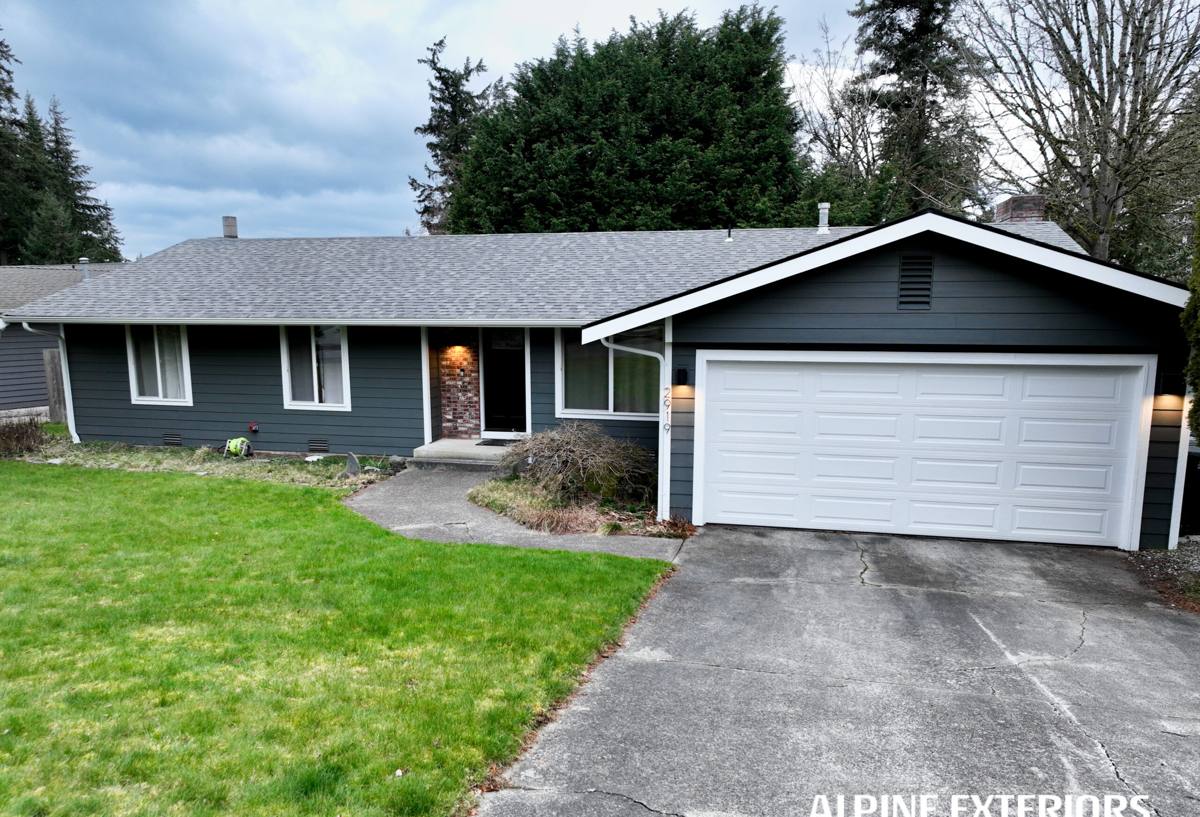
What a Correct Siding Repair Actually Involves
A lot of "siding repair" in this region is really just patching — caulk over a gap, a fresh coat of paint over a soft spot, a board swapped out without asking why it failed in the first place. That approach buys a season or two, not a fix. A correct repair starts with figuring out why that section failed while the rest of the wall didn't.
Diagnosing the Cause, Not Just the Symptom
Before we touch anything, we're looking at the water-management system behind the siding, not just the siding itself: flashing at windows and doors, kick-out flashing at roof-to-wall intersections, the condition of the weather-resistant barrier where we can access it, and whether the original installation left gaps, tight caulk-only joints, or ground contact that's been feeding moisture into the wall for years. If we replace boards without addressing what let water in, the same spot fails again.
Matching Material and Finish
On a home already sided in James Hardie fiber cement, a repair should use the matching HZ product line and, wherever possible, a factory ColorPlus finish that matches the existing color rather than a field-painted patch that will weather differently over time. On homes sided in other materials, we'll always tell you honestly what your options are — including where a full section or full re-side makes more long-term sense than chasing patches on a product that's reaching the end of its practical service life.
Common Repair Scenarios We See in Sudden Valley
| What We Find | Likely Cause | What the Repair Involves |
|---|---|---|
| Soft, delaminating boards near ground level | Mulch or landscaping holding moisture against the base of the wall, slow drying from shade | Remove and replace affected boards, restore proper clearance, correct flashing/drainage at grade |
| Cracked or peeling caulk at seams and trim | Wide temperature swings and constant humidity cycling the joint | Strip old caulk, inspect substrate underneath, re-seal with a product rated for the exposure |
| Moss or algae staining on lower/shaded courses | Limited sun exposure under tree canopy, slow air movement | Careful cleaning, evaluate for hidden moisture damage, address the shading/drainage issue where possible |
| Warped or bowed panels on wood-based siding | Repeated wet/dry cycling on a moisture-absorbent substrate | Panel replacement; often the first sign a broader re-side conversation is worth having |
| Nail pops or fastener staining | Original installation didn't account for expansion, or wrong fastener for the product | Re-fasten to manufacturer spec, patch and finish to match |
Repair vs. Replacement: When a Section Isn't Worth Saving
Not every damaged wall needs a full re-side, and we won't tell you it does. But there's a point where patching stops making financial sense. If we're finding rot at multiple, unrelated locations on the same wall, if the underlying wood-based material is failing broadly rather than in one isolated spot, or if the home is old enough that matching the existing siding profile and finish is no longer realistic, a targeted repair becomes a short-term fix on a wall that needs a real plan. We'll tell you straight which situation you're in before we quote anything.
Our Process for a Sudden Valley Repair Call
1. On-Site Assessment
We walk the exterior, identify every affected area (not just the one you called about — shaded, low-visibility spots often have damage the homeowner hasn't spotted yet), and check the flashing and drainage details behind the problem areas where accessible.
2. Honest Scope and Options
You get a clear explanation of what's failing, why, and what it will take to fix it correctly — including whether a repair is the right call or whether we think you're better served by a larger conversation.
3. The Repair Itself
We remove only what needs to come out, correct the water-management issue underneath if there is one, and install matching material and fasteners to the manufacturer's spec — not just to what will hold for a season.
4. Finish and Cleanup
Caulk, paint-match, and site cleanup so the repair blends in rather than standing out as an obvious patch.
Why We Install and Repair With James Hardie Fiber Cement
When a repair does turn into a larger conversation — a full wall section, an addition, or a whole-house re-side — our answer is James Hardie fiber cement, and only James Hardie. We don't install vinyl, LP SmartSide, Cemplank, Allura, primed spruce, or cedar. That's not a marketing line; it's a standard we hold because of what we see in the field in exactly the conditions Sudden Valley homes face: constant shade, long moss seasons, and moisture that doesn't dry out quickly. Fiber cement doesn't absorb water and swell the way wood-based products can, it's non-combustible, and the HZ5 product line is engineered for wetter, harsher climates like ours. The factory-applied ColorPlus finish holds up to UV and moisture far better than field-applied paint, and it's backed by a strong, transferable warranty. We'd rather turn down a job than install a product we don't believe will hold up on a shaded lake-shore lot in Whatcom County.
Why It Matters That We Already Work in This Community
Sudden Valley's terrain, tree cover, and access can be different from job to job elsewhere in Bellingham — narrower access points, mature landscaping close to the house, and lots where equipment staging takes more planning than it would on a flat, open street. A crew that's already done repair work in this specific community knows to plan for that before the truck shows up, not after. It also means we've seen how siding actually performs here over multiple seasons, not just how it's supposed to perform on paper — which shapes the honest advice you get about repair versus replacement.
What You Can Check Before We Come Out
- Look for soft or spongy spots by pressing gently on siding near the ground and under windows
- Check for visible moss or algae buildup on shaded or north-facing walls
- Note any cracked, missing, or peeling caulk at trim, corners, and window/door edges
- Look for staining or streaking below fasteners or at panel seams
- Check that mulch, soil, or plantings aren't piled up against the base of the siding
- Note any areas where gutters or downspouts have been overflowing onto the wall below
If you're seeing any of that on your Sudden Valley home, or you're just not sure what you're looking at, we'll come take a look. The estimate is free, there's no pressure, and you'll get a straight answer about whether it's a simple repair or something bigger — just fill out the form below to get started.