 Bellingham
 Roofing York Homes for Bellingham's Marine Climate
York sits close enough to the water and the tree line that its roofs take a beating most inland homes never see. Salt-laden air off Bellingham Bay works on exposed metal fasteners and flashing year-round. Driving rain off winter storms finds every weak seam, nail hole, and worn flashing detail. And the shade from mature Western Washington tree cover means moss and moisture linger on north-facing slopes for months at a stretch. A roof that's correctly built for this combination doesn't just look fine on installation day — it's still doing its job in twelve years when a roof built for a drier climate would already be showing granule loss, soft decking, or moss undermining the shingle mat.
New roof installation in York isn't a different product than what we'd install anywhere else in Whatcom County, but it does require different judgment calls: how much underlayment coverage to use, where ventilation has to be beefed up, which flashing details get extra attention, and how the roof is detailed to shed moss and standing moisture instead of holding onto it. This page covers what that actually looks like.
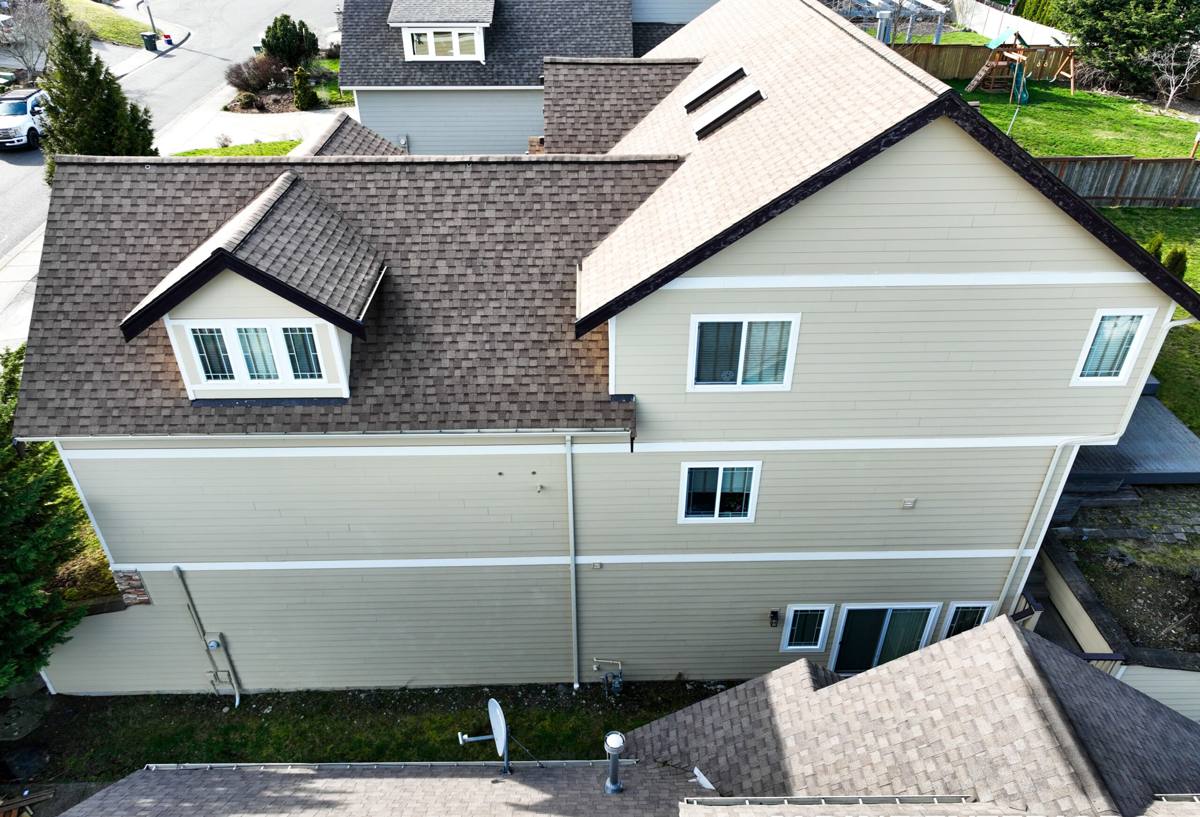
Signs a York Roof Is Due for Full Replacement
Not every roofing problem calls for a full tear-off. Isolated leaks, a handful of missing shingles, or damaged flashing around one vent are usually repair jobs. Full replacement makes sense when the roof's underlying structure and materials are past the point where patching buys you meaningful time. Common signs we look for on York homes include:
- Shingles that are cupping, curling, or losing granules across large sections, not just one slope
- Moss that keeps returning within a season or two of cleaning, especially on shaded north and east-facing roof planes
- Soft or spongy decking felt underfoot during inspection, usually from long-term moisture intrusion
- Daylight visible through the roof deck from inside the attic, or water staining on rafters and sheathing
- Flashing around chimneys, skylights, and roof-to-wall transitions that's rusted, lifted, or was never properly step-flashed
- A roof already past 20-25 years old for asphalt composition, regardless of how it looks from the ground
- Rising energy bills paired with an attic that's noticeably warmer or colder than it should be, pointing to failed ventilation
If you're seeing two or more of these at once, it's worth a real inspection rather than another round of spot repairs. A roof in that condition is usually costing more in repeat repair calls than a planned replacement would.
What a Correctly Installed New Roof Actually Involves
Tear-Off and Deck Inspection
We remove the existing roofing down to bare decking rather than layering over it. That's the only way to actually see the plywood or plank sheathing underneath — and in a climate that drives moisture into roofs for months at a time, hidden deck rot is common enough that skipping this step is how homeowners end up with a new roof over a rotten structure. Any soft, delaminated, or water-damaged decking gets cut out and replaced before anything new goes down.
Ice and Water Shield in the Right Places
Bellingham doesn't get the deep freeze-thaw cycles that make ice damming a constant concern further inland or at elevation, but driving rain and wind-blown water still push moisture up under shingles at eaves, valleys, and low-slope transitions. We run self-adhering waterproof membrane at those vulnerable points — eaves, valleys, around penetrations — as a second line of defense behind the shingles themselves, not just where code minimums require it.
Synthetic Underlayment Across the Field
Over the whole roof deck, synthetic underlayment gives a continuous water-resistant layer that also holds up better underfoot during installation than older felt products, and it doesn't absorb and hold moisture the way felt can in a wet climate.
Flashing Details
Flashing failure is the single most common cause of "new-ish roof, old leak" calls we see. Step flashing at wall intersections, counter-flashing at chimneys, and proper metal at valleys and skylights all get installed fresh — not reused from the old roof, and not caulked-over as a substitute for correct metal work.
Ventilation
Balanced intake and exhaust ventilation keeps the attic close to outdoor temperature and humidity, which protects the decking from underneath and helps shingles last their full rated life. This gets checked and corrected on every replacement, not just installed to match whatever was there before.
Material Options for a York Roof
Most York homes are well served by dimensional asphalt composition shingles, but it's worth understanding the real trade-offs between the common options rather than picking on appearance alone.
| Material | Typical Lifespan | Moss & Moisture Behavior | Notes for This Climate |
|---|---|---|---|
| Architectural asphalt shingles | 25-30 years | Good with proper ventilation; moss-resistant granule options available | Best balance of cost, performance, and warranty support for most homes |
| Standing seam metal | 40-50+ years | Sheds moisture and moss very well; minimal organic buildup | Higher upfront cost; needs correct fastener and underlayment detailing near salt air |
| Cedar shake | 20-30 years with upkeep | Higher maintenance burden — absorbs moisture and needs regular treatment to resist moss and rot | Can work with a strong maintenance commitment; we're upfront that it's more demanding here than in drier climates |
| Synthetic/composite shingle | 30-50 years | Low moisture absorption, good moss resistance | Good middle ground where the look of shake or slate is wanted with less upkeep |
We install what fits the home and the budget honestly. For most York roofs, a quality architectural shingle with proper ventilation and flashing outperforms a cheaper installation of a "better" material — the installation quality matters more than the material name on the wrapper.
What Actually Drives the Cost
| Factor | Why It Matters |
|---|---|
| Roof pitch and walkability | Steeper roofs take longer, need more safety setup, and slow every step of tear-off and install |
| Number of existing layers | Tearing off two layers of old roofing costs more in labor and disposal than one |
| Deck condition | Rotten sheathing found during tear-off adds material and labor that can't be known until the old roof is off |
| Roof complexity | Valleys, dormers, skylights, and multiple penetrations all add flashing labor |
| Access | Tight lots, limited driveway access, or overhead power lines near York properties can affect equipment staging |
We walk every roof before quoting so the estimate reflects the actual home, not a generic per-square number.
How Our Process Works, Start to Finish
- Inspection and estimate — we get on the roof (or use a lift where needed), check the deck where accessible, and give a written estimate with no pressure to sign on the spot
- Material selection — we walk through shingle or metal options, color, and warranty coverage so you know exactly what's going on the house
- Site protection — landscaping, siding, and gutters get covered or protected before tear-off starts
- Tear-off — old roofing comes off down to the deck, with damaged sheathing identified and flagged before anything new goes down
- Deck repair — any rotten or delaminated decking is replaced, not covered over
- Underlayment and flashing — ice-and-water membrane, synthetic underlayment, and new flashing go in at every vulnerable point
- Roofing installation — shingles or panels installed to manufacturer spec and local code, including proper nailing pattern and exposure
- Ventilation check — intake and exhaust venting confirmed and corrected as needed
- Cleanup and magnetic nail sweep — the yard and driveway get swept for stray nails before we consider the job done
- Final walkthrough — we go over the finished roof with you before wrapping up
Ventilation and Moisture: The Part Homeowners Rarely See
A new roof's warranty is only as good as the attic underneath it. In a marine climate like Bellingham's, an attic that's poorly ventilated traps humid air, which condenses on the underside of the decking and slowly rots it from the inside — often invisibly, until a soft spot or stain shows up years later. We check soffit intake, ridge or box exhaust venting, and insulation baffles as part of every replacement, and we'll tell you plainly if your attic setup needs correction, rather than just laying new shingles over an unresolved moisture problem.
Moss: Prevention Built Into the Roof, Not Just Cleaning After the Fact
Moss on a York roof usually isn't a sign of a bad roof — it's a sign of shade, moisture, and organic debris (needles, leaves, seed pods) sitting on the surface long enough to take hold. A new installation can reduce how fast moss returns:
- Zinc or copper strips near the ridge, which release trace metal ions that discourage moss growth as rain washes over the roof
- Moss-resistant shingle products with algae- and moss-inhibiting granules, where that fits the material choice
- Correct ventilation to keep the deck and shingle underside drier
- Trimming back overhanging branches where possible, which is a homeowner-side step that makes a real difference on shaded York lots
None of this makes a roof moss-proof — nothing does in this climate — but it meaningfully slows the return cycle compared to a roof installed without those details.
Permits and Whatcom County Requirements
Roof replacement typically requires a permit, and inspection requirements can vary depending on jurisdiction within Whatcom County and whether York falls under city or county authority for a given property. We handle permitting as part of the job — pulling the permit, scheduling required inspections, and making sure the finished roof meets current code, including ventilation and underlayment requirements. If your property has an HOA with roofing material or color guidelines, that's worth flagging before material selection so there's no rework later.
Why Local Experience in York Actually Matters
Roofing crews that already work in and around York know which slopes in the neighborhood tend to hold moss longest, how prevailing wind and rain patterns off the bay tend to attack certain roof orientations, and what deck conditions are common in homes of a given age and construction style in the area. That's not a marketing point — it changes real decisions, like where we add extra ice-and-water coverage or which ventilation approach makes sense for a given roof shape. It also means faster response if something needs a follow-up look after a storm, rather than waiting on a crew that has to drive in from outside the county.
Get a Straight Answer on Your Roof
If your York home's roof is showing its age, or you just want an honest opinion on whether it's a repair or a replacement, we're glad to take a look. There's a free, no-pressure estimate form below — fill it out and we'll get back to you with next steps.