 Bellingham
 Why Siding in Barkley Takes a Different Kind of Beating
Barkley sits close enough to Bellingham Bay and the surrounding waterways that homes here deal with a steady mix of salt-laden air, wind-driven rain, and long stretches of overcast, damp weather that can last for months. None of that is dramatic on any single day, but it adds up. Siding doesn't usually fail because of one storm — it fails because it never fully dries out between one wet spell and the next.
Barkley was largely built out as a planned neighborhood with a lot of tree cover, landscaped setbacks, and a mix of siding materials installed over the past two-plus decades. That combination of mature trees and consistently wet Whatcom County winters means shaded wall sections stay damp longer, and damp siding is where moss, algae, and rot get their foothold. Repair work here isn't just cosmetic touch-up — it's usually about interrupting a moisture problem before it spreads behind the wall.
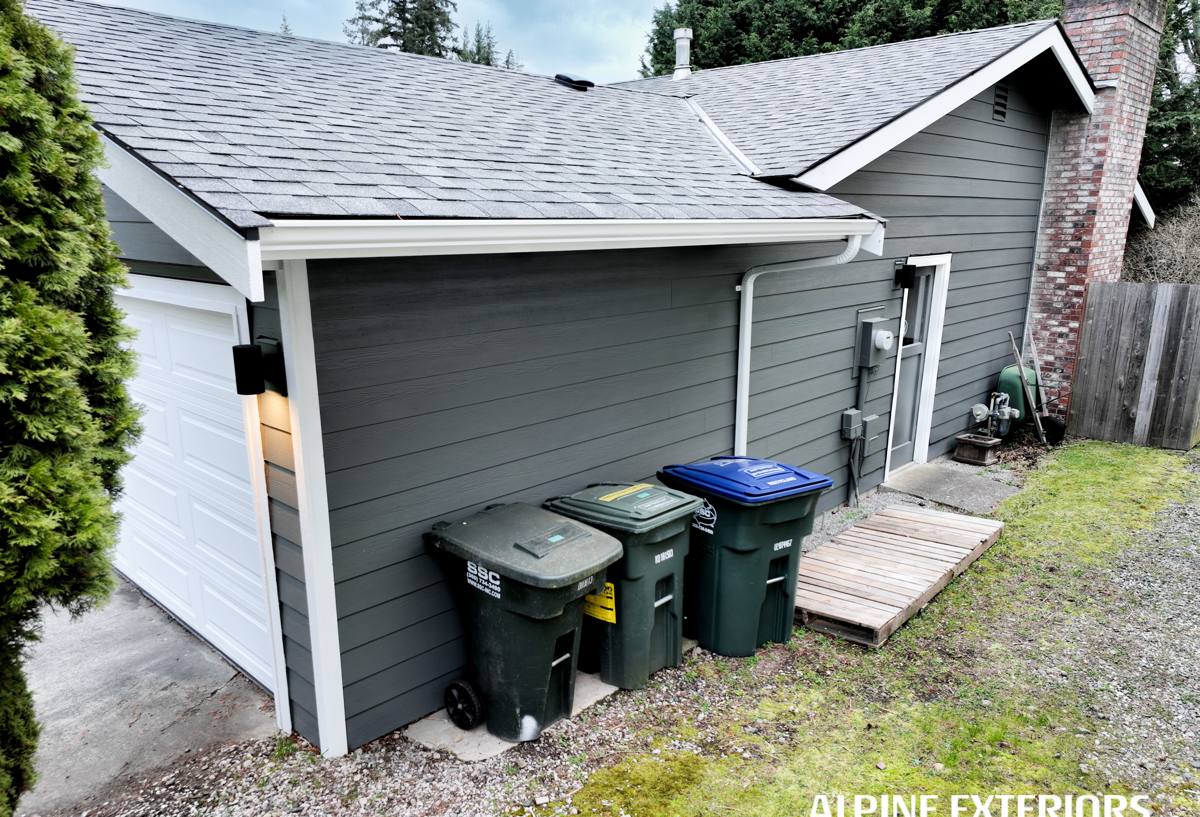
The Damage We Actually See on Barkley Homes
Moisture Intrusion at Joints and Corners
Most siding failure starts small: a gap at a butt joint, a corner trim piece that's pulled away slightly, a window return where the original caulk has shrunk and cracked. Water finds these openings during driving rain and works its way behind the siding. By the time a homeowner notices a soft spot or discoloration on the surface, there's often already damage to the sheathing or water-resistive barrier underneath.
Moss, Algae, and Trapped Moisture
Whatcom County's long moss season is real, and it's not just a roof problem. North-facing walls, shaded sections under trees, and areas with poor airflow collect moss and algae growth that holds moisture directly against the siding surface for weeks at a time. On materials that aren't dimensionally stable, that constant damp contact leads to swelling, delamination, or paint failure well before the siding is actually worn out.
Cracking, Warping, and Fastener Failure
Repeated wet-to-dry cycling stresses siding materials differently depending on what they're made of. Boards that expand and contract with moisture can crack at fastener points, cup at the edges, or pull nails loose over time. We also see impact damage — from ladders, downspouts coming loose in wind, or general yard equipment — that's minor on its own but becomes an entry point for water if it's not addressed.
What a Correct Siding Repair Actually Involves
Diagnosing the Cause, Not Just the Symptom
A patch that covers up a stained board without figuring out why it stained is a temporary fix at best. A correct repair starts with removing enough siding to see what's happening behind it: is the water-resistive barrier intact, is flashing directing water where it should go, is there evidence of rot in the sheathing or framing underneath. Skipping this step is the single most common reason a "repaired" section fails again within a year or two.
Matching Existing Siding Without a Patchwork Look
Replacing a damaged section so it blends in takes more than grabbing the closest board on the shelf. Profile, exposure, and finish all have to line up, and factory-finished siding in particular can be difficult to match once it's weathered for several years. Where an exact match isn't realistic, we're upfront about it and talk through options — sometimes that means refinishing a full wall section rather than leaving an obvious seam.
Getting the Details Right
Correct flashing (including kick-out flashing where a roofline meets a wall), proper fastener placement and spacing, and the right sealant for the material and location all matter more than they get credit for. These are the details that determine whether a repair holds up through another Whatcom County winter or opens back up after the first hard rain.
What Drives the Cost of a Siding Repair
| Factor | Why It Matters |
|---|---|
| Extent of hidden damage | If sheathing or framing underneath needs repair, the job grows beyond just replacing visible boards |
| Material being repaired | Some siding materials are straightforward to source and match; others require special ordering or a wider color-match repair |
| Height and access | Second-story sections, steep grades, or tight side yards common in Barkley's lots can add setup time |
| Number of separate damaged areas | Several small repair spots across a house often costs more in total than one larger, contiguous section |
| Age and condition of surrounding siding | Older, more brittle siding nearby can crack during removal, expanding the repair area |
We give homeowners a written scope before starting so there aren't surprises once we open up a wall section — if we find something worse than expected underneath, we stop and talk it through before proceeding.
Repair or Replace? How We Help You Decide
Not every damaged section needs a full re-side, and we're not going to sell a whole-house replacement when a targeted repair will genuinely hold up. That said, repair isn't always the right call either. A few honest signs that point toward replacement rather than repeated patching:
- Damage shows up in multiple, unrelated areas of the house rather than one isolated spot
- The siding has already been patched more than once in the same general area
- The material itself is nearing or past its realistic service life
- Removing damaged sections reveals moisture problems in the sheathing across a wider area
- The existing siding can no longer be color-matched in a way that looks acceptable
When a repair makes sense, we do the repair — that's the honest answer more often than not for isolated damage caught early.
Our Siding Repair Process
- Inspection: We look at the visible damage and check adjacent areas, trim, flashing, and typically overlooked spots like inside corners and roof-to-wall intersections.
- Diagnosis: We identify the actual cause — a sealant failure, a flashing gap, trapped moisture from moss growth, or straightforward impact damage.
- Written scope: You get a clear explanation of what we found and what we recommend, including if there's a chance we'll find additional damage once we open the wall.
- Removal and underlying inspection: Damaged siding comes off and we check the water-resistive barrier and sheathing before closing anything back up.
- Repair and refinish: Boards are replaced or repaired, flashing and sealant are corrected, and the finish is matched as closely as the material allows.
- Final walkthrough: We show you the completed work and explain anything worth keeping an eye on going forward.
Why We Standardize on James Hardie — Even for Repair Work
Our company only installs James Hardie fiber cement siding, and that shapes how we handle repairs too. When we're patching or extending existing Hardie siding, the ColorPlus factory-finish system and Hardie's consistent product lines make matching far more predictable than it is with materials that fade or discolor unevenly. That's a real, practical advantage during a repair — it's one less variable working against a clean result.
When a repair job is on a different material and we find the damage is symptomatic of a broader issue with that product — vinyl that's become brittle and cracks further during removal, engineered wood siding with edge swelling once its seal has broken down, or painted wood needing repeated refinishing — we'll tell you plainly what we're seeing. We don't install those alternative materials as replacements, and we're transparent about why: moisture behavior, long-term maintenance burden, and how they hold up under repeated repair versus how James Hardie's fiber cement performs. Where a full re-side becomes the right call, non-combustible fiber cement with a factory finish and a strong transferable warranty is what we put on the house — not because the other products are without merit, but because it's the standard we're willing to stand behind long-term in this climate.
Why a Crew That Already Works in Barkley Matters
Repair work benefits from local familiarity in ways that full installs sometimes don't. A crew that's worked houses in Barkley already has a sense of which wall exposures take the worst of the driving rain, where moss builds up fastest given the neighborhood's tree cover, and what siding materials and colors are common enough locally to match without a special order delaying the job. That familiarity also means a faster response — since we're already working in the area, we're not adding a long drive or a scheduling gap onto a repair that shouldn't wait through another wet Whatcom County season.
Between Repairs: What Barkley Homeowners Should Watch For
- Bubbling, peeling, or discolored paint or finish, especially on shaded or north-facing walls
- Soft spots when you press gently on siding near the bottom of walls or below windows
- Visible gaps or cracked caulk at trim boards, corners, and window and door frames
- Heavy moss or algae buildup that stays damp for extended periods
- Streaking or staining running from a specific point, which often traces back to a flashing or gutter issue
- Any section that was previously repaired and appears to be showing the same problem again
Catching these early is what keeps a repair a repair, instead of it turning into a much larger project once moisture has had time to spread behind the wall.
If you're noticing any of these signs on a home in Barkley, we're happy to take a look and give you a straight answer about what's going on and what it'll take to fix it — no pressure, no upsell, just an honest assessment. Reach out for a free estimate using the form below.