 Bellingham
 Why Edgemoor's Bluffside Setting Is Tough on Siding
Edgemoor sits along the bluffs and shoreline of Bellingham Bay, and that setting cuts both ways. The views are part of what makes the neighborhood desirable, but the same exposure to open water means homes here take on salt-laden air, wind-driven rain, and heavy tree cover that most inland Whatcom County houses simply don't deal with. Salt air accelerates the breakdown of paint film and corrodes exposed fasteners over time. Driving rain off the Sound gets pushed sideways into laps and joints that would stay dry on a calmer site. And the mature evergreens and tree canopy common on Edgemoor's wooded lots keep siding shaded and damp for extra days after every storm, which is exactly the recipe moss and algae need to take hold.
None of this means Edgemoor is a bad place to own a home — it means the siding on that home has a harder job to do than siding in a typical subdivision a few miles inland. A product that's marginal in a normal Bellingham yard can fail early on a shaded bluff lot facing the bay.
What This Climate Actually Demands From a Siding Product
Strip away the marketing and a home in this part of Bellingham needs a few specific things from its exterior cladding:
- Resistance to moisture absorption, since wet siding that stays wet is what feeds rot and moss growth
- A factory finish that holds its color and doesn't chalk or fade under salt-air exposure
- Dimensional stability so panels don't swell, cup, or open up gaps at the joints as they cycle through wet and dry seasons
- Non-combustible material, which matters given how much dry vegetation and tree debris collects against homes on wooded lots later in the summer
- A fastening and flashing system that can be installed correctly on multi-story homes and homes with complex rooflines, both common in this neighborhood
This is the lens we use whenever we're asked about siding options for an Edgemoor property. It's also the reason we don't keep multiple product lines on the truck.
Why We Install Only James Hardie
We standardized on James Hardie fiber cement for every home we work on, including the ones in Edgemoor, because it's the one product we've found that consistently holds up to this specific combination of salt air, driving rain, and shade-driven moss without turning into a maintenance project for the homeowner. Hardie's HZ5 formulation is engineered for climates with more moisture cycling, which describes Bellingham and the rest of Whatcom County well. The ColorPlus factory finish is baked on under controlled conditions rather than field-applied, which gives it better adhesion and fade resistance than a job-site paint job — a real advantage on a house getting hit with salt air year-round. And because it's fiber cement, it doesn't feed mold and moss the way wood-based products can, and it won't ignite from a stray ember the way some other claddings will.
We're not going to pretend every other siding product on the market is unusable — vinyl, engineered wood, and cedar all have legitimate uses. But for the specific stress this neighborhood puts on an exterior, Hardie is what we're willing to put our name behind and warranty.
How This Plays Out on an Actual Edgemoor Home
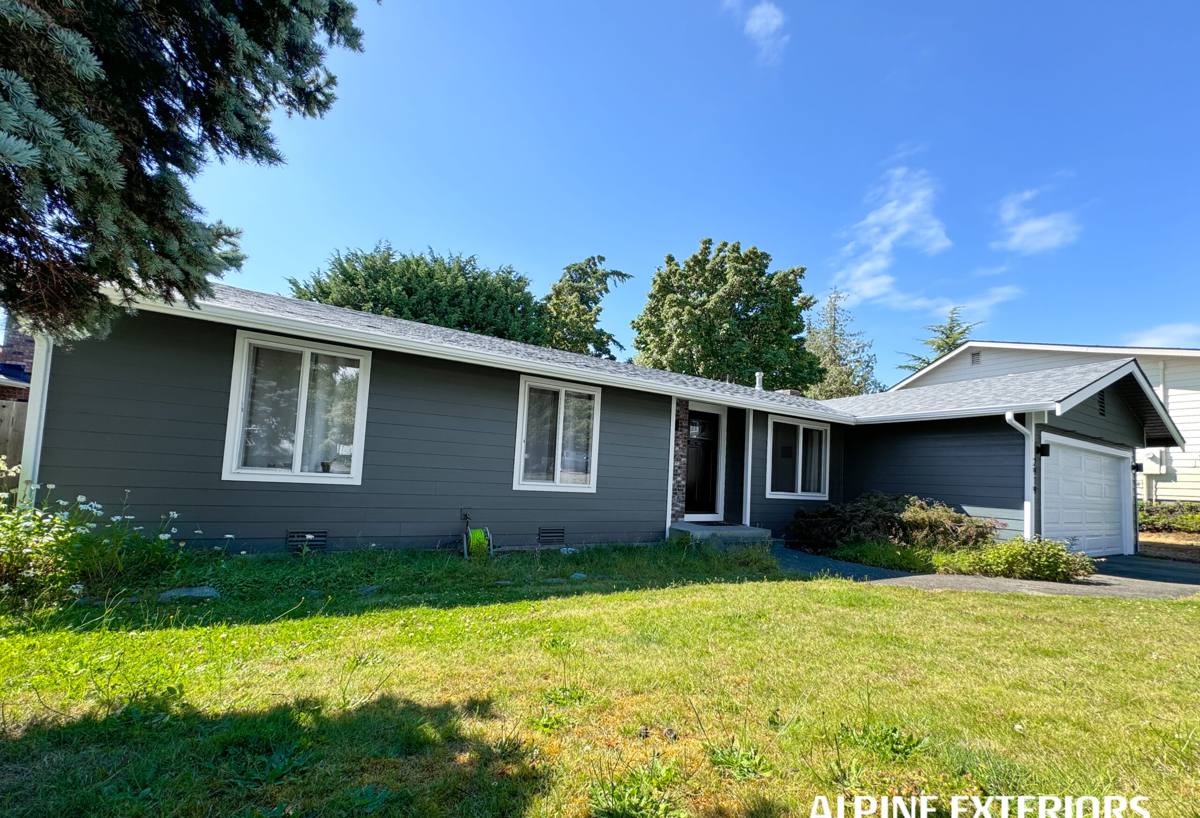
On a shaded, north-facing wall a few dozen feet from the water, we'll typically see the previous siding — often older wood lap or aging vinyl — showing moss staining, soft spots at the bottom courses, or paint failure well before the rest of the house. Hardie doesn't eliminate the need for basic upkeep, but it removes the material itself as the weak link. The board isn't absorbing water and rotting from the inside; at worst it needs a rinse to knock surface growth loose.
The James Hardie Product Lines That Make Sense Here
Not every Hardie product is the right fit for every house, and part of doing this job correctly is matching the product line to the home's style and exposure.
| Product | Best Use in Edgemoor | Notes |
|---|---|---|
| HardiePlank lap siding | Primary field siding on most homes | Available in smooth or cedar-textured finishes; the most common choice for full re-sides |
| HardieShingle | Accent gables, dormers, or Cape Cod-style homes | Gives a shingle look without the moisture and moss issues of real wood shakes |
| HardiePanel | Modern or contemporary accents, garage walls | Vertical panel look, often paired with board-and-batten trim |
| HardieTrim | Fascia, corner boards, window and door trim | Keeps trim from rotting even where lap siding meets end grain |
All of it is specified in the HZ5 formulation appropriate for this climate zone, not the HZ10 version made for hot, dry regions — a detail that matters and is easy for an out-of-area or inexperienced crew to get wrong.
What a Correct Installation Actually Involves
James Hardie siding fails early almost exclusively because of installation mistakes, not because the material itself gave out. On a bluff-exposed, high-moisture site like Edgemoor, the margin for error is smaller than it would be on a sheltered inland lot.
Flashing and Moisture Management
Every window, door, and roof-to-wall intersection needs proper flashing integrated with a weather-resistant barrier behind the siding. On homes taking direct wind-driven rain, we also pay close attention to head flashing above windows and kick-out flashing where roof lines meet walls — two spots that are easy to shortcut and are usually where water actually gets in.
Fastening, Clearances, and Reveal
Hardie's installation manual specifies minimum clearances from grade, roofing, and decks — typically 6 inches or more from grade and 1 to 2 inches from roof surfaces — to keep the bottom edge of the siding out of standing water and splash-back. Fasteners need to land in the right zone of each board at the correct spacing, and cut edges need to be sealed or back-primed since factory finish doesn't extend into a field cut.
Joints and Caulking
Butt joints need consistent, sealed gaps rather than being butted tight, and the sealant used has to be one rated for the movement and exposure the joint will see. On a bayside home, a caulk failure at a joint is one of the more common ways water gets behind the cladding.
- Correct HZ5 product specification for this climate zone
- Weather-resistant barrier installed and lapped correctly before siding goes up
- Flashing at every window, door, and roof intersection
- Minimum clearances maintained from grade, roofing, and decking
- Fasteners placed in the manufacturer's specified fastener zone
- Butt joints sealed with an appropriate, flexible sealant
- Cut edges back-primed or sealed before installation
- Final inspection of trim, caulking, and touch-up paint at joints
Our Process, Start to Finish
We walk every Edgemoor project through the same sequence, adjusted for the site conditions we find:
- On-site inspection — we look at the existing siding, sheathing, and any moisture damage, which is more common on shaded, north- or west-facing walls in this neighborhood than on sun-exposed sides
- Written estimate — covering material, labor, trim work, and any sheathing repair we can identify up front
- Tear-off and sheathing assessment — this is where hidden rot from years of trapped moisture behind old siding often shows up, and we address it before anything new goes on the wall
- Weather barrier and flashing — installed to current best practice, not just to code minimum
- Hardie installation — to manufacturer specification, including correct clearances, fastening, and joint treatment
- Trim, caulking, and paint touch-up — factory-finished ColorPlus boards need touch-up only at cut edges and fastener heads
- Final walkthrough — with the homeowner before we call the job done
Cost Factors for an Edgemoor Project
Every home is different, but these are the variables that most often move the price on a project in this neighborhood:
| Factor | Why It Matters |
|---|---|
| Home size and wall complexity | More corners, gables, and dormers mean more cutting, trim, and labor time |
| Existing siding removal | Wood or vinyl tear-off adds labor and disposal cost versus siding over an existing layer where code allows |
| Sheathing or framing repair | Moisture damage found during tear-off, more common on shaded bluff-side walls, has to be repaired before re-siding |
| Access and site conditions | Steep or wooded lots, common in Edgemoor, can require more staging and care around landscaping |
| Product mix | Combining lap siding with shingle or panel accents adds material and labor beyond a single-product job |
| Color and finish | Factory ColorPlus finishes vary in cost by color; primed-for-paint boards shift labor to a separate paint step |
How Hardie Compares to Other Options Homeowners Consider
We only install Hardie, but homeowners deserve an honest comparison of what else is out there and why we've made the call we have.
| Product | Moisture & Moss Behavior | Salt-Air Finish Durability | Long-Term Maintenance |
|---|---|---|---|
| James Hardie fiber cement | Doesn't absorb water like wood; resists feeding mold and moss | Factory-baked ColorPlus finish holds color well | Occasional wash; caulk and touch-up checks |
| Vinyl siding | Doesn't rot, but can trap moisture behind it and warp or fade | Field color can chalk and fade faster in coastal exposure | Low, but panels can crack and are hard to color-match if damaged |
| Cedar or wood siding | Absorbs moisture readily; prone to moss and rot in shaded, damp spots | Needs regular refinishing to hold up to salt air and rain | Highest — repainting or restaining on a recurring cycle |
| Engineered wood (LP SmartSide) | Better than raw wood but still wood-fiber based and moisture-sensitive at cut edges and joints | Field or factory finish, variable long-term performance in wet climates | Moderate; edge sealing and joint maintenance matter |
Maintenance Through Bellingham's Moss Season
Hardie siding is low-maintenance, not no-maintenance, and a few habits go a long way on a shaded Edgemoor lot:
- Keep gutters and downspouts clear so roof runoff isn't sheeting down the siding face
- Trim back overhanging branches and brush where practical to let walls dry out between rain events
- Rinse siding gently once or twice a year, especially on north-facing walls that see less direct sun
- Inspect caulking at joints and trim every year or two and re-caulk where it's cracked or pulled away
- Touch up any nicked or scratched areas at cut edges promptly to keep water out of the substrate
None of this is difficult, but skipping it on a bay-facing wall will shorten the life of any siding product, Hardie included.
Why Hiring a Crew That Already Works in Edgemoor Matters
A lot of siding problems in this neighborhood trace back to a crew that installed the product correctly for an average inland Whatcom County house but didn't account for what's different here — the salt exposure, the shade patterns off mature trees, the steeper or wooded lot access, or the age and original construction of many Edgemoor homes. We've worked on homes throughout this area and know where moisture tends to collect on a bluff-facing wall, how much clearance to build in on a lot with heavy tree cover, and how to sequence a project around the access limitations that some of these properties have. That local familiarity shows up in fewer surprises during tear-off and a finished job that's actually built for the site it's on, not a generic installation dropped onto a coastal lot.
If you're weighing a re-side or a repair on an Edgemoor home, we're happy to come take a look, walk the property with you, and give you a straight answer on what your siding actually needs. Reach out for a free, no-pressure estimate using the form below.