 Bellingham
 Building Decks for Happy Valley's Bellingham Climate
Happy Valley is one of Bellingham's older in-town neighborhoods, with a mix of home ages, mature tree cover, and lots that often carry some slope. That combination is common across Whatcom County, but it puts specific demands on an outdoor deck: shade from trees keeps surfaces damp longer after it rains, sloped ground changes how footings and drainage need to be planned, and the salt-tinged air off Bellingham Bay works on hardware and fasteners in ways drier inland climates don't. A deck built without those factors in mind will look fine the first summer and start showing problems by the second or third wet season.
This page focuses on one job, in one part of Bellingham: custom deck construction for Happy Valley homes. It covers what the climate actually does to a deck over time, what a correctly built one involves from the ground up, and how we run the job from first estimate to final walkthrough.
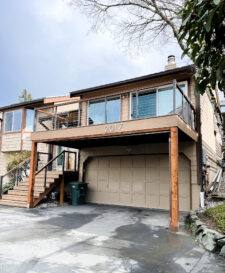
What Whatcom County Weather Does to an Outdoor Deck
Rain and standing moisture
Bellingham gets a long stretch of the year where a deck rarely gets a chance to fully dry out. Rain that lands on a deck surface isn't usually the problem — it's the water that gets trapped underneath boards, in fastener holes, or where a ledger board meets the house. Wood that stays damp for weeks at a time is where rot starts, and it almost always starts from the inside or underneath, not the top.
Moss and algae
Whatcom County's long moss season isn't just a cosmetic issue. Moss and algae hold moisture against a deck surface and make boards slick, which is a real fall hazard on stairs and ramps. Some decking materials resist this better than others, and board spacing and airflow underneath the deck make a bigger difference than most homeowners expect.
Salt air and hardware corrosion
Homes closer to Bellingham Bay deal with airborne salt that accelerates corrosion on fasteners, brackets, and railing hardware. This is a slower, quieter failure than rot — a rusted joist hanger or corroded ledger bolt doesn't always announce itself until it's already lost structural strength. It's one of the most common corners cut on lower-cost deck builds in coastal areas.
Choosing Decking Material for a Happy Valley Home
There's no single "best" decking material — there's a best material for a given budget, maintenance appetite, and how much sun or shade the deck actually gets. Shaded decks under mature trees, common in older Bellingham neighborhoods, need different handling than a deck in full sun.
| Material | Moisture & moss resistance | Maintenance | Typical lifespan | Relative cost |
|---|---|---|---|---|
| Pressure-treated fir/hem-fir | Fair — needs sealing to perform well | Annual cleaning, re-sealing every 1–2 years | 10–15 years with upkeep | Lowest |
| Western red cedar | Good natural rot resistance, still needs airflow | Cleaning plus periodic oil or stain | 15–20 years with upkeep | Mid |
| Capped composite | Very good — sheds moisture, resists algae staining | Occasional washing, no sealing/staining | 25+ years | Higher |
| PVC decking | Excellent — doesn't absorb moisture | Lowest — washing only | 25+ years | Highest |
Cedar remains a reasonable, honest choice for homeowners who like real wood and are willing to keep up with periodic cleaning and refinishing — it's a maintenance commitment, not a maintenance-free product, and that's worth being upfront about before you commit to it. Composite and PVC cost more upfront but trade ongoing labor for durability, which tends to matter more on shaded, moss-prone lots where wood surfaces stay damp longer.
What's Underneath Matters More Than What's on Top
Most deck failures we get called about aren't decking-board problems — they're substructure problems that took years to show up. A few things we treat as non-negotiable on every build:
- Footing depth and bearing matched to the actual soil on site, not a generic assumption — sloped lots common in older Bellingham neighborhoods often need this looked at more carefully than a flat yard would.
- Ledger board flashing where the deck attaches to the house, so water is directed away from the house band board rather than trapped behind it. This single detail is behind a large share of the moisture damage we see on older decks.
- Joist protection — a moisture barrier or tape on top of framing lumber so standing water under the decking boards isn't sitting directly on exposed wood.
- Airflow and drainage under the deck, especially on lower decks close to grade, so moisture and moss have somewhere to go instead of sitting trapped against framing.
- Corrosion-appropriate hardware for coastal air, not just whatever fastener happens to be cheapest at the supply yard that week.
None of this is visible once the deck is finished, which is exactly why it's worth asking a contractor to walk you through it before the work starts, not after.
Our Deck-Building Process
A custom deck job runs the same basic sequence whether it's a small entry deck or a full multi-level build. What changes is the detail work at each step.
- Site visit and assessment. We look at grade, drainage, tree cover, sun exposure, and how the deck will attach to the house before talking materials or layout.
- Design and material selection. Layout, decking material, and railing style get decided together, based on how the space will actually be used and how much upkeep you want going forward.
- Permitting. Most deck projects in the City of Bellingham require a permit, and setback or height rules can affect layout on tighter or sloped lots. We handle this as part of the job rather than leaving it to the homeowner.
- Footings and framing. This is the stage that determines how the deck performs over the next 20 years — footings, ledger attachment and flashing, joist layout, and hardware selection all happen here.
- Decking installation. Board spacing is set with drainage and airflow in mind, not just a uniform gap for appearance.
- Railings and stairs. Built and fastened to current code requirements, with corrosion-resistant hardware throughout.
- Final walkthrough. We go over the finished deck with you, including what maintenance it actually needs and on what schedule.
Railings, Fasteners, and Hardware for Coastal Conditions
Hardware choice is one of the easiest places to cut a corner that won't show up for a few years. In a coastal, high-moisture climate like Bellingham's, we treat fastener and bracket selection as part of the engineering of the deck, not an afterthought.
| Hardware type | Coastal performance | Where it fits |
|---|---|---|
| Standard galvanized | Adequate inland, weaker close to salt air over time | Lower-exposure interior framing on some builds |
| Hot-dip galvanized | Better corrosion resistance than standard galvanized | General structural connectors on most builds |
| Stainless steel | Best resistance to salt-air corrosion | Fasteners and hardware on exposed, near-water, or high-visibility areas |
The right call depends on the specific deck's exposure and budget — we'll walk through this with you rather than defaulting to whatever's cheapest, since a mismatched fastener under a deck can quietly compromise a structural connection long before anyone notices.
Keeping a Happy Valley Deck in Good Shape
A well-built deck still needs some seasonal attention in this climate. None of it is complicated, but skipping it for a few years is how small issues turn into expensive ones.
- Sweep leaves and debris off the deck surface regularly in fall — trapped organic matter holds moisture and feeds moss growth.
- Rinse or lightly scrub the surface once or twice a year to knock back algae and moss before it gets established.
- Check railings and stair connections annually for looseness — hardware can loosen or corrode gradually without any visible warning.
- Keep gutters and downspouts near the deck clear so runoff isn't dumping extra water onto or under the structure.
- For wood decking, plan on re-sealing or re-staining on the schedule your material actually needs, not "whenever it looks dry."
- Look underneath the deck once a year for standing water, moss buildup on framing, or signs of soft wood.
Permits, Setbacks, and Site Considerations
Deck permitting in Bellingham accounts for structural safety, setback from property lines, and height depending on the design. Older neighborhoods with a mix of home ages and lot sizes, like much of the area around Happy Valley, sometimes have less straightforward layouts than a newer, uniformly platted subdivision — a sloped backyard or a tight side yard can change what's buildable before design even starts. We handle the permit process as a standard part of the job, including any conversations with the city about setbacks or grade, so it isn't left for the homeowner to sort out mid-project.
Why Local, Bellingham-Based Experience Matters
A deck built by a crew that works Whatcom County regularly understands things a traveling crew or an out-of-area contractor has to learn on the fly: how long moss season actually runs here, what a normal amount of rain-driven moisture exposure looks like on a shaded lot, and which fastener grade is worth the extra cost given how close a property sits to the Bay. That familiarity shows up in the small decisions — flashing details, hardware grade, board spacing — that don't matter in a dry climate but matter every year here.
If you're planning a custom deck for your Happy Valley home, we're happy to walk the site, talk through material options honestly — including the maintenance trade-offs — and give you a clear, no-pressure estimate. The form below is the easiest way to get that conversation started.