 Bellingham
 Why Roofs in Birch Bay Wear Differently Than Roofs Inland
Birch Bay sits right on the water, and that changes what a roof has to deal with day to day. Homes just a few miles inland in Bellingham catch some of the same weather, but a roof this close to Puget Sound gets it worse and gets it more often: salt-laden air, wind-driven rain that finds its way under standard flashing details, and a moss season that can run eight months or longer in a wet year. None of that means Birch Bay roofs fail faster by default — it means they need repair work that actually accounts for those conditions, not a patch job built for a drier part of the state.
Salt Air and Metal Components
Salt in the air speeds up corrosion on anything metal on your roof — nails, flashing, vent boots, and gutter fasteners. A fastener that would last decades in a dry inland climate can start rusting and weeping stains within just a few years this close to the water. Once a fastener corrodes, it loses grip, and that's how you end up with lifted shingles, loose flashing, and slow leaks that don't show up until the drywall underneath is already stained.
Driving Rain and Wind
Storms off the water in this part of Whatcom County don't always come straight down. Wind-driven rain pushes sideways and even upward under laps, ridge caps, and flashing that would keep water out in calmer weather. Repairs that don't account for wind direction — sealant used in place of proper flashing, shingles nailed without enough overlap — tend to fail again during the next real storm rather than wearing out gradually over years.
A Long Moss Season
Shade, moisture, and moderate temperatures are exactly what moss wants, and Birch Bay's tree cover and marine humidity give it plenty of both for most of the year. Moss doesn't just look bad — it holds water against the roofing material, lifts shingle edges as it spreads, and works its way into nail holes and laps over time. A roof that looks fine from the ground can have moss doing quiet damage underneath for a season or two before a leak ever shows up inside the house.
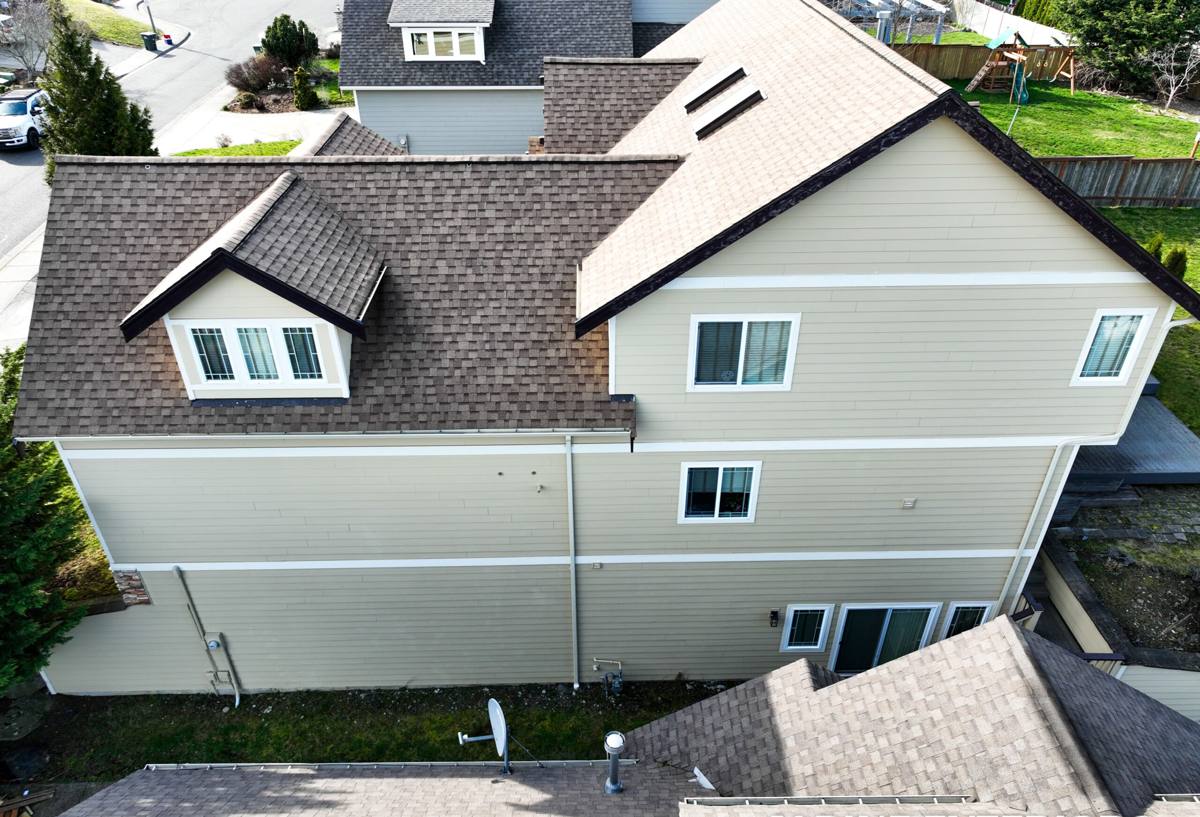
Common Roof Repair Issues We See Around Birch Bay
Most of the repair calls we get in this part of Whatcom County fall into a handful of categories. Recognizing them early is often the difference between a straightforward repair and a much bigger project.
- Lifted or missing shingles along roof edges and ridges, usually from wind combined with weakened fasteners
- Moss buildup in valleys and on north-facing slopes that holds moisture against the roof deck
- Rusted or failing flashing around chimneys, skylights, and roof-to-wall transitions
- Granule loss on older asphalt shingles, leaving them thin and more vulnerable to wind and rain
- Soft or discolored ceiling spots inside the home, usually the first sign homeowners actually notice
- Clogged gutters and downspouts backing water up under the roof edge
- Nail pops and cracked sealant around vent boots and pipe penetrations
Any one of these on its own is usually a manageable repair. Left alone through another wet season, though, several of them tend to show up at once.
What a Correct Roof Repair Actually Involves
Diagnosis Before Patching
The most common mistake we see in repairs done elsewhere is treating the symptom instead of the source. Sealant slapped over a cracked flashing joint, or a single shingle swapped in without checking the underlayment beneath it, might stop a leak for a season — but if the underlying cause, whether that's corroded fasteners, moss-lifted laps, or failed flashing, isn't addressed, the same spot leaks again. A correct repair starts with tracing the water back to where it's actually getting in, which is sometimes several feet from where the stain shows up inside.
Matching Materials and Technique to the Existing Roof
Repairs need to match what's already on the roof — shingle type, exposure, nailing pattern, and flashing style — so the repaired section performs the same as the rest of the roof instead of becoming its own weak point. On older roofs, that sometimes means sourcing a close match rather than an exact one, and being upfront with the homeowner about that before work starts.
Repair Types and When Each Applies
| Repair Type | When It's Used | Typical Scope |
|---|---|---|
| Spot shingle replacement | Isolated wind or impact damage, small area | A few hours, single crew visit |
| Flashing repair or replacement | Leaks at chimneys, walls, skylights, or valleys | Half day to full day depending on access |
| Moss removal and treatment | Buildup on shaded or north-facing slopes | Cleaning plus a preventive treatment application |
| Underlayment repair | Leak found beneath shingles after removal | Requires removing and resetting shingles over the area |
| Gutter and drip edge repair | Water backing up under the roof edge | Often paired with a roof repair visit |
Our Process for Birch Bay Roof Repairs
1. On-Site Inspection
We start by getting on the roof, not just looking at it from the driveway. That means checking flashing, fasteners, moss coverage, and the condition of the shingles or roofing material itself, along with a look in the attic where we can access it to check for staining, damp insulation, or daylight coming through where it shouldn't.
2. A Clear, Written Repair Plan
Before any work starts, you get a plain explanation of what's actually wrong, what we recommend fixing, and what it costs — not a vague estimate with room to pad the invoice later. If a roof is old enough or damaged enough that repair isn't the honest recommendation, we'll say so instead of patching something that really needs to be replaced.
3. The Repair Itself
Work is done with materials and fasteners suited to a marine climate — corrosion-resistant fasteners in particular, given how much faster standard hardware corrodes this close to the water. We protect landscaping and walkways during the work and clean up debris, old shingles, and loose nails before we leave the property.
4. Follow-Up
We stand behind the work and stay reachable if something doesn't perform the way it should. A repair that leaks again within a season isn't a finished job, and we treat it that way.
Materials and Methods We Rely On
Our standard for coastal and near-coastal repair work in Whatcom County leans toward materials that hold up to salt exposure and sustained moisture, even where that costs a little more or takes a little longer to install correctly:
- Corrosion-resistant fasteners rather than standard galvanized nails, since standard hardware corrodes noticeably faster in salt air
- Self-adhering ice-and-water membrane at vulnerable points — valleys, eaves, and flashing transitions — for a second layer of protection beyond the shingles themselves
- Metal flashing profiles matched to the existing roof-to-wall and roof-to-chimney details rather than generic stock pieces forced to fit
- Moss treatments applied after cleaning, not used as a substitute for physically removing existing growth
We're upfront when a lower-cost material or shortcut would save money up front but create more maintenance or a shorter service life down the road — that's a trade-off worth explaining honestly, not skipping past.
Preventive Maintenance That Actually Extends Roof Life Here
A lot of the repair work we do could have been avoided, or at least caught much earlier, with basic seasonal maintenance. In a climate like this, that maintenance matters more than it does in drier parts of the state.
| Maintenance Task | Recommended Frequency | Why It Matters Here |
|---|---|---|
| Gutter and downspout cleaning | At least twice a year | Prevents water backing up under the roof edge during heavy rain |
| Moss inspection and treatment | Annually, before wet-season growth builds up | Stops moss before it lifts shingles and holds moisture against the deck |
| Flashing and fastener check | Every 1-2 years | Catches salt-air corrosion before it causes a leak |
| Full roof inspection | After any major windstorm | Wind off the water can lift or crack shingles without obvious damage visible from the ground |
Roof Repair vs. Roof Replacement: Knowing Which One You Need
Not every roof problem calls for a full replacement, and not every roof problem should be patched indefinitely either. A few honest questions help sort out which side of that line a given roof is on:
- Is the damage isolated to one area, or showing up in multiple spots across the roof?
- Is the roofing material itself still in reasonable shape, or is it thin, brittle, and past its expected service life?
- Has this same area leaked before, suggesting a recurring weak point rather than a one-time event?
- Would the cost of another round of repairs start approaching what full replacement would cost?
We'll tell you directly if a roof is a good candidate for repair, or if repair would just be delaying a replacement that's coming regardless. That call should be based on the roof's actual condition, not on which answer is easier to sell.
Why Hiring a Crew That Already Works in Birch Bay Matters
A roofing crew based near Bellingham and working regularly throughout Whatcom County already knows how this coastline behaves — which slopes hold moss the longest, how far wind-driven rain travels under a lap, and which flashing details tend to fail first on homes exposed to the water. That's not something you can fully substitute with general roofing experience gained in a drier region.
There's also the practical side: a local crew can get to Birch Bay quickly when a leak shows up during a storm, can follow up in person if a repair needs a second look, and is still around next season if something related comes up. Confirm any roofing contractor you're considering is properly licensed, bonded, and insured to work in Washington — that protects you if something goes wrong on your property during the work, not just the contractor.
If you're dealing with a leak, missing shingles, moss buildup, or just want an honest opinion on your roof's condition, we're happy to take a look. Estimates are free, with no pressure to move forward — use the form below to get in touch.